Welcome to FairVote’s 2024 elections hub, where we’ll keep you up to date on all the latest from the 2024 election cycle, and what it means for reformers like us.
Ranked choice voting ballot measures
Four states and several cities held ballot measures on ranked choice voting in 2024. Read on to learn more about this year’s ballot measure campaigns.

Washington, DC campaign
Initiative 83 would bring ranked choice voting to DC’s elections and let independents vote in taxpayer-funded primary elections. It qualified for the ballot after Make All Votes Count DC submitted over 40,000 signatures – likely the most signatures ever for a DC ballot initiative.
Initiative 83 WON in Washington, DC, and currently leads in all eight wards!
Colorado campaign
Proposition 131 would bring open primaries and RCV to the Centennial State. The measure qualified for the ballot thanks to signatures from 213,000 Coloradans.
Proposition 131 lost in Colorado.
Idaho campaign
Proposition 1 would have implemented open primaries and RCV in the Gem State. It was placed on the ballot after Idahoans for Open Primaries turned in over 94,000 signatures from all over the state.
Proposition 1 lost in Idaho.
Nevada campaign
In 2022, Nevadans voted in favor of adopting open primaries and ranked choice voting general elections. Under Nevada law, as a citizen-initiated constitutional amendment, the measure had to pass again in 2024 to take effect.
Measure 3 lost in Nevada in 2024.
Oregon campaign
Measure 117 would have implemented ranked choice voting statewide in Oregon. It was referred to the November ballot by Oregon’s legislature – the most significant step ever taken by a state legislature to promote RCV.
Measure 117 lost in Oregon, but is winning in both counties where RCV is currently used, suggesting that when voters use RCV, they like it.
Oak Park, Illinois
Oak Park residents gathered signatures to put a ranked choice voting measure on the November 2024 ballot – part of a growing trend in Illinois after Evanston adopted RCV a few years ago.
Ranked choice voting WON in Oak Park with roughly 79% in favor!
Peoria, Illinois
In Peoria, a non-binding RCV measure appeared on the November 2024 ballot, asking voters if Illinois should adopt RCV for state and federal elections. The question was referred to the ballot at the annual township meeting.
Ranked choice voting WON in Peoria with roughly 67% in favor!
Richmond, California
In July, the Richmond City Council voted unanimously to put ranked choice voting on the November ballot. Passing Measure L would make Richmond the ninth California city to use this better form of elections, joining its neighbors like San Francisco and Berkeley that have used RCV to provide better representation for decades.
Although a majority of Richmond voters voted in favor of RCV, a competing measure to adopt two-round elections is currently ahead by a larger amount. If both measures pass, the one with more votes will be enacted.
Anti-RCV measures
Opponents of reform placed measures on the ballot in Alaska and Bloomington, MN to repeal ranked choice voting – even though similar repeal measures have a track record of failure. In Alaska, 85% of voters say RCV is simple and 62% say they liked the state’s new election system. In Bloomington’s most recent election with RCV, it saw the highest turnout in two decades. A repeal effort in Minnetonka, MN last year fell flat – voters supported RCV by an even higher margin than when they first adopted it.
Meanwhile, Missouri’s state legislature slipped a provision into a ballot measure about noncitizen voting to prohibit RCV – even though no Missouri cities even use RCV.
Alaska and Bloomington voted to keep using ranked choice voting, while the ban measure passed in Missouri.
The presidential election
Ranked choice voting for presidential elections is no longer just a theory. Alaska and Maine used RCV to award their Electoral College votes. Even more places have used RCV in presidential primaries. Read on to learn all about RCV in the 2024 presidential election!
RCV in the general election
Alaska and Maine both used RCV in their 2024 presidential elections, giving voters the freedom to vote their conscience without fear of “playing spoiler.” In non-RCV states, voters faced pressure from friends and family to pick the “lesser of two evils” instead of their favorite candidate.
Ahead of Election Day, FairVote partnered with SurveyUSA to poll Maine’s ranked choice voting contests, including the presidential race. See the results here.
RCV in Maine and Alaska
Maine’s legislature passed RCV for presidential general elections in 2019, and it was first used in 2020. Alaska adopted RCV for its presidential elections by ballot measure – as part of Question 2 in 2020. It was used for the first time in 2024.
RCV and the “spoiler effect”
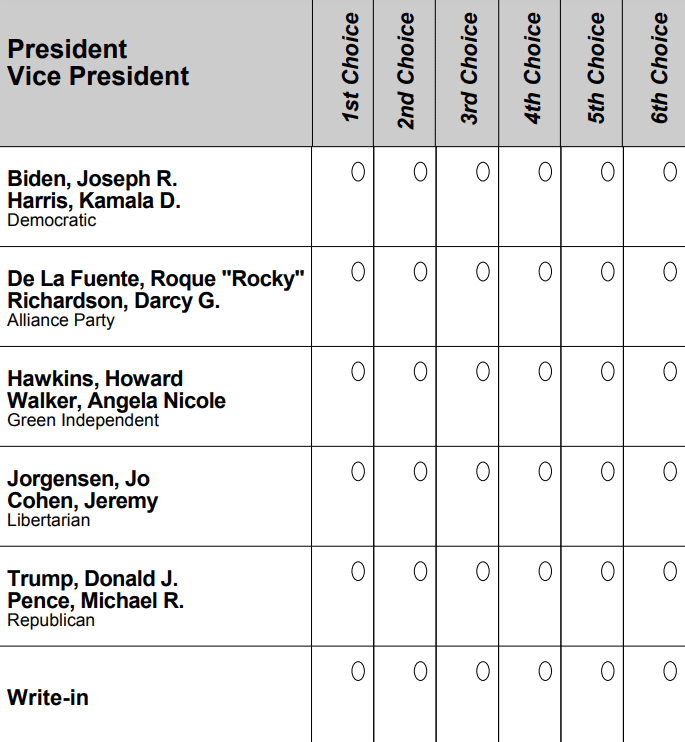
Every election cycle, we see the same thing: Voters face pressure to vote “strategically” to defeat the candidate they like the least. With ranked choice voting, they can vote for their true favorite choice, and know their vote will count for a backup choice if their favorite can’t win!
See our analyses of how “vote-splitting” has impacted past presidential elections, and the concerns both parties had about it this time. You can also learn about how RCV mitigates the “spoiler effect” in the video below:
RCV in presidential primaries

RCV in presidential primaries gives voters better choices and lets more votes count. In February, the Republican Party in the Virgin Islands became the first Republican state or territory party to use RCV in a presidential primary. In March, Maine became the first state to use RCV in its government-run presidential primaries.
RCV prevents “zombie votes”
One benefit of using RCV in presidential primaries is that it prevents “zombie votes” – which occur when candidates drop out after some voters have already voted early, or when voters vote for a candidate they don’t know has dropped out. With RCV, if your favorite candidate withdraws, your vote simply counts for a backup choice!
Over 3 million Democrats cast zombie votes in 2020, and hundreds of thousands of Republicans did so in 2016 and 2024. Compare that to the five states that used RCV in their 2020 Democratic primaries, or the Virgin Islands GOP primary in 2024, which virtually eliminated zombie votes.
For more information on how RCV improves presidential primaries, see the analyses below:
- The 2024 presidential primaries and ranked choice voting (September 2024)
- 204,000 Republicans cast “zombie votes” in the Super Tuesday primaries (March 2024)
- Analysis of Virgin Islands presidential primary results (February 2024)
- New Hampshire primary needs RCV to prevent 5,500 wasted votes (January 2024)
- The Iowa Republican caucus should use ranked choice voting (January 2024)
Ranked choice polls of 2024 elections
Ranked choice polling provides more information on voter preferences, including which candidate voters prefer if their favorite drops out of the race, and which candidates are strong “consensus” picks. See our polls of the 2024 presidential election below.
- Maine presidential and congressional elections poll (November 2024)
- Possible Kamala Harris VP picks poll (July 2024)
- Possible Democratic nominees poll (July 2024)
- Republican presidential primary poll (September 2023)
- Republican presidential primary poll (August 2023)
2024 congressional elections
Congressional elections are broken
In FairVote’s biennial Monopoly Politics report, we project how every congressional district will vote two years in advance, based on partisanship, gerrymandering, and incumbency alone.
Our projections for the 2024 elections were 98% accurate, showing just how much partisanship is the defining factor in election outcomes, rather than local issues or candidate quality.
Our broken, single-choice elections also drive polarization. They pit factions against each other in a race to deflate the other side’s turnout, and provide almost no incentive to collaborate. See our report on how electoral incentives led just a few members to hold Congress hostage last year.
2024 elections showed RCV in action
One way to improve our congressional elections is to use ranked choice voting, which Alaska and Maine already do. In both states, RCV has given voters better choices and picked winners whom most voters can support. Read more in these articles:
- Ranked choice voting lowers polarization in politics (September 2024)
- Alaska Natives are embracing ranked choice voting (January 2024)
- Analysis from Alaska’s RCV elections in November 2022 (December 2022)
- Alaska’s ranked choice voting winners earn strong mandates and reflect the state’s political diversity (November 2022)
- Results and analysis from Maine’s 2nd District (November 2022)
- New poll shows 82% of Maine CD-2 voters find ranked choice voting easy (November 2022)
The Fair Representation Act
The Fair Representation Act (FRA) is a bold, comprehensive solution that would solve the problems of partisan gerrymandering and uncompetitive elections for U.S. House. It would implement the “gold standard” proportional form of RCV for House elections, ensuring nearly every American can elect a member of Congress they support.
See what your state’s congressional districts could look like under the FRA.
2024 state and local elections
Ranked choice voting in state elections
Maine uses ranked choice voting in its primaries for governor and state legislature, identifying consensus nominees who represent their whole parties. Alaska uses RCV in general elections for those offices, giving voters better choices and identifying winners supported by the majority.
Both states have done great work educating voters on how the voting method works. Here’s a video from the Alaska Division of Elections about RCV:
Ranked choice voting in local 2024 elections
13 cities and counties used ranked choice voting in their local elections in 2024, including the largest cities in three states (Maine, Vermont, and Oregon). Some places are implementing RCV for the first time, while others have used it for over a decade. Some are using the “instant runoff” form of RCV, while others are using the “gold standard” of proportional RCV to choose their city councils.
RCV was used in Burlington, VT in March, where voters elected their first female mayor. On November 5, RCV was used in the following cities and counties:
- Albany, CA
- Berkeley, CA
- Oakland, CA
- San Francisco, CA
- Arden, DE
- Takoma Park, MD
- Portland, ME
- Westbrook, ME
- Benton County, OR
- Corvallis, OR
- Portland, OR
- Arlington County, VA
Eureka, CA, originally planned to use RCV as well, but not enough candidates ran for it to make a difference.
Learn how ranked choice voting improved recent local elections:
- Analyzing Arlington’s second ranked choice voting election (June 2024)
- Analysis of Berkeley city council election using ranked choice voting (June 2024)
- Burlington’s first female mayor elected with RCV (March 2024)
- Ranked choice voting in 2023: A year in review (January 2024)
- Utah cities show ranked choice voting in action (November 2023)
- Poll: Boulder voters love RCV (November 2023)
- Election Day 2023: Ranked choice voting in action (November 2023)
- Successful ranked choice voting rollout in Arlington, VA (June 2023)
Electoral College Research and History
Americans don’t get to vote for the president directly. Instead, we vote to choose our state’s members of the “Electoral College,” who then vote for the president on our behalf.
As a result of the Electoral College, candidates for president tend to concentrate nearly all of their attention on a few “swing states” – states that are narrowly divided and could vote for either candidate – while ignoring the vast majority of voters who live elsewhere.
The map below shows where the major-party presidential and vice presidential candidates have held events since their party conventions this summer. It reveals just how skewed candidate attention is toward this year’s seven major swing states (Arizona, Georgia, Michigan, Nevada, North Carolina, Pennsylvania, and Wisconsin) compared to the rest of the country.
FairVote’s archives have numerous resources on the Electoral College. A few highlights are linked below:
- How Maine and Nebraska award their electoral votes
- Controversial elections under the electoral college
- How the Electoral College works today
Throughout American history, electors in the Electoral College have overwhelming voted for their party’s presidential and vice presidential nominees. However, occasionally they do not. Electors who cast a vote for someone other than their party’s nominees are called “faithless electors.”
FairVote has several resources specifically covering faithless electors, including a list of faithless electors throughout history, analysis of litigation involving faithless electors, and a list of state laws that seek to penalize or replace faithless electors.
How often do recounts change election results?
Conducting election recounts to ensure fair, accurate, and genuine democratic outcomes is a critical component of effective election administration. Trust in elections requires trust in a jurisdiction’s recount process. It is an ongoing learning experience for election administrators to conduct efficient and reputable recounts, as well as to determine when victory margins and data from post-election audits should trigger a recount.
In a recent report, we quantify various aspects of statewide recounts in the United States between 2000 and 2023, including how often they occur, how often they change outcomes, and how much vote totals change. We also use this analysis to make recommendations for policymakers on recount laws. Our main findings are:
- Statewide recounts are rare: Out of the 6,929 statewide general elections between 2000 and 2023, there were 36 statewide recounts. In other words, there was one recount for every 192 statewide elections.
- Outcome reversals are even rarer: Recounts resulted in only three reversals, or one out of every 2,310 statewide elections. All three reversals occurred when the initial margin was less than 0.06% of all votes cast for the top two candidates. The last statewide recount reversal was the 2008 U.S. Senate race in Minnesota.
- Recounts tend to shift only a small number of votes: Statewide recounts resulted in an average margin shift of 551 votes between the frontrunners, representing 0.03% of the vote. Recounts typically widen the gap between the top two candidates instead of decreasing it.
- States should require automatic recounts in close races: When the margin is very close, a recount should occur automatically without a candidate or voters having to petition for one. A threshold of 0.1% to trigger an automatic recount is sufficient to capture all races that are close enough for an outcome reversal to be plausible.
- A threshold for campaign-funded recounts should be established to prevent frivolous recounts: The recent trend of recounts for races with no realistic possibility of an outcome reversal reveals a flaw in the recount statutes in many states. Most states that allow campaign-requested recounts have no upper limit on when these recounts may be requested. Allowing campaign-requested recounts only for close races would prevent frivolous recounts and prevent a decline in voter confidence in our elections.
- Recount laws should go hand-in-hand with rigorous post-election audit procedures: Post-election audits should be tailored to the margins in each race, and the number of audited ballots should increase in relation to the percentage of discrepancies found as the audit progresses.
Read our full report on recounts here.
Information on How to vote
The 2024 general election has concluded, and Americans have elected their next president and members of Congress. The information below was compiled ahead of the election, and some of it may be outdated.
Getting started
In every state but North Dakota, citizens must register to vote with their state or local government. Some states allow you to register to vote up until or on the day of the election.
Depending on your state, you may need to bring a government-issued photo ID to vote in person, or include a copy of one with your mail-in ballot.
Our friends at vote.org have compiled an excellent one-stop shop to find the necessary forms. They can show you how to register, where to vote, and when the polls are open – no matter where you are in the country. They can also help you find out what early voting options are available in your area, whether you’ll need an ID, and how to apply for an absentee ballot.
Early voting
Early voting takes one of two forms: voting with an absentee ballot (usually by mail), or voting in-person before Election Day.
Every state except Alabama, Delaware, Mississippi, and New Hampshire offers in-person early voting to all voters. Visit vote.org to find early voting sites and hours.
All 50 states offer absentee ballots to voters, but eligibility varies by state. In most states, voters must request an absentee ballot in order to vote from home.
| Type | States |
|---|---|
| All-Mail Elections: State automatically mails a ballot to every registered voter. | CA, CO, DC, HI, NV, OR, UT, VT, WA |
| No-Excuse Absentee Voting: States where any voter can request an absentee ballot without providing a reason. | AK, AZ, FL, GA, ID, IL, IA, KS, ME, MD, MA, MI, MN, MT, NE, NJ, NM, NY, NC, ND, OH, OK, PA, RI, SD, VA, WS, WY |
| Excuse Required: States where voters must provide a specific reason (such as illness or travel) to receive an absentee ballot. | AL, AR, CT, DE, IN, KY, LA, MS, MO, NH, SC, TN, TX, WV |
If you receive a mail-in absentee ballot, you should fill it out and return it as soon as you can. Some states will accept any ballot postmarked by Election Day, but others will only accept ballots that arrive before the polls close on Election Day, or before Election Day itself. The sooner you send your ballot in, the more likely it is that your vote will count. The table below shows absentee ballot return deadlines by state.
| Deadline | States |
|---|---|
| Deadline is before Election Day | LA, ND |
| Ballot must be received by a certain time on Election Day | AZ, CO, DE, FL, GA, HI, ID, IN, IA, KY, ME, MA, MI, MN, MO, MT, NE, NH, NM, PA, RI, SC, SD, TN, WS, WY |
| Ballot must be postmarked by Election Day, but can arrive later | AK, CA, DC, IL, KS, MD, MS, NV, NJ, NY, OR, TX, VA, WA |
| Deadline differs based on whether you return your ballot in-person or by mail | AL, AR, CT, NC, OH, OK, UT, VT, WV |
How to return your absentee ballot
All 50 states and Washington, DC allow you to return your absentee ballot via the mail. Most states also offer options to return absentee ballots in-person – whether at an elections office, polling place, early voting site, or designated ballot “drop box.”
All of these options are safe and secure ways to vote, so which to use is typically a matter of personal preference. However, if it’s less than a week until the election and your state has a ballot receipt deadline on or before Election Day, it may be best to return your ballot in-person to make sure election officials receive it on time.
Ranked choice voting
50 cities, counties, and states across the country use ranked choice voting (RCV), which gives voters the opportunity to rank candidates in order of preference. If your first choice can’t win, your vote simply counts for your highest-ranked choice who can.
Alaska and Maine both use RCV statewide for certain elections. RCV is also used in the largest cities in seven states (ME, MN, NY, OR, UT, VT, and WA). Read the other sections of this page to learn more about ranked choice voting elections and ballot measures in 2024; the number of states using RCV could triple this November!
Become a poll worker
Poll workers are a crucial part of our democracy, making our elections run smoothly and ensuring votes are counted accurately. Yet across the country, there are often shortages of poll workers. If you want to go above and beyond as a participant in our democracy, sign up to be a poll worker in your community!
The U.S. Election Assistance Commission can help you find out how to become a poll worker in your community.
Know your rights
- If you’re an American living overseas, you can still vote absentee in the last state where you lived! To do so, you must send a filled-out Federal Post Card Application to your local election officials each year you want to vote.
- If you’re on line at your polling place by the time polls close, officials must let you vote.
- If you make a mistake when marking your ballot, ask election workers to provide you with a replacement.
- If poll workers can’t verify your identity on-site, request a provisional ballot. They may be able to verify your identity later.
- In most of the United States, the minimum age to vote is 18, but some states allow 17-year-olds to participate in primaries if they will be 18 by the time of the general election. In addition, seven cities allow 16-year-olds to vote in local or school board elections.
Primary and runoff elections
Many of the candidates who will appear on this year’s general election ballot were chosen in “primary elections” this spring and summer. Most of these contests were “party primaries,” where each political party chose who would represent it. But in some states, all candidates appeared on the same primary ballot regardless of party, and a set number of winners advanced to the general election.
Different states have different rules for who can participate in primaries. The table below shows which system each state uses for its state legislative primaries (note: states may use a different system for congressional, presidential, or statewide primaries).
| Type of primary | States |
|---|---|
| Closed Primaries: Voters must be registered with a party ahead of the election to participate in its primary. | DC, DE, FL, KY, NV, NJ, NM, NY, PA, TN, WY |
| Partially Closed: Parties can choose whether to allow independents and/or members of other parties to participate in their primaries. | CT*, ID, KS*, MD, OK, OR, SD, UT, WV |
| Partially Open: Voters can vote in any party’s primary, but doing so registers them with that party. | IL, IN, IA, OH |
| Open to Unaffiliated Voters: Unaffiliated voters can vote in the primary of their choice, but party members can only vote in their party’s primary. | AZ*, CO*, ME, MA, NH, NC, RI |
| Open Primaries: Voters can select either party’s primary ballot regardless of their own registration. | AL, AR, GA, HI*, MI*, MN, MS, MO, MT, ND*, SC, TX, VT, VA, WS |
| All-Party Primaries: States with one all-party primary. | AK*, CA*, LA*, NE*, WA* |
In addition, some states and localities hold runoffs when no candidate reaches a certain share of votes cast in a primary or general election – usually 50% of votes – so be on the lookout in case you need to vote again!
| Type of runoff | States |
|---|---|
| States with primary runoffs | AL, AR, GA, MS, NC, OK, SC, SD*, TX |
| States with general election runoffs | GA, LA, MS* |