2023 was a big year for ranked choice voting (RCV), with seven new ballot measure wins, hundreds of thousands of voters using RCV in municipal elections, new endorsers from across the political spectrum, and increasing support from state legislatures. This report provides an overview of RCV in 2023. Highlights include:
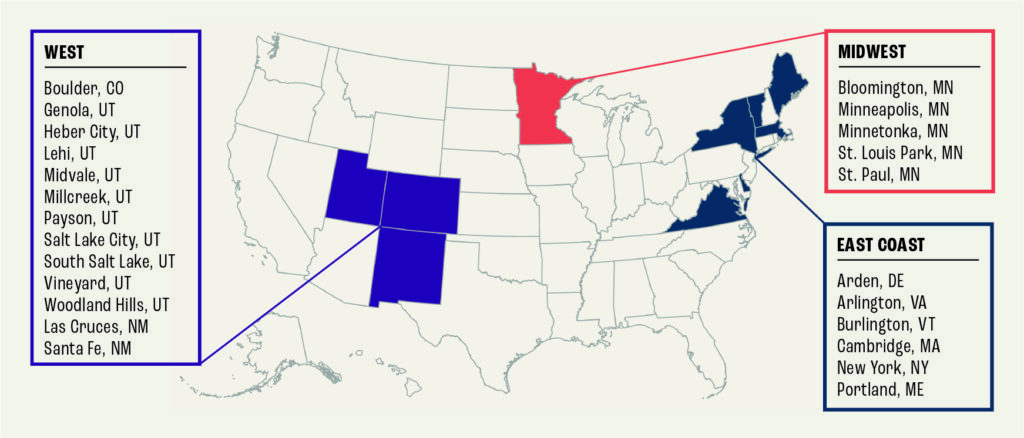
Voters in 24 cities and counties – home to 10 million people – used RCV in 2023.
Across those 24 jurisdictions, voters used RCV in 70 elections.
Voters in seven cities voted YES on RCV.
Six states passed RCV legislation.
RCV wins on the ballot
In 2023, voters in seven cities voted in favor of preserving, adopting, or expanding RCV – growing its winning streak to 27 city ballot measure wins in a row!
Kalamazoo, East Lansing, and Royal Oak, Michigan all said YES to RCV in November 2023! These cities are home to about 180,000 Michiganders, and will implement RCV pending state approval.
Easthampton, MA voted to implement proportional RCV for multi-winner elections, with 60% voting yes. Easthampton already uses RCV in single-winner elections.
Minnetonka, MNreaffirmed its support for RCV in the face of a repeal attempt. 59% voted in favor of keeping RCV – a larger margin than when RCV first won in 2020, showing that voters like RCV even more now that they’ve used it.
Redondo Beach, CAsaid YES to RCV, with 77% voting in favor. Redondo Beach will join seven other California cities in using RCV.
Burlington, VTsaid YES to RCV for a second time in three years, with 64% in favor. Burlington will expand RCV to apply to all municipal elections; it previously applied only to city council races.
New support for RCV
In 2023, high-profile voices from across the political spectrum embraced RCV:
[Ranked choice voting] sounds good at this stage. It looks good on paper. I like the results that came out of Alaska and Maine. And so if it continues to perform well . . . at this stage the evidence suggests [ranked choice voting] would be a superior way to proceed.
We like the fact that candidates were actually perhaps a little bit more civil to their opponents . . . I think what we demonstrated in Alaska was the possibility that electoral reform can happen and it can deliver outcomes that are less partisan and perhaps less politically rancorous.
I’ve always been supportive of the concept of ranked choice voting. We just completed our first mayor’s race in Boulder using ranked choice voting. In talking to my friends and neighbors, it went very smoothly, people understood what they were doing. They got their voice counted, regardless of who their first choice was.
Whereas: The open primary and ranked choice voting system provides more opportunities for Alaska Natives to run for public office and get elected . . . Be it resolved that the delegates . . . express our support of the preservation of Alaska’s open primary and ranked-choice voting system as current law.
In 2023, RCV facilitated more civil campaigns, better representation, and high voter engagement. Here are highlights from some key elections:
New York City used RCV in its primaries for the second time. In Council Districts 1 and 9, rival candidates “cross-endorsed” each other, encouraging voters to rank them first and second. Voters utilized more rankings in more competitive contests, with 67% ranking multiple choices in four-candidate races compared to 61% in three-candidate races.
Arlington, Virginia used proportional RCV for the first time in its Democratic primary for County Board, to nominate candidates for two open Board seats. Proportional RCV led to a representative outcome, with candidates on both sides of the county’s major housing debate securing nominations. 84% of voters ranked a winning candidate first, second, or third, meaning most voters saw a candidate of their choice nominated. In December, Arlington announced that it will make RCV permanent for County Board primaries.
In Portland, Maine’s open mayoral contest,the outgoing mayor provided a ranked endorsement (Mark Dion first and Andrew Zarro second). Upon winning the tight race, Dion said the campaign “was civil and it’s what this city deserves.”
Salt Lake City, Utah used RCV in its mayoral election for the first time. Incumbent Mayor Erin Mendenhall won with 58% of votes. Two council districts also used RCV to determine a winner.
Santa Fe, New Mexico used RCV for its 1st Council District election. Alma Castro, a restaurant owner and the city’s youngest council candidate in 2023, beat three other candidates despite being outspent 3-to-1. Santa Fe County made headlines for its high turnout.
Minneapolis, Minnesota used RCV for its city council elections, and the close race in Ward 8 garnered considerable media interest. Andrea Jenkins, the first Black transgender woman to be elected to office in the U.S., won re-election. 79% of voters used the opportunity to rank multiple candidates in the race.
St. Paul, Minnesota used RCV to elect its first all-female council, joining cities like Las Cruces (NM), which previously elected an all-female council, and New York City, which elected its first majority-female council with RCV. All seven women elected to the St. Paul Council are under the age of 40, and six are women of color.
Large cities around the country are particularly interested in RCV. As of 2023, the largest cities in seven states have adopted RCV. Five of those used it last year.
Boulder’s first-time RCV implementation is the new gold standard
In November, voters in Boulder, CO used RCV for the first time, after adopting direct mayoral elections with RCV in a 2020 ballot measure.
Boulder’s RCV implementation was smooth and efficient, setting the new gold standard for other cities and states moving to RCV. Boulder election administrators communicated with voters, the media, and stakeholders about what to expect; released RCV results on election night; and performed a risk-limiting audit (considered a best practice for election security, but still a rarity for most elections).
In the mayoral race, incumbent Aaron Brockett won re-election with 52% in the RCV count, in a close race with Councilmember Bob Yates. Yates initially led with 44% of first-choice support, but Brockett was a more popular second choice among voters who supported the two eliminated candidates, pushing him to a majority win in the second round of the RCV count.
Brockett’s victory is considered a “come-from-behind” win; this is a somewhat rare but natural feature of RCV. RCV allowed voters to rank a lower-performing candidate first without “spoiling” the election, and then consolidate behind Brockett.
Notably, Brockett was identified as the winner in the RCV mayoral race before Boulder’s plurality city council races were called – directly contradicting some opponents’ claims that RCV contests take longer to count or call. 86% of Boulder voters said it was easy to complete their ballot, and 77% said they were satisfied with their voting experience.
Following the election in Boulder, Colorado Gov. Jared Polis endorsed RCV – citing how smooth the process was.
Legislative progress for RCV
2023 saw pro-RCV legislation introduced in 33 states, up from 25 in 2022. Over twice as manypro-RCV bills were introduced in state legislatures in 2023 than in 2022, and seven became law.
The biggest win of 2023 was in Oregon, where legislators placed a measure on the 2024 ballot to adopt RCV for all statewide and federal elections. Oregon would be the most populous state to adopt RCV statewide.
Additionally, Illinois passed two pieces of RCV legislation – one that allows municipalities to use RCV for military and overseas voters, and one that creates a task force to study RCV. Minnesota also created a task force to study RCV. Connecticut’s new state voting rights legislation included proportional RCV as a possible remedy to voting rights challenges. Vermont and California authorized RCV for local elections in the City of Burlington and Santa Clara County, respectively.
At the federal level, the Voter Choice Act, which would provide federal grants to support local and state governments implementing RCV, was re-introduced by Sens. Michael Bennet of Colorado and Angus King of Maine.
State voting rights acts expand protections using proportional RCV
As of 2023’s end, four states explicitly include proportional ranked choice voting as a remedy for discriminatory election methods like winner-take-all block voting for city councils and school boards. Proportional RCV can lead to increased representation for voters of color without requiring the drawing of districts.
New York’s John R. Lewis Voting Rights Advancement Act took effect last summer, giving voters tools to fight discriminatory election rules, including at-large elections. Proportional RCV is included as a potential remedy.
Connecticut’sJohn R. Lewis Voting Rights Act, signed into law last summer, also gives voters tools to fight discriminatory election rules, including district boundaries with discriminatory effects. Like the New York law, the Connecticut law includes proportional RCV as a potential remedy for discriminatory election methods.
In Pico v. Santa Monica, California’s Supreme Court clarified that alternative election methods like proportional RCV can be used as a benchmark to measure vote dilution. This makes it easier for voters of color to prove vote dilution and adopt a more representative election method.
Washington State’s Supreme Court upheld the Washington Voting Rights Act in Portugal v. Franklin County, and noted that proportional RCV is a possible remedy to discrimination under the law.
Research and media highlights
RCV was a popular topic in the news and in academia in 2023. It continues to gain attention as the fastest-growing nonpartisan election reform in the nation.
Research highlights
Alaska’s implementation of nonpartisan primaries and RCV general elections increased meaningful participation and electoral competition, while also improving representation. See Alaska’s Election Model from Unite America.
In New York City’s first election cycle with ranked choice voting primaries, women made history by securing a majority on the city council. In the two years since, that council has had a “significant impact on both women’s issues and gender issues for all New Yorkers.” See Impact Analysis of NYC’s Woman Majority Council from RepresentWomen.
Most of the Republican members of Congress behind Kevin McCarthy’s removal as House speaker were first elected with pluralities of the vote in Republican primaries in hyper-partisan districts. RCV could incentivize more productive legislative behavior. See The “Motion to Vacate” and Electoral Incentives from FairVote.
85% of U.S. House elections will be safe for one party in 2024 – the highest in the 25-year history of FairVote’s “Monopoly Politics” biannual project. The Fair Representation Act would restore meaningful choice and real representation. See Monopoly Politics 2024from FairVote.
59% of participants in a deliberative poll support the use of RCV for state primary elections, and 57% support it for general elections. See Democratic Reform from the Stanford Deliberative Democracy Lab.
Several of our nation’s largest cities – like Chicago, Houston, Phoenix, Philadelphia, Dallas, Jacksonville, Denver, and Memphis – elected their mayors and/or city councils in 2023. Crowded fields and vote-splitting meant candidates won important contests with less than a third of the vote, or advanced to runoffs.
Runoffs have high costs for taxpayers, subject voters to weeks of negative advertisements, and usually have much lower turnout than the initial election. It’s no wonder several candidates who ran in runoffs support RCV – a better, faster, and cheaper alternative.
Chicago, Illinois held runoff elections for mayor and fourteen city council seats in April. In the initial nine-way contest for mayor, voters felt pressured to vote strategically and pick a candidate with a shot at making the runoff rather than vote for their true favorite. Progressive Brandon Johnson beat moderate Paul Vallas in the mayoral runoff with 51% of votes, following five extra weeks of negative campaigning. Both Vallas and Johnson support RCV.
Denver, Colorado held runoff elections for mayor and four city council seats in June. Mike Johnston and Kelly Brough competed in the mayoral runoff – even though a majority of voters selected other candidates. Johnston won with 55% of votes in the runoff two months later. Johnston and Brough both endorsed RCV – no surprise after the long, expensive, and negative runoff campaign. Their neighbors in Boulder held a mayoral election with RCV and selected their mayor in a single election with no wait.
Phoenix, Arizona held runoff elections for two city council seats in March. The runoffs were held five months after the initial election in November, and turnout in the two districts dropped by 40% and 52%.
Memphis, Tennessee elected Paul Young as mayor with just 28% of the vote, meaning most Memphis voters actually voted against their mayor-to-be. In this 17-way, one-round, single-choice race, vote-splitting was inevitable. It’s no wonder Memphis voters have asked for RCV multiple times.
Houston, Texas held runoff elections for mayor, controller, and seven city council seats. All nine races that went to a runoff saw turnout drop from the initial election. In the mayor’s race, John Whitmire beat Sheila Jackson Lee in the runoff, where turnout dropped by 20%.
Philadelphia, Pennsylvania uses a partisan primary and general election system, with the Democratic nominee essentially guaranteed to win the general election. Cherelle Parker won the crowded Democratic primary with just 33% of votes.
Highlighting successes from partners in the RCV movement
While FairVote continues to lead the RCV effort nationally, our partners are largely to thank for RCV’s success in 2023. Many local groups and national partners have made significant progress with ballot measures, state legislatures, and city councils.
RCV for Colorado helped with a successful first-time implementation in Boulder, with polling showing that nearly 9 out of 10 voters found completing their RCV ballot easy.
Rank MI Vote ran winning RCV campaigns in three Michigan cities.
FairVote Minnesota successfully defended RCV in Minnetonka, where opponents tried to repeal it. 59% of Minnetonka voters voted to keep RCV, up from the 55% who voted to adopt it in 2020.
Oregon RCV worked with the Oregon state legislature to win arguably the biggest RCV legislation in history – a bill referring a ballot question for statewide RCV to voters in 2024.
Cal RCV successfully lobbied to pass a bill allowing Santa Clara County to adopt RCV, and facilitated a successful campaign to adopt RCV in Redondo Beach.
Advocates in Easthampton, MA won a ballot measure to expand RCV to more offices. Pending state approval, the city will begin using proportional RCV for multi-winner seats.
Advocates in Acton, Lexington, and Brookline, with support from Voter Choice Massachusetts, advanced RCV through city councils. These cities now await state approval to hold ballot measures and adopt RCV.
National organizations likeUnite America andRepresentUs continue to support RCV through thought leadership and campaign support.
Rank the Vote supported another year of tremendous growth for RCV, bringing in new volunteers, donors, and endorsements to the movement, and playing a key role in municipal campaigns.
RepresentWomen launched the Women’s Power Collaborative and released a report on the impact of the majority-women city council elected with RCV in New York City.
TheRanked Choice Voting Resource Center continues to provide expertise on RCV implementation to election administrators and policymakers. In 2023, they released a new edition of RCV MAPS, a state-by-state analysis of voting equipment compatibility with RCV.
2024 is on track to be the biggest year yet for RCV! Here are some of the most exciting developments we’re watching:
RCV on the ballot
At least two states (Oregon and Nevada) will vote on adopting ranked choice voting statewide – and more could join them, including Colorado and Idaho. If enough states and cities approve RCV ballot measures, the number of Americans using RCV could more than double!
There are also campaigns underway to bring RCV to some of America’s largest cities, including Washington, DC! RCV is already used in the largest cities in seven states, and those uses have built momentum for even more wins elsewhere!
We also expect ballot measures or city-council adoptions of RCV in more cities than ever before. Leaders in about 30 cities have signaled intent to pursue RCV in 2024, and though some efforts will likely be postponed, we expect an exciting year for local expansion of RCV.
RCV helping pick the president
Ranked choice voting for presidential elections is no longer just a theory. Alaska and Maine are both using RCV in their presidential general elections, giving voters the freedom to vote their conscience without fear of “playing spoiler.” In non-RCV states, voters will face pressure from friends and family to pick the “lesser of two evils” instead of their favorite candidate.
Even more places are using RCV in presidential primaries, starting with the third-in-the-nation Virgin Islands Republican caucus on February 8. While this year’s primaries are looking less competitive than past cycles, RCV will still prevent “zombie votes” – which occur when candidates drop out after some voters have already voted early, or when voters vote for a candidate they don’t know has dropped out.
With RCV, if your favorite candidate withdraws, your vote simply counts for a backup choice!
RCV in action
Maine and Alaska will use RCV statewide in 2024, including for the presidential election, U.S. House seats in both states, and a U.S. Senate seat in Maine.
A dozen cities will also use RCV, including a groundbreaking first-time use of proportional RCV in Portland, OR. Portland’s election will demonstrate the value of this gold-standard reform on a major scale, giving voters from all backgrounds and all parts of the city a voice on the city council.
RCV becoming law
Twice as many pro-RCV bills were introduced in state legislatures in 2023 than in 2022, and we expect this rapid growth to continue!
In Congress, the Fair Representation Act is on track for reintroduction in 2024. The Fair Representation Act would use multi-member districts with ranked choice voting to elect the House of Representatives, ensuring nearly every American can elect someone they support to Congress! The act would also break the power of gerrymandering and give voters better choices on the ballot, no matter where they live.
Conclusion
As 2024 begins, there’s no doubt that RCV is on the move. It remains the fastest-growing nonpartisan election reform in the nation, sustained by the work of our partners, tireless volunteers, and our staff.
2024 offers unprecedented opportunities for our movement’s continued growth – from historic first uses of RCV, to statewide ballot measures, to its use in the presidential election, to our shared work lifting up RCV as an obvious solution to some of the election cycle’s most glaring problems.
Better elections with RCV are possible, and 2024 will be a critical year for turning that possibility into reality.