Alaska’s ranked choice voting winners earn strong mandates and reflect the state’s political diversity

Alaska voters used ranked choice voting (RCV) on November 8 for state and federal offices. This was their second use of RCV after a special election in August.
Three incumbents won re-election to the three statewide offices on the ballot: Governor Mike Dunleavy, Senator Lisa Murkowski, and Representative Mary Peltola. These statewide officeholders include a conservative Republican (Dunleavy), a moderate Republican (Murkowski) and a moderate Democrat (Peltola). Ranked choice voting gave Alaskans better choices than simply one Republican and one Democrat on the ballot, and let them express that their preferences are more complex than just ‘red or blue.’
Mary Peltola is more popular now than she was three months ago
Mary Peltola won reelection to Alaska’s single U.S. House seat in a re-match of the special election from August. In August, Peltola earned 40% of first-choice preferences and then won with 51% in the final round. This time, she earned 49% of first choices and 55% in the final round.
Even with a more crowded field than in August (4 candidates instead of 3), Peltola increased her first-round vote total by more than 50,000 votes. Additionally, 70,000 more voters participated in the November election than the August one (lower turnout is typical in primary and special elections). It is possible that Peltola’s first-round increase came entirely from these new participants, but the more likely scenario is that she won over some voters who had supported one of her opponents in August.
Notably, in her short time in office, Peltola continued to advance the legislative priorities of her predecessor, Republican Don Young, by reintroducing his bills in the House. She also hired Young’s former chief of staff and earned Lisa Murkowski’s cross-party endorsement.
Peltola’s cross-partisan appeal is likely what earned her the votes of so many more Alaskans this time around, and is a testament to the bridge-building that RCV incentivizes. When Peltola won the RCV special election in August with a broad coalition, she knew that her coalition included voters who had ranked a Republican as their first choice. This knowledge incentivized her to govern in a cross-partisan manner, setting her up for an even bigger win with a larger coalition in her second RCV election.
Lisa Murkowski holds off a challenge
Senator Lisa Murkowski won a fourth full term in the U.S. Senate after a narrow lead among first choices and a final-round vote share of 54%. Murkowski was elected for the fourth time because she had the strongest depth and breadth of support across Alaska – in the form of 1st choices, and enough 2nd and 3rd choices to win.
Murkowski is known as one of the most independent Senators and famously won a write-in campaign in 2010 after losing the Republican primary to a Tea Party candidate. Murkowski’s broad appeal and idiosyncratic voting record make her popular in Alaska, and make her an ideal candidate for reforms like ranked choice voting, that elevate candidates who can appeal beyond just a single base of voters. Murkowski’s opponents included Trump-endorsed conservative Republican Kelly Tshibaka and Democrat Pat Chesbro, but neither was able to build the same kind of coalition as Murkowski.
Mike Dunleavy is a strong first-choice favorite
Mike Dunleavy, a conservative Republican, won a majority of first-choices and earned another term as Governor. Dunleavy won 51% of first-choices, double the amount of his nearest challenger.
| Candidates (governor / lieutenant governor) | Round 1 |
|---|---|
| Dunleavy / Dahlstrom | 50.3% |
| Gara / Cook | 24.2% |
| Pierce / Grunwald | 4.5% |
| Walker / Drygas | 20.7% |
| Write Ins | 0.3% |
Dunleavy’s strong showing among first-choices demonstrates that he’s effectively connecting with most Alaskan voters. Once full ballot data is released, we will also be able to determine how many voters liked Dunleavy as a second choice. In previous ranked choice voting elections, it is common for the winning candidate to be ranked in the top 3 on 73% of voters’ ballots.
Voters choose to rank multiple candidates
Most voters for eliminated candidates chose to rank a second choice on their ballot. When Chris Bye and Nick Begich were eliminated in the U.S. House race, a significant majority of ballots transferred to a backup choice. The same was true in the Senate race after Buzz Kelley and Pat Chesbro were eliminated. (Kelley had already withdrawn from the race but his name still appeared on the ballot and he earned 3% in the first round.)
Alaskan voters receive clear instructions and find ranking to be “simple”
A poll from Alaskans for Better Elections found that 92% of Alaskans reported receiving instructions on how to rank their choices, 79% of Alaskans reported RCV to be “simple,” and 60% say Alaska’s state and local elections were more competitive compared to previous years.
Other ranked choice voting polls show that voters like and understand the system everywhere it’s used, helping to explain its rapid growth over the last decade.
State legislative races with RCV
Of the 59 state legislative races on the ballot, 22 had three or more candidates, and we’re tracking the RCV outcomes in each of them. Twelve of those were decided in the first round because a candidate earned more than 50% of first-choice preferences. The remaining ten went to “instant runoffs,” using RCV rounds to determine the candidates with the most support.
The combination of open primaries and ranked choice voting allowed ballot configurations that better reflected individual districts than a ballot with just one Democrat and one Republican – for example, in one of the state’s most conservative areas (House District 28), four Republicans faced off in the general election.
Notable races are those in the 11th, 15th, and 18th State House Districts, where candidates won “come-from-behind” victories. These victories are rare; in most RCV races, the candidate who leads in the first round goes on to win. When come-from-behind victories occur, it is often because of vote-splitting between similar candidates.
For example, Republican Julie Coulombe won the 11th House District seat after trailing independent Walter Featherly in Round 1. Coulombe and fellow Republican Ross Bieling appear to have split Republican support among voters’ first choices, but the two Republicans consolidated support in the second round after Bieling was eliminated. Republicans consolidated in the same way in the 15th District, elevating Tom McKay in the final round over Democrat Danny Wells.
Similarly, Democrats earned a come-from-behind victory in the 18th District. Democrats Cliff Groh and Lyn Franks split a majority of votes in Round 1, but both trailed the sole Republican David Nelson. In the final round, Groh pulled ahead after earning second-choice preferences from Franks supporters.
Races with 1 or 2 candidates
Races with one or two candidates still used a ranked ballot, giving voters the option to rank write-in candidates. For example, see the sample ballot below from Alaska’s 4th House District, where voters could rank candidates in their one-candidate state senate race and their two-candidate state representative race.
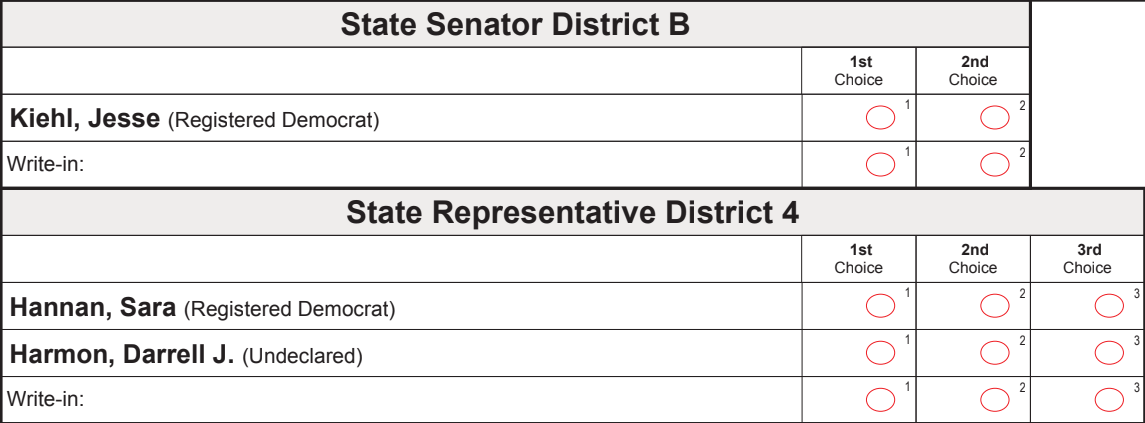
Not all RCV cities and states allow voters to rank in one- or two-candidate races, but this option in Alaska lets voters express their full preferences and gives analysts (like us!) the greatest possible insight into voters’ choices.