New ranked choice poll shows Kamala Harris is the consensus choice for Democrats if Biden withdraws

Learn more about how ranked choice voting would improve our presidential elections and solve the “spoiler problem.”
Note: See this page for a deep dive into polling of possible running mates for Kamala Harris.
A new SurveyUSA/FairVote ranked choice poll of 2,050 likely voters in six swing states finds that Kamala Harris is the strong favorite among Democrats and independent respondents to replace Joe Biden should he withdraw from the race. Among all likely voters, Biden performs the strongest against Donald Trump of all potential nominees (44%-44%). Harris performs the best of all non-Biden options (Trump 46%-Harris 42%).
Toplines and key findings include:
- Harris has both deep and broad support. She is the first choice of 37% of likely Democratic and independent voters; she continues to consolidate support in a ranked choice voting tabulation. Harris ultimately wins with 68% and her strongest opponent, Michigan Gov. Gretchen Whitmer, receives 32%.
- Harris is a strong consensus candidate, ranked in the top 3 choices by 56% of Democratic and independent voters. Other candidates commonly ranked in voters’ top three choices include Whitmer (31%) and Transportation Secretary Pete Buttigieg (29%).
- Harris is the most popular first-choice candidate for both women and men, across every racial group, and across every age group among likely Democratic and independent voters.
- In a ranked choice poll for a Harris running mate, Buttigieg bests Whitmer 52-48%, within the poll’s credibility interval. Buttigieg also has the most first-choice support.
The poll allowed respondents to rank up to seven choices for a potential Democratic presidential nominee and vice-presidential nominee. Ranked choice polling provides more information on voter preferences, including voters’ backup choices, head-to-head matchups of all candidates, and which candidates are strong “consensus” picks (ranked in voters’ top 3 or top 5 choices).
The poll is available here, with additional analysis below.
Kamala Harris would win a ranked choice voting election among Democratic contenders
Choosing among 8 top Democratic contenders, 37% of Democratic and independent voters would rank Harris first, compared to Gretchen Whitmer’s 12%. Harris grows her 25-point lead to a 36-point lead due to her popularity as a backup choice. She ultimately defeats Whitmer 68-32% in the final round.
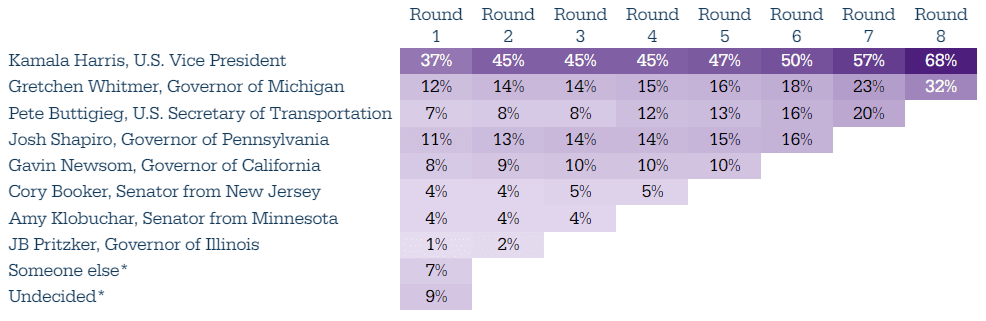
*This ranked choice tabulation eliminates “Someone else” and “Undecided” first, even though they had a higher first-round vote total than some named candidates.
Of interest, Harris is the most popular backup choice for Josh Shapiro supporters (44% of his votes transfer to her). When Buttigieg is eliminated, Harris and Whitmer are more evenly matched as the backup choice.
Only likely Democratic or undecided voters were asked to rank the potential Democratic nominees.
Harris is popular across multiple metrics
Harris performs well in ranked choice voting because she is popular as a second- or third-choice candidate. 56% of respondents rank Harris as one of their top three choices, nearly twice as many as any other candidate.
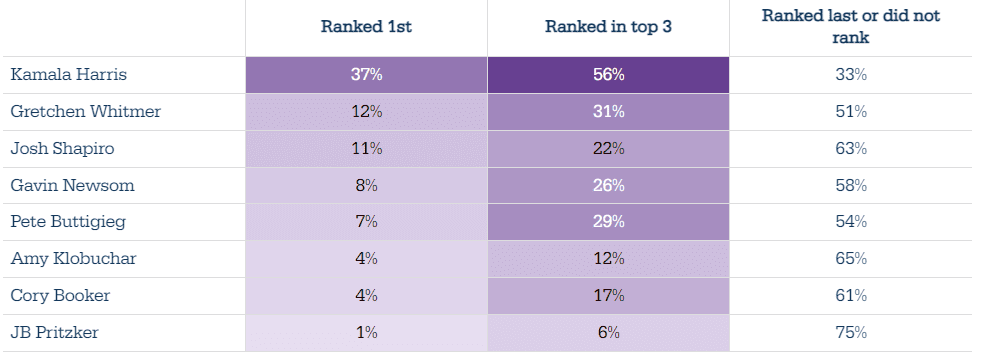
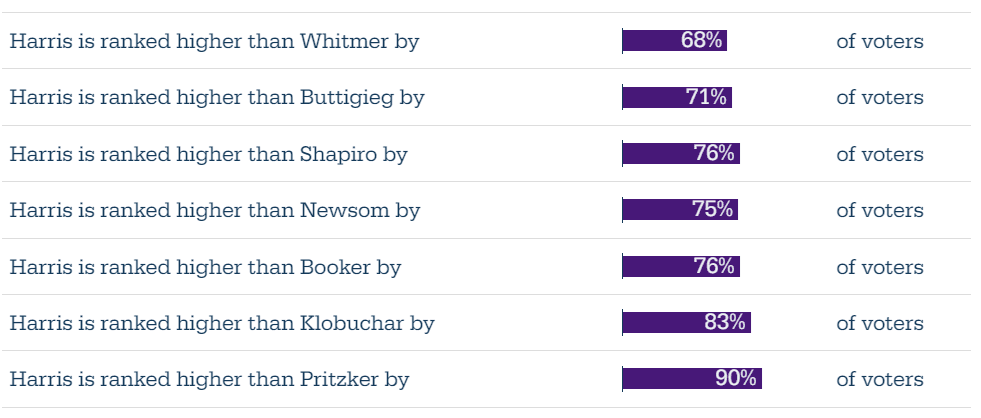
Ranked choice polling also allows us to simulate head-to-head matchup between each pair of candidates. Harris would beat every other potential Democratic nominee in a head-to-head race, and Whitmer would beat every other candidate except Harris.
Buttigieg and Whitmer are popular VP picks on a Harris ticket
Democratic or undecided voters also weighed in on nine possible running mates should Harris become the nominee.
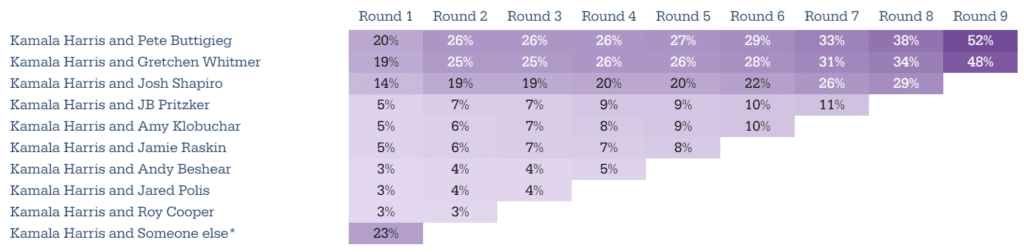
*This ranked choice tabulation eliminates “Someone else” first, even though they had a higher first-round vote total than some named candidates.
Voters are closely divided between Pete Buttigieg and Gretchen Whitmer as a possible running mate, with Josh Shapiro close behind. Buttigieg has the most first-choice support and defeats Whitmer 52-48% in a ranked choice voting tally, but the result is within the poll’s credibility interval.
Biden performs best against Trump, Harris is top alternative
All respondents, regardless of party ID, assessed possible Democratic nominees compared to Donald Trump and other candidates.
Biden and Trump are in a dead heat in the combined six swing states in this poll. Both poll at 44%, with 7% of respondents planning to vote for someone else and 5% undecided.
Among alternatives to Biden, Harris performs the best but still falls 4 points short of Trump.
Independent and third-party voters are split between Biden and Trump
7% of respondents reported that they plan to vote for a candidate other than Biden or Trump in November. However, that group is less certain of their choice. 49% said they might change their minds, compared to just 10% and 11% of Trump and Biden voters, respectively.
Among those whose first choice is another candidate, Trump has an edge. 28% prefer Trump as a second choice, 17% prefer Biden, 10% would not vote for a second choice, and 45% remain undecided.
Ranked choice voting is used in the presidential general election in both Maine and Alaska; it can end the “spoiler” problem and deliver a majority winner in a multi-candidate field. In this poll, Trump is the more popular second choice and would win in the second round of counting, 51-49%.
That is within the poll’s credibility interval; the number of respondents who are undecided on their second choice dwarfs the final margin between Trump and Biden.
Voters overwhelmingly support ranked choice voting
54% of all respondents said they would support implementing ranked choice voting where they live. Only 22% would oppose it, with 22% not sure.
Younger voters, voters of color, and liberal voters reported the highest level of support for ranked choice voting. RCV is currently used in 50 U.S locations home to over 13 million voters, including statewide in Maine and Alaska.
Poll methodology
SurveyUSA interviewed 2,700 adults, proportionally sampled from the battleground states of Arizona, Georgia, Michigan, Nevada, Pennsylvania, and Wisconsin on July 8-10, 2024.
Of the adults, 2,334 were identified as being registered to vote; of the registered voters, 2,050 were identified by SurveyUSA as likely to vote in the November election and were asked the substantive questions of all likely voters which follow. A subsample of 1,065 voters who either identified as Democrats or as independents who say they vote more often for Democrats or who say they vote equally for members of both parties was asked the questions relating to the Democratic presidential and vice-presidential nominating process.
The credibility interval for questions asked to all respondents is 2.2 points or higher. For questions asked only to Democratic and independent voters, the credibility interval is 5.3 points or higher.
Appendix: Head-to-head matchups
Below are the simulated head-to-head matchups between each pair of candidates. Ranked choice polling allows us to simulate these matchups.
As noted above, Kamala Harris would defeat every other Democratic presidential contender in a head-to-head race:
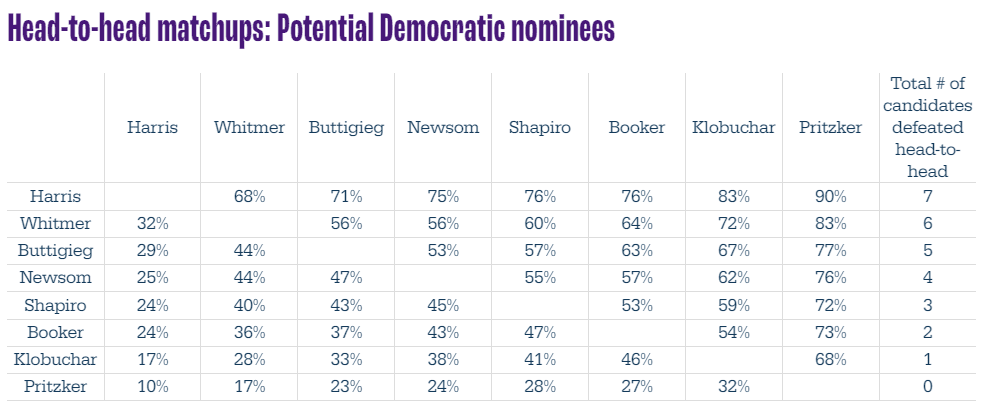
How to read this table: Read across rows. Read the first row with data as, “Harris beats Whitmer for 68% of voters; Harris beats Buttigieg for 71% of voters; etc”
Among the vice-presidential contenders, Pete Buttigieg defeats every other candidate head-to-head. Whitmer defeats every candidate besides Buttigieg.
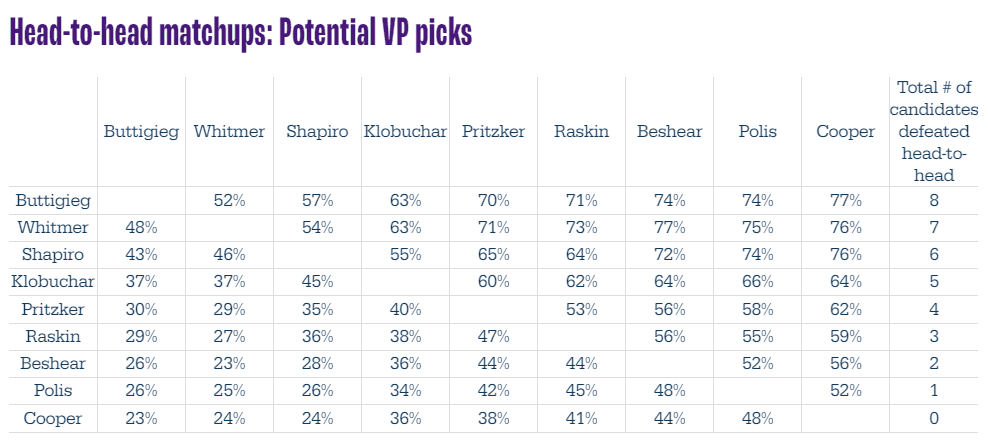
How to read this table: Read across rows. Read the first row with data as, “Buttigieg beats Whitmer for 52% of voters; Buttigieg beats Shapiro for 57% of voters; etc”