Possible Kamala Harris VP picks examined in new ranked choice poll

Learn more about how ranked choice voting would improve our presidential elections and solve the “spoiler problem.”
A SurveyUSA/FairVote poll of 2,050 likely voters in six swing states finds that Kamala Harris is Democrats’ consensus choice for a new nominee, and tests how voters feel about possible vice-presidential (VP) picks. Now that Biden has officially withdrawn from the race and endorsed Harris, it’s valuable to take a closer look at VP picks.
The poll allowed respondents to rank up to eight choices for a Kamala Harris VP. Ranked choice polling provides more information on voter preferences, including voters’ backup choices, head-to-head matchups of all candidates, and which candidates are strong “consensus” picks (ranked in voters’ top 3 or top 5 choices).
Toplines and key findings include:
- Transportation Secretary Pete Buttigieg bests Michigan Governor Gretchen Whitmer (52-48%) among likely Democratic and independent voters, within the poll’s credibility interval. Buttigieg also has the most first-choice support.
- Buttigieg and Whitmer are the strongest consensus choices. Each is ranked by 38% of Democratic and independent voters as one of their top 3 choices. Pennsylvania Governor Josh Shapiro and U.S. Senator Amy Klobuchar also perform well on this measure.
- A majority of poll respondents support implementing ranked choice voting where they live.
The poll is available here, with additional analysis below.
Pete Buttigieg would win a ranked choice voting race among nine possible Kamala Harris VP picks
Choosing among nine Democratic VP contenders, 20% of respondents rank Buttigieg first, followed closely by Whitmer at 19%. Pennsylvania Governor Josh Shapiro also performs well with 14%, but no other candidates earn more than 5% of first choices.
In the ranked choice voting tabulation, Buttigieg wins by four points in the final round, 52-48%. He grows his lead most when JB Pritzker is eliminated, with 45% of those voters ranking Buttigieg next.
*This ranked choice tabulation eliminates “Someone else” first, even though they had a higher first-round vote total than some named candidates.
Buttigieg and Whitmer are consensus choices for a Kamala Harris VP
In addition to being popular first choices, Buttigieg and Whitmer are also common backup choices; both were ranked as a first, second, or third choice by 38% of voters.
Shapiro and Klobuchar were also ranked in the top three by at least a quarter of voters. Klobuchar is particularly notable by this metric, given her relatively low first-choice support – we see just how popular she is as a second choice in the next section.

Second choices reveal voter preferences
By studying the most common second choices for supporters of each candidate, we can learn whether coalitions exist between certain candidates or groups of voters.
Buttigieg is the most common second choice for supporters of Klobuchar, Pritzker, and Raskin. Klobuchar is the most common second choice for supporters of Beshear, Whitmer, Buttigieg, and Cooper.
Somewhat notable given Harris’s home state of California, Midwesterners are the most popular second choices. Buttigieg, Klobuchar, Whitmer, Shapiro, and Pritzker all appear multiple times as popular second choices in the table below; Beshear, Cooper, Raskin, and Polis do not appear.
| First choice | Most common 2nd choice | Next most common 2nd choice |
|---|---|---|
| Andy Beshear | Klobuchar (30%) | Shapiro (21%) |
| Pete Buttigieg | Klobuchar (33%) | Buttigieg (26%) |
| Roy Cooper | Klobuchar (22%) | Shapiro (17%) |
| Amy Klobuchar | Buttigieg (38%) | Whitmer (21%) |
| Jared Polis | Pritzker (43%) | Whitmer (14%) |
| JB Pritzker | Buttigieg (21%) | Whitmer (21%) |
| Jamie Raskin | Buttigieg (29%) | Whitmer (21%) |
| Josh Shapiro | Whitmer (29%) | Buttigieg (22%) |
| Gretchen Whitmer | Klobuchar (30%) | Buttigieg (28%) |
Head-to-head matchups between candidates
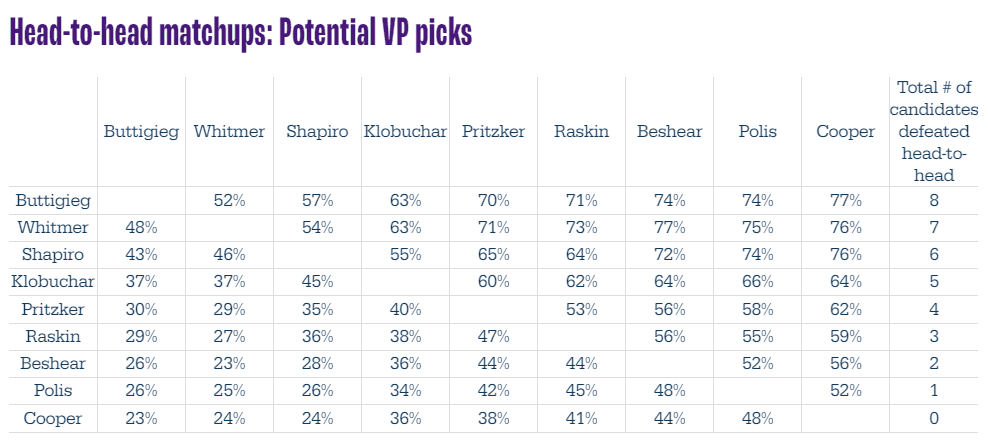
Below are the simulated head-to-head matchups between each pair of candidates. Ranked choice polling allows us to simulate these matchups.
Among the vice-presidential contenders, Pete Buttigieg defeats every other candidate head-to-head. Whitmer defeats every candidate besides Buttigieg.
Voters overwhelmingly support ranked choice voting
54% of all respondents said they would support implementing ranked choice voting where they live. Only 22% would oppose it, with 22% not sure.
Younger voters, voters of color, and liberal voters reported the highest levels of support for ranked choice voting. RCV is currently used in 50 U.S locations – home to over 13 million voters – including statewide in Maine and Alaska.
Poll methodology
SurveyUSA interviewed 2,050 likely voters from the battleground states of Arizona, Georgia, Michigan, Nevada, Pennsylvania, and Wisconsin on July 8-10, 2024.
A subsample of 1,065 voters who either identified as Democrats or as Democratic-leaning independents was asked the questions relating to the Democratic presidential and vice-presidential nominating process.
The credibility interval for questions asked to all respondents is 2.2 points or higher. For questions asked only to Democratic and independent voters, the credibility interval is 5.3 points or higher.