Albuquerque, Lewiston, and Houston need ranked choice voting
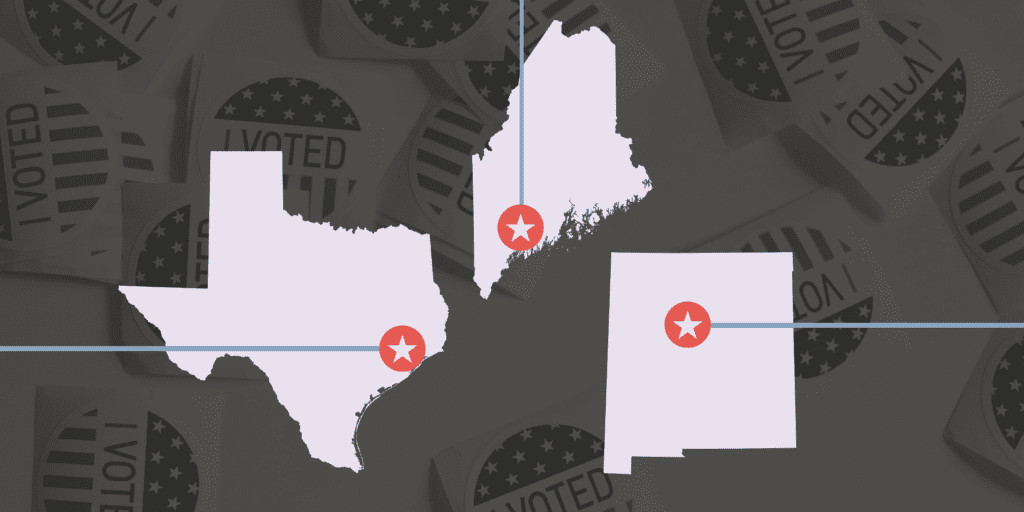
Over the past week, Houston (TX), Albuquerque (NM), and Lewiston (ME) held runoff elections. In all three cities, voters initially went to the polls on November 7, and were asked to return just a few weeks later. Turnout declined in every single runoff, minimizing choices in the decisive election. Ranked choice voting (RCV) is a faster, better, and cheaper alternative to runoff elections.
With RCV, voters can indicate backup choices, allowing for an instant runoff. RCV identifies the most-preferred candidate in just one election, saving voters’ time and taxpayers’ money. Lewiston and Albuquerque both recently considered adopting RCV, and hopefully this week’s elections will be the impetus they need to get it done.
Houston: 20% turnout decline in mayoral race
Houston held runoff elections for mayor, controller, and seven City Council seats. Eighteen candidates initially ran in the open mayoral contest; state Senator John Whitmire and Congresswoman Sheila Jackson Lee advanced to the runoff with 43% and 35% of votes, respectively.
Runoff systems fail to prevent “strategic voting” because vote splitting can impact which candidates make it into the runoff, and leave voters stuck with two options they don’t like in the decisive election. As one Houston voter said, the runoff is “more of a vote against someone than a vote for someone, unfortunately.”
Moreover, shortly after Jackson Lee announced her bid to be the city’s first African American woman mayor, two other Black Democrats withdrew to run for other offices. Single-choice voting often has a “lane-clearing” effect, in which candidates may leave the race if there’s already a perceived “frontrunner” representing their community or ideology with whom they might split the vote. This ends up limiting choice for voters and creating barriers for diverse startup candidates.
Whitmire won the December 9 runoff with 65% of votes, but the big loser was the runoff system; turnout dropped 20% from the initial election. In fact, all nine races that went to runoffs saw turnout drop, ranging from an 8% drop in the District G council race to a 21% drop in the District H race.
In the races for city council at-large Positions 1 and 3, the two candidates who advanced to the runoff won less than 50% of votes combined in the initial election – meaning a majority of voters did not see their top choice on the decisive ballot. RCV, on the other hand, allows voters to elect a winner when their choices are broad.
Lewiston: 42% turnout decline in mayoral race
On December 12, Lewiston held a mayoral runoff election. Incumbent Mayor Carl Sheline and former state Representative Jon Connor faced off after winning 45% and 38% respectively in the initial election. Sheline won the runoff with 51% of votes. However, due to the 42% turnout decline, Sheline won with fewer votes than he received in the general election. Before the runoff, Connor said that “a lot of people don’t know that there’s a runoff. We’re talking to a lot of folks and they say the same thing.”
Lewiston’s Charter Review Committee has discussed moving to RCV in the past. Committee Chair Ed Barrett said that runoffs and RCV “get you to the point where somebody has majority support,” but “it might make sense to go to ranked choice to avoid the need for a runoff, particularly when you’re pushing up against the holidays.” Former Councilor Alicia Rea said “reducing the number of times we ask our residents to come out to vote in elections is important since we have historically low turnout in the runoff elections we have seen in recent years.”
Compare Lewiston to Portland, Maine, which uses RCV. In Portland’s mayoral race, no candidate won a majority of first-choice support. Voters who supported a lower-performing candidate got to weigh in on the decision between frontrunners Mark Dion and Andrew Zarro via rankings. Dion was declared the winner with 52% of votes the morning after the election, while Lewiston had to wait nearly a month.
Albuquerque: 38% turnout decline in council race
Also on December 12, Albuquerque held a runoff for its District 4 City Council seat. Four candidates ran on November 7; Gun Violence Task Force Chair Nichole Rogers and local nonprofit leader Jeffrey Hoehn advanced with 40% and 32% of votes, respectively. Rogers won the runoff with 52% of votes. However, turnout dropped by 38%, and Rogers won with fewer votes than she received in the general election.
The Bernalillo County Clerk requested a whopping $1.2 million from the County Commission to conduct the runoff election, and that’s for just one district! Deputy County Clerk Michelle Kavanaugh expressed that “These (runoff) elections are more important than the general election. I mean, they are going to hit every single person closer to home, right at their front door.”
With ranked choice voting, elections would be decided when participation is naturally the highest. The Albuquerque City Council has considered RCV in recent years, and if the city adopts RCV, it would cement New Mexico’s status as a trailblazer. Santa Fe has used RCV since 2018, and Las Cruces has since 2019. New Mexico would become the 8th state in which the largest city uses RCV.