Trump administration sues to block Alaska Senate election result

On President Trump’s order, the Department of Justice sued Friday in an attempt to pre-emptively block the results of Alaska’s Senate election if Senator Dan S. Sullivan loses his re-election bid. Additionally, President Trump published two late-night posts last week about Senator Dan Sullivan, Senator Lisa Murkowski, and Alaska’s election system – which combines open, all-candidate primaries and ranked choice voting general elections.
Early voting has already begun in Alaska, and nothing about this lawsuit changes how Alaskans vote or whether their votes count. Alaskans will vote, the state will count and certify the votes, and voters’ voices will be heard.
Below, we answer questions on ranked choice voting in Alaska’s election, and share legal commentary on the lawsuit. For further reading, here are two additional resources on RCV in Alaska elections:
- What to expect in Alaska’s 2026 ranked choice voting elections
- When should we expect results in Alaska’s ranked choice voting elections?
What does ranked choice voting have to do with this election, and the “two Dan Sullivans”?
RCV is not why the “other” Dan Sullivan is on the ballot – and it actually helps solve the problem. There is a long history of gamesmanship and same-name candidates in any election system, but RCV makes it much less effective. With RCV, any small number of voters uncertain about the “Dan Sullivans” can rank both candidates on their ballot, and their vote will count for the stronger candidate – which is extremely likely to be Senator Sullivan. The two candidates are clearly differentiated on the ballot.
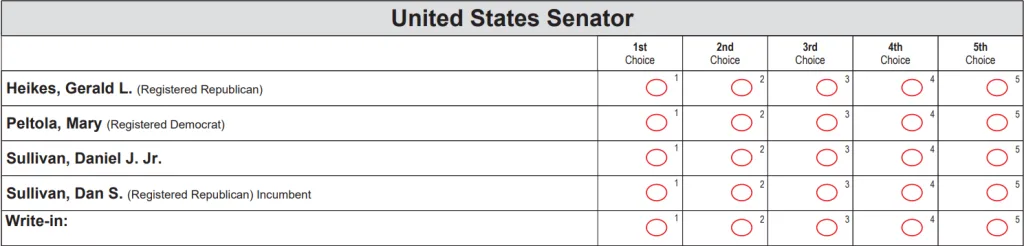
The day after the DOJ filed its lawsuit, Senator Sullivan boosted a 30-second jingle simply telling voters, “Dan S. is your number 1, if he’s not rank him second,” and “Dan S., Daniel, Jerry – just don’t rank Mary.”
Blaming RCV for the “two Dan Sullivans” is like getting mad at the guardrail, not the car that tried to drive you off the road.
What about President Trump’s other comments on ranked choice voting?
RCV is completely party-neutral. Voters get to decide who wins, and candidates need majority support to win. Republicans, Democrats, and independents have won RCV elections – including President Trump winning Alaska in 2024. In Alaska’s first RCV election in 2022, voters elected a conservative Republican governor, a moderate Republican Senator, and a moderate Democratic congresswoman on the same day. Notably, Lisa Murkowski did not win “because of” ranked choice voting or “come from behind” in 2022; she won the most first-choice support and consolidated majority support in the RCV tally.
Additionally, voters overwhelmingly understand RCV – 84% of Alaska voters say that ranked choice voting is simple. In Alaska’s first RCV election in 2022, 99.9% of ballots cast were valid.
RCV election results are accurate, secure, and transparent. Most of the steps of running an RCV election are exactly the same as any other election.
What are legal experts saying about United States v. Alaska, which seeks to block Alaska from certifying its own election?
Notre Dame professor and election law expert Derek Muller:
The legal argument is one of the worst ones I’ve ever seen.
UCLA professor and election law expert Rick Hasen:
It’s the worst complaint I’ve ever seen.
NYU professor and election law expert Richard Pildes:
It is one of the weakest election lawsuits I’ve ever seen. It should have no realistic chance of success in the courts.
Ben Ginsberg, a veteran Republican election law expert who was counsel to George W. Bush’s 2000 and 2004 presidential campaigns:
Boy, they are scraping the bottom of the barrel. It feels like a real desperation play to me, because it has got zero basis in the law.
This is a state legal issue, and the Alaska Supreme Court already ruled in June that Daniel J. Sullivan belongs on the ballot. DOJ’s last-minute lawsuit raises an issue the court already addressed four months ago. Additionally, legal experts have also raised that: the Department of Justice does not have statutory authority to sue in this case, and that this case would fail both the Supreme Court’s Major Questions Doctrine and its Purcell Principle – which limits election challenges during election cycles.
###
FairVote is a nonpartisan organization seeking better elections for all. We research and advance voting reforms that make democracy more functional and representative for every American.