Cumulative voting proposed to protect minority voting rights in Keller, Texas

A recent case in Texas federal court captures the voting rights issues at stake in school board elections, and the potential use of cumulative voting as a remedy to vote dilution.
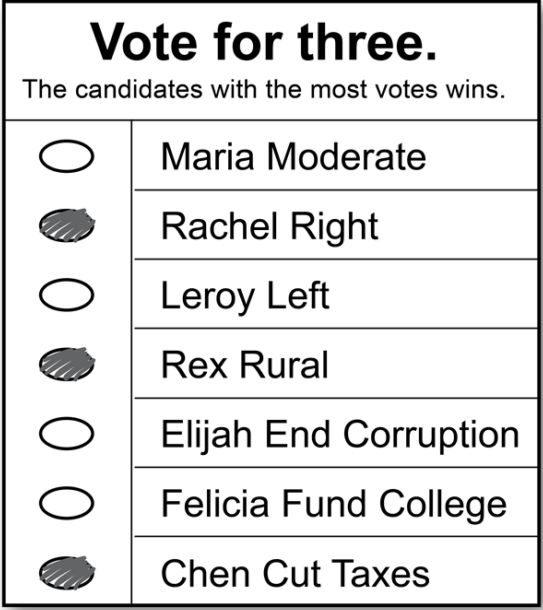
The Keller Independent School District Board of Trustees is currently elected using plurality block voting. Block voting lets the largest group of voters choose every member of an elected body. It typically dilutes the voting power of any voters who do not belong to the largest interest group in a jurisdiction – these are often voters of color.
In June 2025, the Brewer Storefront law firm sued the school district, arguing that the current voting system violates the Voting Rights Act by diluting voting power for people of color.
Sign up for the latest news from the election reform movement, or get involved in your community.
The plaintiffs presented election data going back to 2017 to demonstrate that school board candidates supported by a majority of Hispanic voters typically lost. Notably, all seven of Keller’s school board trustees are White, even though 15% of voters and 25% of students are Hispanic.
Sometimes, vote-dilution cases can be resolved by switching to district-based elections and drawing majority-minority districts. Yet this solution is only viable if voters of color live in the same geographic areas, which is not the case in Keller and many other communities across the country.
That’s where voting methods like cumulative voting and proportional ranked choice voting – which was recently used to settle a state voting rights act lawsuit in Newburgh, NY – come in. These voting methods are designed to move our elections closer to proportional representation – where groups of voters elect winners in proportion to their share of the votes cast. For instance, if 60% of votes go to conservatives and 40% go to liberals, then about 60% of seats go to conservatives and 40% go to liberals.
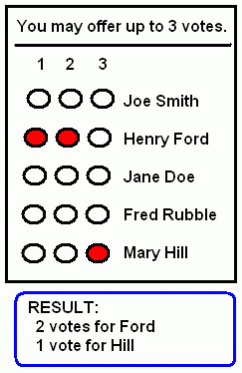
Cumulative voting is a semi-proportional system. Each voter has multiple votes; voters can vote for as many candidates as the number of open seats, or put multiple votes behind the same candidate. If voters of color actively consolidate their voting power behind the same candidate, they will typically be able to elect at least one candidate of their choice.
The Brewer Storefront proposed cumulative voting as a way to remedy vote dilution in Keller, though a federal judge ultimately dismissed the lawsuit. Even though the Storefront has not been successful, cumulative voting has a long history as a remedy in Voting Rights Act cases, including in Texas. In 1995, the Texas legislature adopted cumulative voting as an alternative voting system for school boards; the bill was signed into law by then-Governor George W. Bush. As part of the Keller case, FairVote Director of Research and Policy Deb Otis filed an affidavit listing over 40 Texas school districts and localities that have adopted cumulative voting as a remedy in VRA cases.
More proportional voting methods are valuable tools for building a more representative democracy. Cities, counties, and states should consider these tools as they work to improve their elections.