Protecting voting rights with proportional representation
Recent events have brought renewed attention to the threats facing voting rights in the United States. In the ongoing battles over redistricting, politicians are increasingly dismantling districts that have provided representation for Black and Brown communities. And as the Supreme Court continues to chip away at the Voting Rights Act, cases like Louisiana v. Callais and Turtle Mountain Band of Chippewa Indians v. Howe threaten the ability of communities of color to elect candidates who represent their interests.
The consequences could be profound. Systemic efforts to prevent Black Americans from gaining representation in Congress and state legislatures deprived them of political power for nearly a century, and continue to shape our society today.
As these threats multiply, then, so too must our responses. Defending voting rights in our current era will require advocates to pursue all available avenues to push back against this assault and build a more inclusive democracy.
In addition to protecting and expanding the Voting Rights Act, another pathway to durable political power for communities of color is proportional representation.
How does proportional representation help?
Under our current system, each district only elects one legislator. Single-member districts can safeguard representation for communities of color when mapmakers draw the lines in a way that ensures an equal opportunity to win seats – or, failing that, when courts step in to protect voters against discriminatory maps.
But when politicians and judges both turn their backs on the VRA’s promise of equal opportunity, the power of single-member districts to protect communities against discrimination becomes more limited.
Single-seat elections are “winner-take-all”: The biggest group of voters in the district gets 100% of the representation – and everyone else gets nothing. Without robust enforcement of the Voting Rights Act, winner-take-all elections silence voters in the minority, inflate the influence of voters in the majority, and place unchecked power in the hands of mapmakers.
Under proportional representation, each district would elect multiple legislators, and groups of voters would elect winners equal to their share of the vote: If a group casts 35% of votes, that group wins roughly 35% of the seats. This intuitive and powerful approach provides a structural protection for voting rights that does not rely on the good will of judges or legislators (or even redistricting commissions) to produce inclusive and representative maps.

With fewer district lines to draw, proportional systems reduce the power of mapmakers to determine who wins and loses – giving more power back to voters. And with more legislators from each district, proportional systems give more communities a seat at the table – no matter what the Supreme Court decides in Callais.
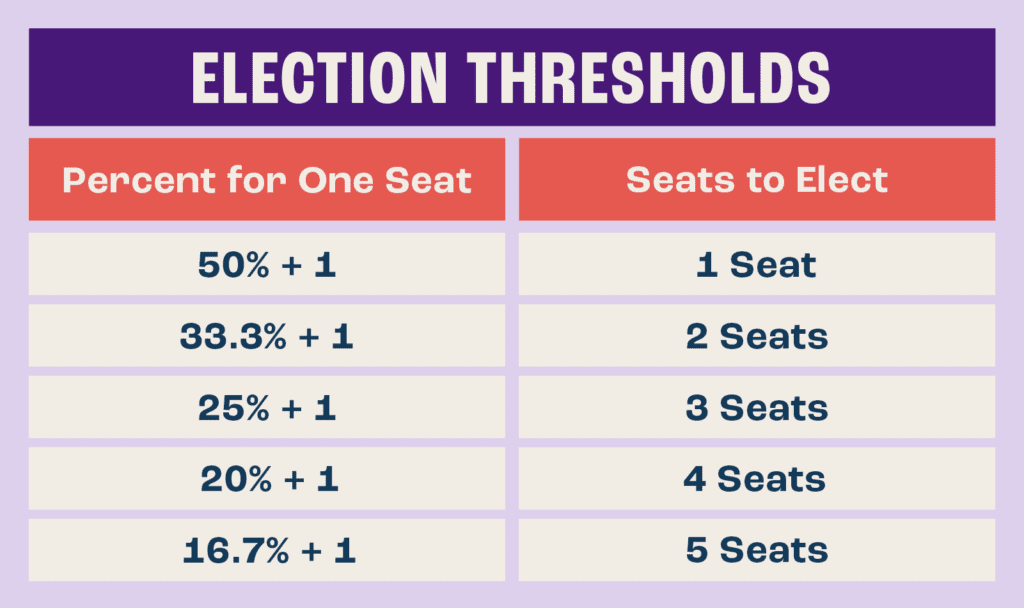
As the number of seats in each district goes up, so too do the opportunities for more groups to have a voice in government. For example, a 3-seat election only requires 25% of the vote to win. And in a 5-seat district, any group of voters larger than 16.7% could elect a candidate of their choice. This gives voters of color across an entire state, not just those in select districts, a chance to elect their preferred candidates – and a chance to hold more of their state’s elected leaders accountable.
Where is proportional representation used?
Most democracies around the world use proportional representation to elect their legislatures. The United States is an outlier for continuing to rely largely on the winner-take-all system it inherited from Great Britain.
But even within the United States, proportional systems have a history of successful use. In the early 1900s, numerous U.S. cities adopted proportional systems, including New York City, Cleveland, Cincinnati, Boulder, Long Beach, and Sacramento. In many cities that adopted proportional elections, Black candidates were elected for the first time – decades before the passage of the Voting Rights Act.
For example, in 1941, Adam Clayton Powell Jr. became the first Black candidate elected to the New York City Council, after the city adopted a proportional election system. Powell went on to become the first Black member of Congress elected from New York State, and one of the most influential legislators in recent American history. Powell shaped Title VI of the Civil Rights Act of 1964, and ushered in legislation creating landmark programs like Medicare, Medicaid, Head Start, school lunches, a minimum wage increase, and college student loans. His election shows how political power can translate into policies that shape our lives.
Today, many cities and counties are again exploring the promise of proportional representation. Two analyses of Portland, Oregon’s first proportional elections in 2024 found that the system delivered representative results for communities of color. And many state voting rights acts – such as those in California, Colorado, Connecticut, Minnesota, New York, and Washington – recognize both opportunity districts and proportional representation as potential remedies to vote dilution.
What would proportional representation look like for Congress?
To achieve proportional representation nationwide, Congress could require each state with two or more representatives to use multi-member districts and a proportional voting method. This would create more opportunities for Americans across racial communities to be represented, and ensure some states do not continue to gerrymander while others “unilaterally disarm.”
The Fair Representation Act (H.R. 4632) is currently the only bill that has been introduced to implement proportional representation nationwide. It would bring proportional ranked choice voting – also known as the “single transferable vote” – to U.S. House elections.
Using modeling developed by redistricting expert Moon Duchin, FairVote projects that under the FRA:
- Black voters would have power-to-elect in 26% of districts (compared to 5% now)
- Latino voters would have power-to-elect in 22% of districts (compared to 6% now)
- Asian American voters would have power-to-elect in 5% of districts (compared to less than 1% now)
- Every district would likely elect members of both parties.
As an example, the map below shows how the FRA would improve representation in Texas – giving voters of color power to elect candidates of choice in five additional seats.
Note that our methodology takes a cautious approach to measuring seats where voters of color have power to elect a candidate of their choice. We only count districts where the citizen voting age population is above the threshold to elect and a community can elect a candidate outright without any crossover support from voters outside the ethnic or racial group. In practice, many opportunity districts protected by the Voting Rights Act are not majority-minority districts, and instead provide voters of color an opportunity to elect with the help of crossover voters. Such districts are not captured in the single-winner analysis here. Similarly, we expect levels of representation for communities of color under the Fair Representation Act would likewise exceed the power-to-elect figures provided here due to crossover voting.
To see what representation under the FRA could look like in your state, view sample maps for all 50 states here.
FairVote believes the FRA is the “gold standard” for securing fair representation in Congress. Congress could also give states more flexibility by requiring multi-member districts and proportional representation, while giving states a choice over what type of proportional representation they would prefer to implement.
Members of Congress have long recognized that multi-member districts could offer a potential path forward to greater representation, including in the States’ Choice of Voting Systems Act (H.R. 1173) introduced in 1999 by former Rep. Mel Watt (NC). This bipartisan legislation was cosponsored by prominent members of the Congressional Black Caucus, such as Representatives Jim Clyburn (SC), Danny Davis (IL), Bobby Scott (VA), and Bennie Thompson (MS), as well as by Republican Representatives Tom Campbell (CA) and John Edward Porter (IL). This bill was introduced in the wake of the Supreme Court’s 1993 decision in Shaw v. Reno – another case that curtailed the power of single-member districts to provide full redress under the Voting Rights Act.
The gerrymandering wars are increasingly taking power from voters, and giving it to politicians and mapmakers. The Supreme Court is once again pushing the crown jewel of the Civil Rights Movement – the Voting Rights Act – to the brink. Now is the time for bold action, renewed faith, and a new front to secure lasting representation for communities of color. Proportional representation can be a key tool in building a true, multiracial democracy.
Where can I learn more?
- Improving redistricting with proportional representation
- The Fair Representation Act gives communities of color more power – FairVote and More Equitable Democracy
- Modeling the Fair Representation Act – MGGG Redistricting Lab
- Sample Fair Representation Act maps