Proportional representation (PR) ensures elections are fair for all voters. Instead of electing one legislator, different groups of voters elect winners in proportion to their share of the votes cast. For instance, if 60% of votes go to conservatives and 40% go to liberals, then about 60% of seats go to conservatives and 40% go to liberals.

In PR systems, then, voters are represented by multiple legislators – not just one. In multi-member districts, more voters can elect candidates of their choice. Political, racial, and other groups can gain accurate representation. At the congressional level, proportional representation would also effectively eliminate gerrymandering and make every district competitive.
While all forms of proportional representation share these core advantages, they differ in how votes are cast, counted, and translated into seats. Below, we provide an overview of three major PR systems – proportional ranked choice voting (RCV), party list PR, and mixed-member PR.
Proportional ranked choice voting
How proportional RCV works
Voters rank the candidates in order of preference. Candidates who receive a certain share of votes — the threshold — are elected, in proportion to their share of the votes.
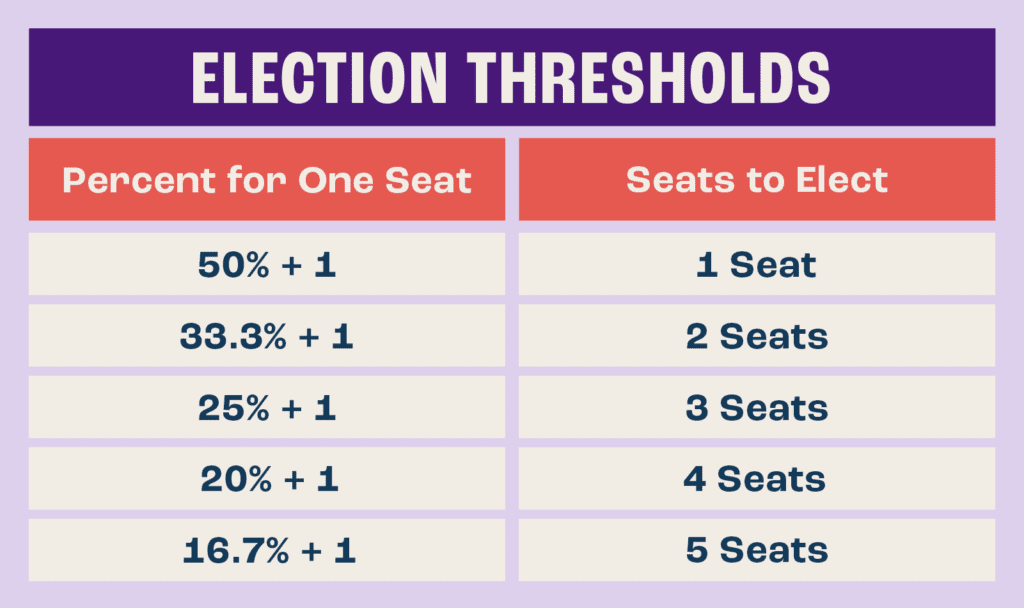
In a proportional RCV contest, voters’ first-choices are counted. Any candidate above the threshold is elected. As with other PR methods, proportional RCV is intended to match seats to votes; if a candidate either earns more votes than the threshold or has no chance to meet the threshold, the lower rankings of voters who ranked them Number 1 come into play.
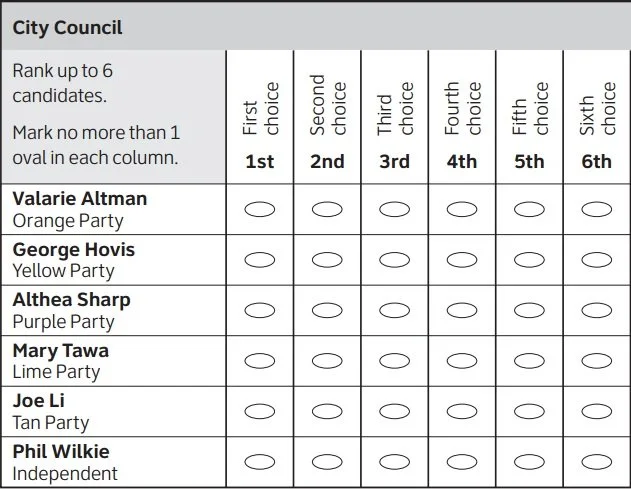
Proportional RCV is known internationally as the “single transferable vote,” or STV. Read more about how proportional RCV is counted here.
Where proportional RCV is used
Proportional RCV is the only form of PR adopted in the United States to date. It is currently used in Portland, Oregon; Cambridge, Massachusetts; Minneapolis, Minnesota; Albany, California; and other U.S. municipalities. Internationally, Australia and Ireland use proportional RCV for national elections, with additional uses in Scotland and New Zealand.
Benefits of proportional RCV
Proportional RCV allows voters to express a wider range of choices, including nuanced preferences between candidates. It can be used in partisan and non-partisan elections.
In partisan elections, voters can rank candidates from different parties, which incentivizes parties to bargain for cross-endorsements and form coalitions. For example, in Australia, there is a long-running coalition between the conservative Liberal and National parties, and a more recent coalition between the progressive Labor and Green parties. Parties typically issue “how-to-vote” cards advising their supporters to rank their coalition partner(s) second. In Australia, proportional RCV has produced a “two-and-a-half party system,” where there are two major coalitions but smaller parties or independents regularly earn seats.
Proportional RCV can be especially valuable in contexts where voter preferences cut across traditional partisan divisions. If an ethnic, racial, or issue-based group reaches the threshold to elect and votes cohesively (e.g. they make up at least 17% of the electorate in a 5-member district), that group can elect a candidate of its choice. For this reason, proportional RCV has been recognized under six state voting rights acts as a remedy to prevent vote dilution for historically underrepresented communities.
Tradeoffs with proportional RCV
Voters may not have strong or nuanced preferences between particular candidates for some or all races on the ballot. The vast majority of voters who rank just one candidate still help elect a candidate of choice; however, if that candidate gets eliminated, the voter forgoes some degree of influence over the election.
Party list proportional representation
How party list PR works
Parties produce a list of candidates who appear on the ballot. Seats are awarded to parties in proportion to the number of votes for each party.
In “open-list” PR, voters choose one candidate from a party list. The party is still awarded seats according to its share of the vote. However, the order in which candidates are elected from a party’s list is determined by how many votes these individual candidates received.
In “closed-list” PR, voters vote directly for a party, and candidates are elected in an order determined by the party.
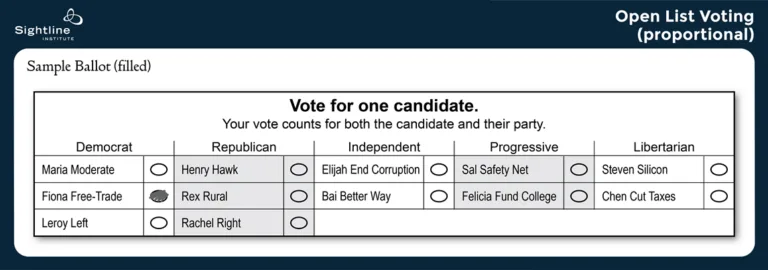
Where party list PR is used
Party list PR is the most common electoral system for electing legislatures globally. In many countries, such as Brazil and Norway, party list PR is used to elect national legislatures. In other countries, like Germany and Spain, party list PR is used in local or regional elections.
Benefits of party list PR
There is a large body of political science research that emphasizes the importance of parties. Party list PR gives parties a central role in elections, particularly in its closed-list form where the party can fully control its own nominees. In addition, parties sometimes coordinate their campaigns to maximize their electoral success. For example, in Sweden, small parties have formed coalitions and combined their lists in order to win more seats. Parties may also coordinate by targeting different geographic areas or segments of voters to avoid splitting the vote, or by pooling campaign resources. These alliances can lay the groundwork for formal governing coalitions after the election.
Party list PR also tends to encourage multi-party systems because the threshold for winning representation is typically low. This gives voters a wider range of options and increases the chances that smaller parties can gain seats.
Tradeoffs with party list PR
Party list PR gives voters less control over how their vote is counted than proportional RCV. In closed-list systems, voters can’t express any preference between individual candidates within their preferred party; in open-list systems, voters must accept that their vote could help elect a candidate from their chosen party that they don’t support.
In addition, party list PR cannot easily accommodate independent candidates, although in a multi-party environment, independents might choose to affiliate with smaller and/or emerging parties. Party list PR is not currently applicable in nonpartisan elections, which are the norm for most local offices in the United States. However, localities could allow candidates to form slate lists – groups of candidates who run together under a shared local platform or banner – and allow for proportional allocation of seats between slates rather than parties.
Mixed-member proportional representation
How MMP works
Mixed-member proportional representation (MMP) combines a single-member district system with proportional representation. Voters cast two votes: one for a candidate in their district and one for a party. In MMP systems, district representatives are elected first using “pick-one,” plurality voting. Additional seats are then allocated from party lists to bring each party’s total number of seats in the legislature closer to its share of the party vote. Most MMP systems include a threshold that a party must reach to qualify for list seats. MMP is also sometimes called “compensatory proportional representation” or the “additional member system.”
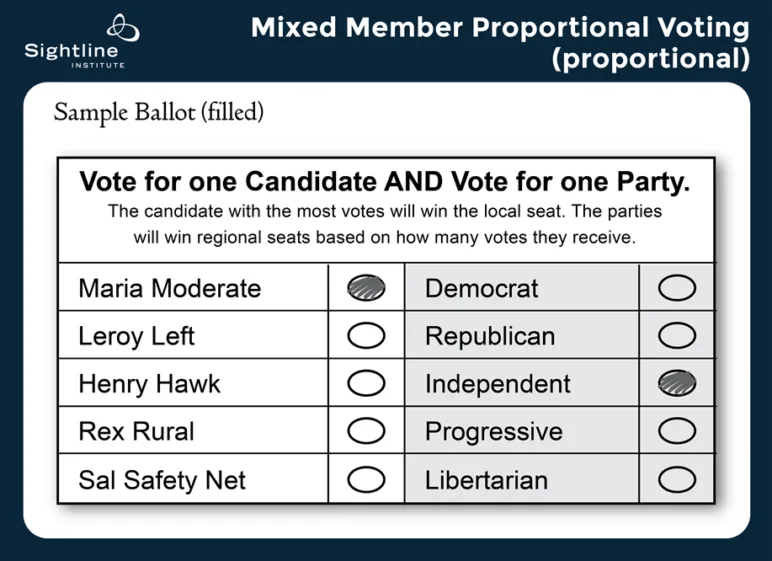
Where MMP is used
Germany, New Zealand, South Korea, and Bolivia are among the countries that use MMP in national elections.
Benefits of MMP
MMP gives voters both local representation and proportional outcomes in the legislature. Voters can support a preferred district candidate while also expressing a party preference, ensuring that parties’ overall seat totals reflect their share of the vote and that parties continue to play a central role in elections.
MMP allows smaller parties to gain representation even if they win few or no district contests, provided they cross the party vote threshold. Also, because the district contests use single-member districts, the list of candidates on each ballot is relatively short.
Tradeoffs with MMP
In MMP, voters have to vote two ways – for a district candidate and for a party – and may need additional education to understand how these votes interact to determine overall representation.
The system can also produce overhang seats, which occur when a party wins more district seats than it would be entitled to under strict proportionality. Additionally, votes for parties that do not reach the threshold to qualify for list seats are effectively “wasted,” meaning those voters do not help elect a candidate or party of their choice.
How to choose between these PR systems
Moving from winner-to-take-all to any form of proportional representation will deliver important changes. These are different systems with different benefits, but any of them is a big improvement over the status quo. Consider the benefits and tradeoffs listed above, but don’t let the differences between systems hold you back from choosing one and pursuing it.