How to stop the gerrymandering wars and give every voter a voice

Last month, President Trump asked Texas Republicans to redraw their state’s congressional map to secure more U.S. House seats for the GOP. This request ignited a gerrymandering war between Republicans and Democrats across the nation – with legislators of both parties threatening to redraw their states’ maps to counter the “other side.”
Thankfully, there’s a way we can end these gerrymandering wars once and for all: Reintroduced last month, the Fair Representation Act would make every congressional district competitive by combining ranked choice voting with multi-member districts. Voters can ask their representative to support the act here.
Sign up for the latest news from the ranked choice voting movement, or get involved in your community.
FairVote’s David Daley explained how the act combats gerrymandering on PBS’s Amanpour & Co. last week:
The gerrymandering arms race continues to heat up, with more and more states preparing to join. On Sunday, Democrats in the Texas House of Representatives left the state to prevent the chamber from having the quorum required to conduct business, preventing passage of a new map with five additional safe Republican seats.
Governor Greg Abbott has threatened to have all of those who left removed from the legislature, on grounds of “abandonment or forfeiture of an elected state office.”
Meanwhile, New York Governor Kathy Hochul and California Governor Gavin Newsom have announced that they want to redraw their own states’ maps in Democrats’ favor to offset GOP gains in Texas. Republicans in Missouri, Indiana, and Ohio – and Democrats in Maryland, Illinois, and New Jersey – may also get involved.
Though it’s unusual for legislators to redraw maps in the middle of the decade, gerrymandering itself is nothing new. Since the United States was founded, politicians have understood that they can manipulate district lines to dilute the power of the opposing party.
The Fair Representation Act can effectively eliminate gerrymandering and make every district competitive because combining RCV and multi-member districts delivers proportional representation. That means different groups of voters elect winners in proportion to their share of the votes cast.
For instance, if 60% of votes go to conservatives and 40% go to liberals, then about 60% of seats go to conservatives and 40% go to liberals. Drawing members of one party into unfavorable districts would no longer deny them representation.
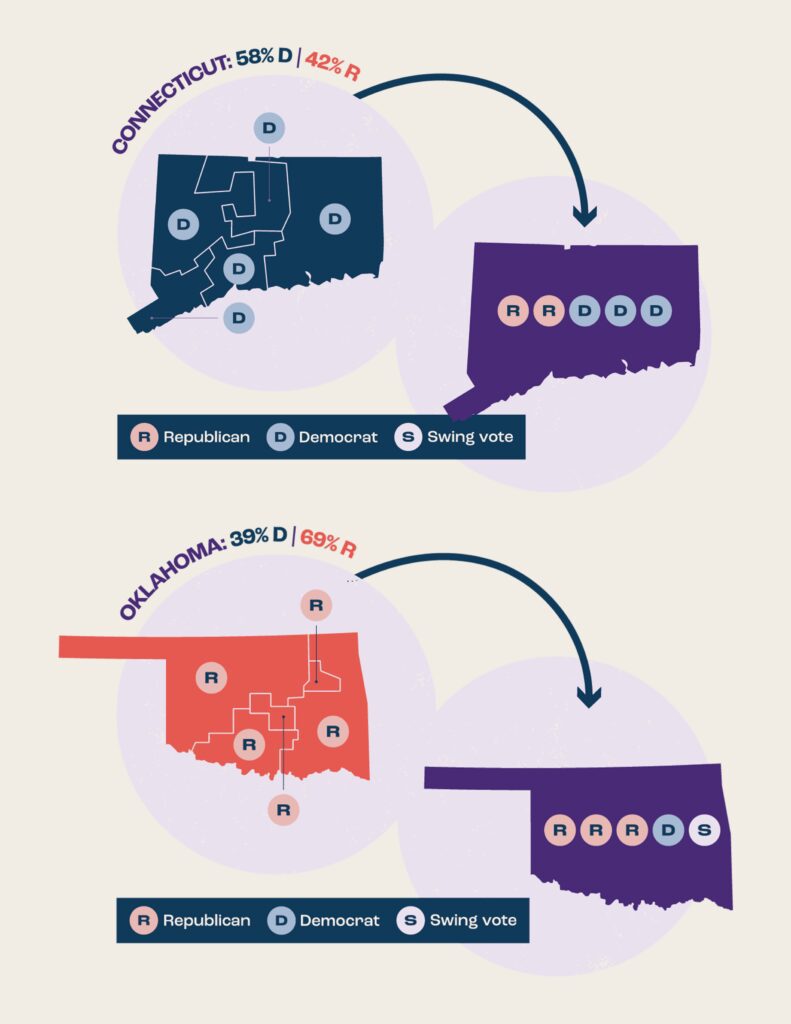
Republicans in states like Massachusetts and Connecticut would finally have representation in their states’ congressional delegation, as would Democrats in Arkansas and Oklahoma.
In fact, President Trump took note of this underrepresentation on Tuesday, mentioning that:
In Massachusetts, I got, I think, 41 percent of the vote, a very blue state, and yet [Democrats] got 100 percent of Congress… No, it shouldn’t be that way.
The bill, sponsored by Rep. Don Beyer (VA) and Jamie Raskin (MD), also includes a ban on mid-decade redistricting – another defense against the race to the bottom we are currently experiencing. Learn more about the Fair Representation Act here.