Improving redistricting with proportional representation

Congressional redistricting is back in the news – with Texas Republicans, California Democrats, and state legislators across the nation redrawing U.S. House maps mid-decade to maximize the number of seats their party is likely to win.
Mid-decade redistricting is unusual; states usually only redraw their maps every 10 years, after the Census. But the gerrymandering wars are nothing new.
A range of reforms could reduce gerrymandering and make district lines less important. The best would be a national shift to proportional representation with multi-member districts, as embodied by the Fair Representation Act.
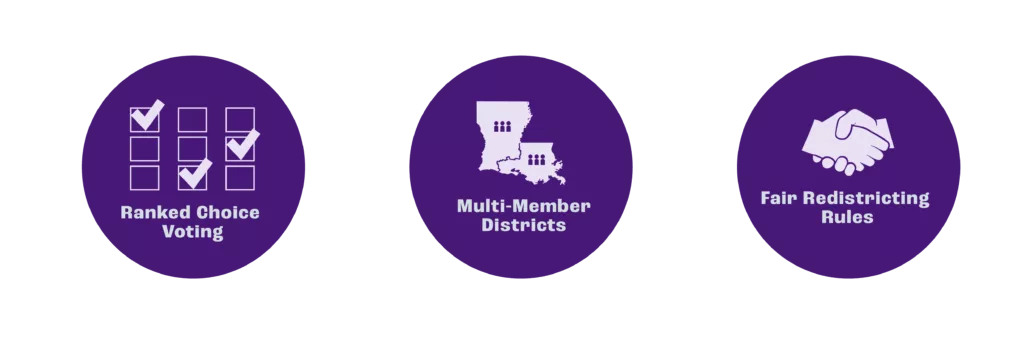
Just introduced by Reps. Don Beyer and Jamie Raskin, the Fair Representation Act offers a national solution to a national problem. It would combine multi-member districts, ranked choice voting (RCV), and uniform national redistricting rules.
Sign up for our newsletter for the latest information on election reform.
Why do we need a national solution to gerrymandering?
The current incentives of our state-by-state redistricting system reward the sort of tit-for-tat partisan warfare that voters hate.
If a state controlled by Republicans gerrymanders its map to elect more Republicans, a state controlled by Democrats is incentivized to do the same to elect extra Democrats. States that take good-faith steps to reduce gerrymandering are accused of “disarming unilaterally.”
We are seeing this in real time this summer, with Texas Republicans acting first to squeeze out more seats for their party – and California Democrats quickly following suit in response.
What’s wrong with single-member districts?
Several different reforms would reduce gerrymandering – including banning mid-decade redistricting, giving the power to draw districts to nonpartisan citizen or expert commissions instead of partisan legislators, and/or requiring states to follow a set of uniform redistricting criteria.
But if the goals of eliminating gerrymandering are better representation, more voter voice, and a more responsive government, there are still major shortcomings as long as we use single-member districts.
Single-member districts don’t guarantee fair representation
Even if single-member districts were drawn fairly, tens of millions of Americans still wouldn’t have a U.S. representative responsive to their views. That’s because, in congressional districts represented by only one member, sizable minority groups have no way to elect a candidate of their choice.
Think of rural Democrats or urban Republicans, who might make up 30 or 40% of the population in their district. They should have some voice, but their preferred candidates will nearly always be defeated by a candidate from the other party. In our polarized political system, this means their U.S. representative is unlikely to agree with – or even listen to – any of their views.

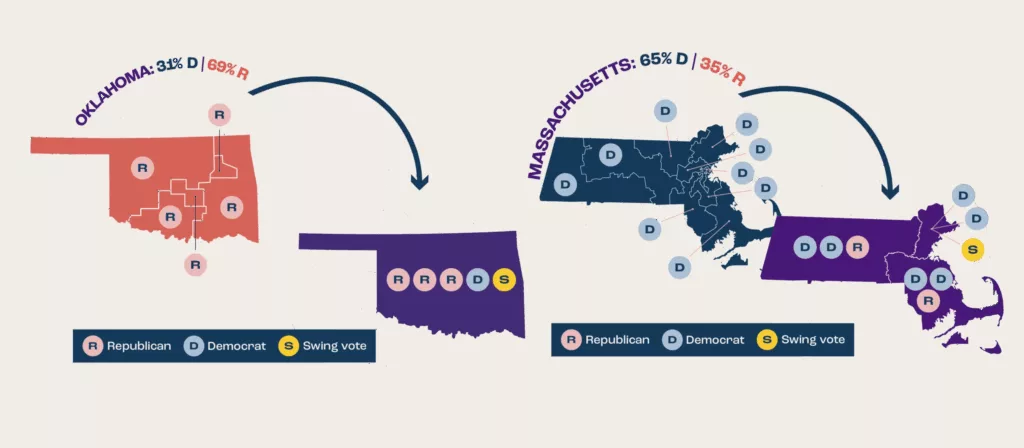
It’s the same situation for Oklahoma Democrats and Massachusetts Republicans, who are geographically dispersed across their states. The Bay State hasn’t elected a Republican member of Congress for over 30 years, even though Republicans routinely win 35 to 40% of the vote there.
This lack of representation also extends to communities of color that are geographically dispersed, or not large enough to form the majority in a majority-minority district. Additionally, with the continued erosion of the federal Voting Rights Act, the future of majority-minority districts as a tool for fair representation may be under threat.
Single-member districts often fail to deliver competition and accountability
Ending gerrymandering does not guarantee more competitive races – a congressional map could reasonably represent the partisan split in a given state, but with all seats “safe” for either Democrats or Republicans.
This is close to the reality already – in the 2024 U.S. House elections, only 37 of 435 races (9%) were decided by five percentage points or fewer. The vast majority of congressional elections are effectively decided not in November, but in low-turnout summer party primaries – and often by just a fraction of the voters in those contests.
The fact is: Most of us have never voted in a competitive congressional election in November.
Single-member districts can drive polarization
This lack of representation and lack of competition also lead to greater political polarization. Elected officials win by appealing to smaller, more partisan primary electorates – because that’s where the real competition is for most elections. The officials have little incentive to engage with voters – or work across the aisle with other elected officials – who don’t share all their views.
The result is a polarization machine: Members of Congress are most focused on appealing to the most dedicated voters in their own party.
How does proportional representation with multi-member districts help?
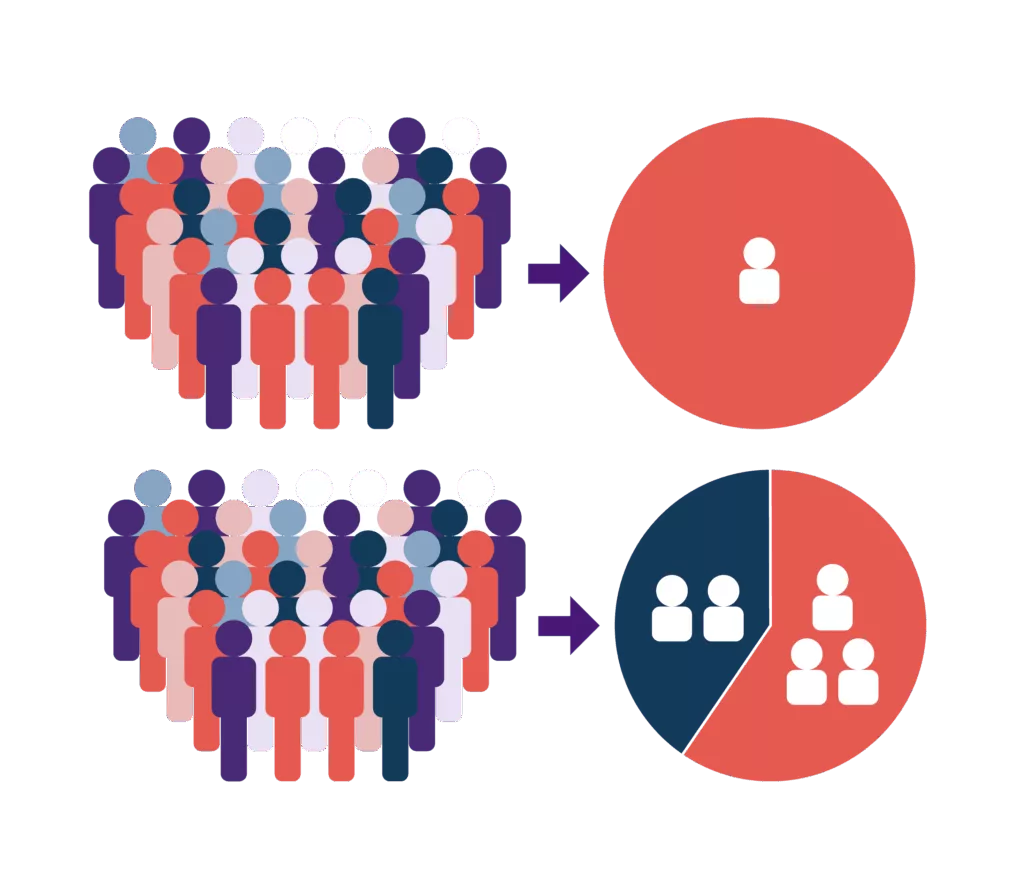
Most democracies worldwide use proportional representation to elect more functional legislatures. Proportional representation is exactly what it sounds like: Different groups of voters elect winners in proportion to their share of the votes cast.
For instance, if 60% of votes go to conservatives and 40% go to liberals, then about 60% of seats go to conservatives and 40% go to liberals. Think about this in a multi-member district with five members: Three would be conservatives, and two would be liberals.
This is a gerrymandering killer, and a boon for representation. First, multi-member districts would mean fewer lines to draw and, therefore, fewer opportunities to gerrymander.
Second, the remaining district lines become far less important. Drawing members of one party into unfavorable districts would no longer deny them a voice – they will still win seats in proportion to their share of the vote.
Research has found that this system would lead to fair partisan and racial representation, regardless of how district lines are drawn.
What’s the Fair Representation Act?
The only congressional bill to implement proportional representation is the Fair Representation Act (FRA) – which combines multi-member districts and ranked choice voting to deliver proportionality. The FRA could be passed by Congress, and does not require a constitutional amendment.
Each state with two or more representatives would use multi-member districts, creating more opportunities for Americans across the political spectrum to be represented.

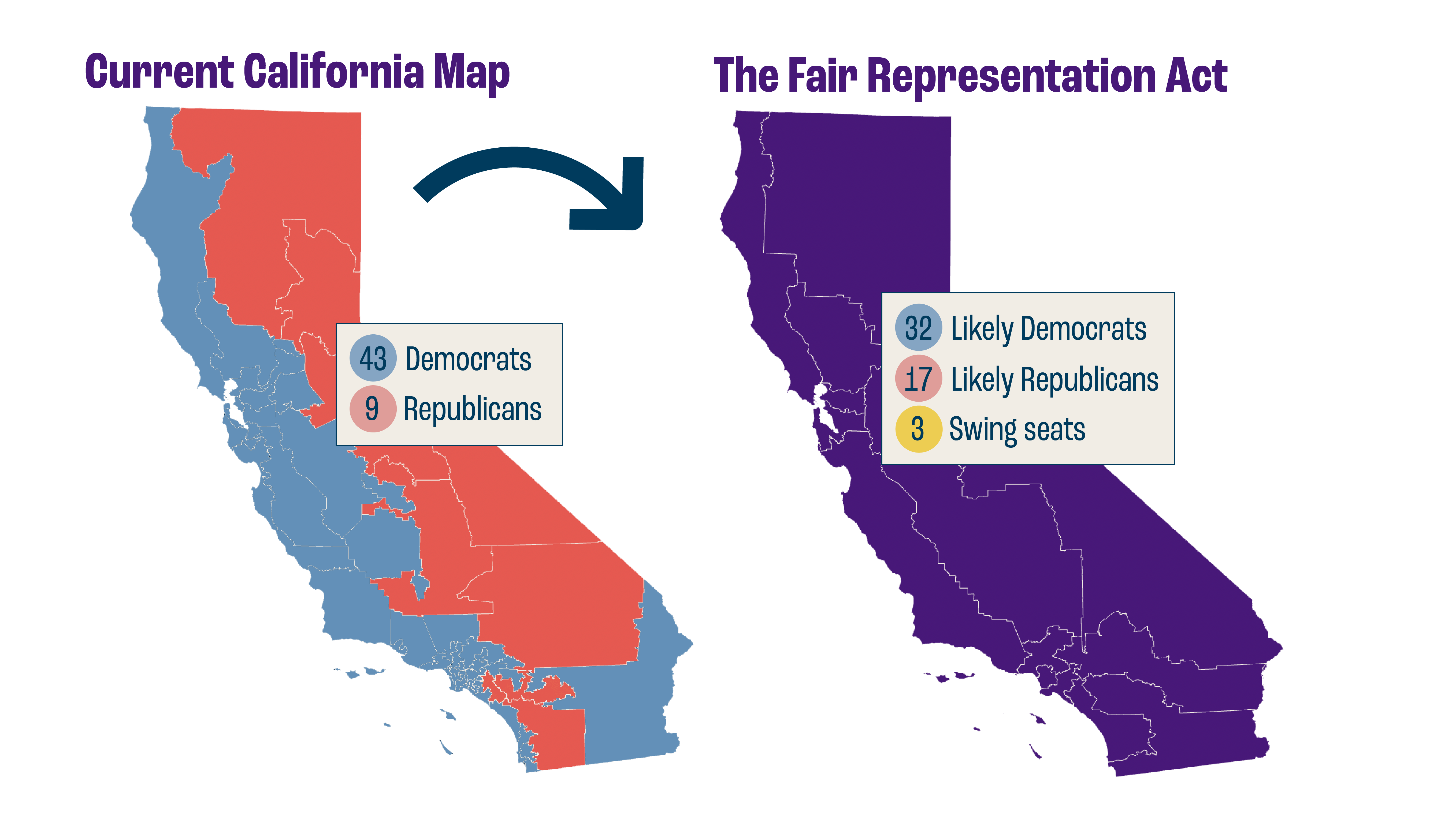
The FRA would end the gerrymandering wars and make every congressional district competitive in November – not just in the primary. With ranked choice voting, successful candidates will have to appeal to more voters and different bases of support, often asking for 2nd- and 3rd-choice support.
Multi-member districts would elect members of both major parties, incentivizing collaboration across party lines. By making more voters count in the general election, the Fair Representation Act would reward elected officials for their ability to tackle big issues.
FairVote has developed sample congressional maps for each state should the FRA be implemented, showing the likely partisan outcomes of elections under this better system. We project a roughly equal share of seats for Republicans and Democrats. In other words, the FRA would dramatically increase competition and choice without favoring either major party – the real winners are the voters.
Where can I learn more?
FairVote Senior Fellow David Daley has written extensively about the current gerrymandering wars, gerrymandering’s recent history both in legislatures and the court system, and the need for the Fair Representation Act. Here are a few of his recent appearances:
- CNN Political Briefing (8/22/25): Who Will Win the Gerrymandering War?
- MSNBC (8/21/25): ‘Redistricting Armageddon’: GOP and Dems battle over maps in Texas and California
- WBUR’s Here & Now (8/19/25): How the Supreme Court orchestrated the fight for mid-decade redistricting
- NY Times (8/14/25): Trump isn’t the only one to blame for the gerrymander mess
- NPR’s 1A (8/11/25): The fight over redistricting in Texas
- CNN (8/6/25): More states threaten to redistrict amid gerrymandering fight
- Washington Post (8/5/25): Texas ignited a gerrymandering war. We will all pay the price.
- MSNBC (8/4/25): David Daley Discusses the Gerrymandering Wars on MSNBC
- PBS (7/28/25): Will gerrymandering end Democrats’ hopes of taking back the House in 2026?
Reports
FairVote has also tracked the lack of competition in U.S. House elections for nearly 30 years. For example, we accurately projected 98% of 2024 House contests nearly two years before the election – even before we knew most of the candidates running:
- Why Congress is broken and how we can fix it
- Monopoly Politics 2026
- Dubious Democracy 2024
- U.S. House results can be projected with 98% accuracy – two years in advance
- Uncompetitive and unrepresented: Voters locked out of representation
Fair Representation Act
- The Fair Representation Act
- Proportional representation
- Sample Fair Representation Act maps
- Our Common Purpose: Reinventing American Democracy for the 21st Century – American Academy of Arts and Sciences
- Modeling the Fair Representation Act – MGGG Redistricting Lab
- Combatting gerrymandering with social choice: The design of multi-member districts – Cornell University
- An Open Letter to Congress: Why we Need the Fair Representation Act
- The Fair Representation Act gives communities of color more power – FairVote and More Equitable Democracy