An open letter to Congress: The Fair Representation Act is needed to end our broken winner-take-all elections
This is an open letter from academics across a variety of disciplines. Note that signatories have endorsed this statement as individuals and their endorsement does not necessarily represent the views of their institutions.
The problems become clearer every day. The U.S. House is not only unable to govern effectively, it can hardly run itself and choose its own leadership. Today, the chamber designed by the founders to represent “an exact portrait of the people” and“ think, feel, reason, and act like them” feels impossibly distant from John Adams’ vision. The House, and therefore our politics, remains stuck in the stubborn vice of extremism and obstructionism.
Voters understand this far too well. As our politics have become more disconnected from the will of the people, our elections have become uncompetitive. In 2022, only 36 of 435 U.S. House races were genuine tossups. More than 84% were decided by more than 10 percentage points. Over 60% were runaways decided by more than 20 percentage points. Low turnout, base-driven summer primaries increasingly determine who wins election to the U.S. House – and how those members are incentivized to behave in Washington.
Whether the culprit is gerrymandering, political geography, supercharged polarization, or some combination, one issue is at the root of the problem: Winner-take-all elections from single-member districts. We must fix this core issue if the House is to represent everyone equally.
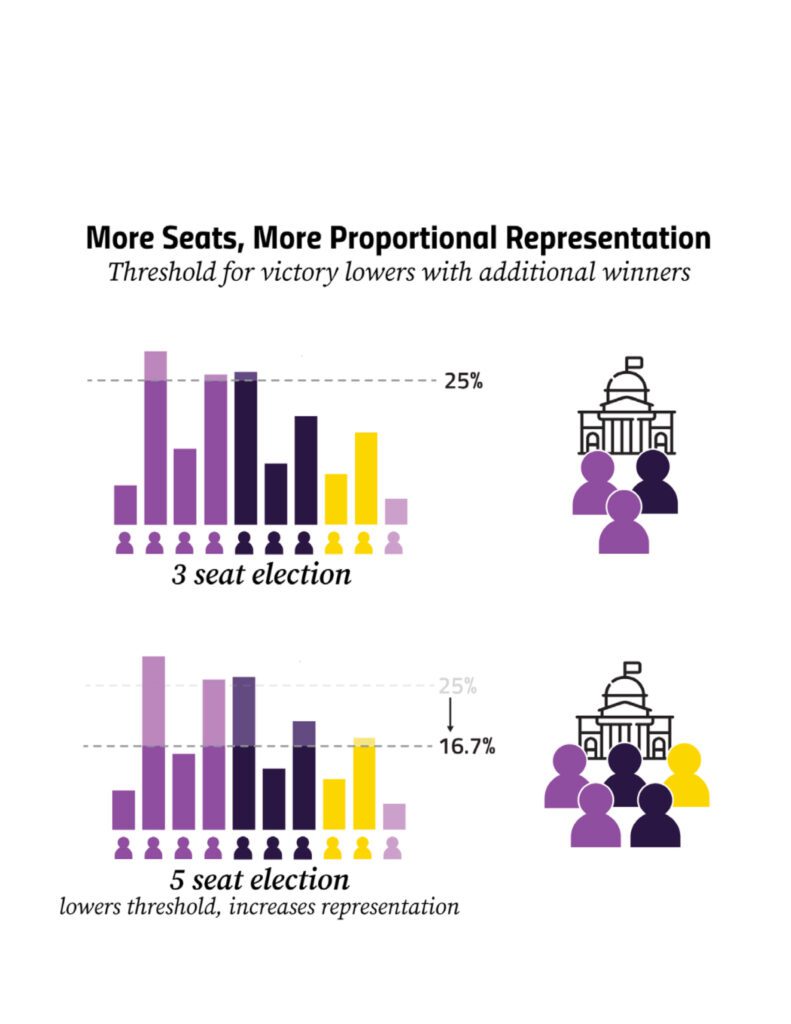
We are a group of researchers and practitioners across a wide range of disciplines, including political science, law, mathematics, and more, and we urge Congress to act. We call on Congress to pass the Fair Representation Act, which would adopt multi-member congressional districts with proportional representation.
The Fair Representation Act, introduced by Rep. Don Beyer of Virginia, is the practical solution to a system that has become fundamentally broken. It addresses three key problems that lead to dysfunction.
First, the FRA restores competitive elections. Multi-member districts would likely elect members of both major parties and create space for candidates outside of the two-party system. Every district would become a swing district, and every voter would cast a ballot that matters in a competitive race.
Second, the FRA creates more opportunities for Americans across the political spectrum to be represented in government, no matter their color, ideology, or zip code. This means greater inclusion for racial minorities, Trump voters in Manhattan or California, Democrats across the heartland, and independents and third-party voters everywhere. It maximizes the number of voters who can elect someone who represents their interests.
Third, the FRA would essentially eliminate gerrymandering. Each state with two or more Representatives would draw multi-member districts instead of single-member districts. Research has found that this system would lead to fair partisan and racial representation, regardless of how the lines are drawn. We could permanently end the gerrymandering wars that have so distorted the representativeness and responsiveness of our politics. And as the Supreme Court continues to weaken the historical protections of the Voting Rights Act, the FRA would provide a strong, needed defense against modern racial gerrymanders.
The nation needs action. Congress has the ability to pass a single statute and reimagine an inclusive politics that represents everyone, equally, and encourages members of Congress to build coalitions with popular support. We need not have a paralyzed, gridlocked Congress. We could have a House with the ability to take bold action on the nation’s most urgent priorities. We could have elections in which every vote matters and translates into seats. We could have a U.S. House in which every part of our political spectrum is fairly represented according to its numbers. We urge Congress to seize this moment and pass the Fair Representation Act.
Once again, we urge Congress to end our broken winner-take-all elections by passing the Fair Representation Act. This change only requires an act of Congress.
Sincerely,
Danielle Allen, James Bryant Conant University Professor, Harvard University and Chair, FairVote Board of Directors
Douglas J. Amy, Professor Emeritus of Politics, Mount Holyoke College
Duane Cooper, Associate Professor of Mathematics, Morehouse College
Caroline Fredrickson, Distinguished Visitor from Practice, Georgetown Law and Senior Fellow, Brennan Center for Justice
Charlotte Hill, PhD
Adrienne Jones, J.D., Ph.D., Assistant Professor, Political Science, Morehouse College
Alex Keena, Associate Professor of Political Science, Virginia Commonwealth University
Lawrence Lessig, Roy L. Furman Professor of Law and Leadership, Harvard Law School
Arend Lijphart, University of California, San Diego
Norman J. Ornstein, PhD, Senior Fellow Emeritus, American Enterprise Institute
Alan Parry, Utah Valley University
John A. Rapp, Professor Emeritus, Political Science, Beloit College;
Benjamin Reilly PhD, Visiting professor, United States Studies Centre, University of Sydney
Nicholas Stephanopoulos, Kirkland & Ellis Professor of Law, Harvard Law School
Rein Taagepera, Professor Emeritus of Political Science, University of California, Irvine
Karen Tokarz, Charles Nagel Professor of Public Interest Law & Policy, Washington University School of Law
Ismar Volić, Wellesley College and Institute for Mathematics and Democracy
Jay Wendland, Ph.D.
Sam Wang, Princeton University and Electoral Innovation Lab