Women Candidates Boost Other Women Candidates in RCV Elections
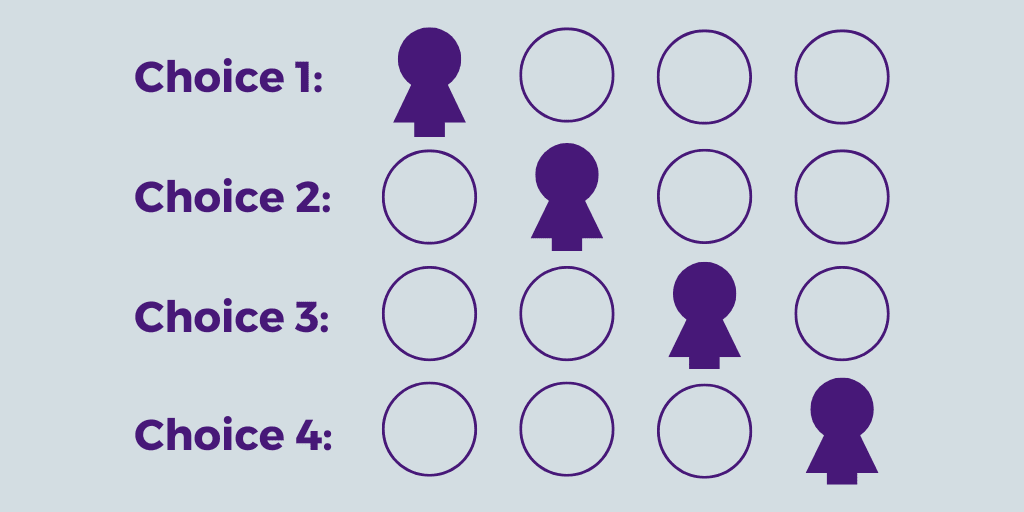
In 80% of single-winner RCV elections from 2004 to 2021, women left in the race after a competing woman candidate was eliminated benefited from the transfer of votes.
An analysis of vote transfer between candidates of the same gender in ranked choice voting (RCV) elections reveals that people who ranked a woman as their favorite candidate often selected women as their back-up choices, leading to those candidates benefitting from a ranked choice system.
In RCV elections, if a voter’s top choice is eliminated because they did not earn enough support, their ballot transfers to their second choice in an “instant runoff”, allowing their vote to stay in play. Ballot transfer prevents like-minded voters from splitting their support between multiple candidates. FairVote tested whether ballots for women candidates tend to transfer to other women candidates.
We analyzed more than 500 single-winner RCV elections since 2004 to determine whether support for women candidates was more likely to transfer to other women. Overall, women earned more than their expected amount of transfer votes in 80% of cases. If there are 3 men and 2 women in the race, then we would expect women to get ⅖ of total votes.

Out of the hundreds of RCV elections that occurred between 2004 and 2021, three elections from Minneapolis and New York City serve as important case studies.
Case Study: Minneapolis (2013)
In the 2013 Minneapolis City Council election for Ward 13, 5 candidates, 3 men and 2 women ran for a single open seat. Missy Durant, Linea Palmisano, Bob Reur, David Regan, and Matt Perry all campaigned to replace Betsy Hodges. Missy Durant was eliminated in the 4th round, leaving just two finalists left in the race. A majority of Durant’s ballots (54.6%) transferred to Linea Palmisano in the final round. This pushed Palmisano to win the election over Perry with 51.8% of final-round votes. In a close election, the vote-transfer from one woman candidate to another was enough to help Palmisano maintain her lead. Palmisano has since been re-elected to that city council seat two more times.

Case Study: New York City (2021)
Similarly, in the 2021 38th District Council Member election in New York City, Yu Lin, Rodrigo G. Camarena, Jacqui Painter, Cesar Zuniga, Victor Swinton, and Alexa Aviles also ran for an open seat. Jacqui Painter was eliminated in the 4th round, and 55.07% of ballots transferred to Alexa Aviles in the following final round. Again, another woman candidate stood on the winner’s podium in the final round over Camarena and Lin with 51.8% of final-round votes after a woman candidate was eliminated in the previous round.

Happening simultaneously, the race for the Bronx Borough President was underway with 5 candidates: Fernando Cabrera, Nathalia Fernandez, Luis R. Sepulveda, Sammy Ravelo, and Vanessa L. Gibson. After Nathalia Fernandez was eliminated in the 4th round, only Vanessa L. Gibson and Fernando Cabrera were left. 55.1% of the votes from Fernansez’s elimination transferred to Gibson, and Gibson pulled ahead of Cabrera by 53.5%.

Conclusion
The number of women running for election is at an all-time high across both major parties. In plurality-winner elections, though, candidates may worry about splitting the vote among women.
In each of these cases of ranked choice voting, though, voters ranked their choices for these single winner elections in a way that benefits more women running for office. When a woman candidate was eliminated, over half of the ballots for the final round choices transferred to the woman candidate remaining, and ultimately, helped the final woman candidate to win the election. Overall, women benefitted more than expected in 80% of RCV rounds where a woman was eliminated and at least one other woman remained in the race.
This could be particularly important within the Republican Party, where women are less represented in public office. As we see more Republican women run for office, ranked choice voting could be an excellent way to remove barriers that would otherwise keep them from winning.
The ability of RCV to help like-minded candidates build power for their communities, rather than dividing support, is one of its key reasons why it has proved to be so beneficial for U.S. elections so far, and why it should be expanded further. At least ten jurisdictions will vote this November on whether to adopt RCV. Currently, Dozens of cities, counties, and states use RCV, encompassing over 10 million voters.
If you care about electing more qualified women to office and the election reforms that help make that happen, visit RepresentWomen. Their report, In Ranked Choice Election, Women Win, illustrates how ranked choice voting continues to have a positive impact on women’s representation in government over the past decade.