Which Maine elections will use ranked choice voting this November?

On November 3, Maine will use ranked choice voting (RCV) in its U.S. Senate election and both U.S. House elections. Each of these races will have only one Democrat and one Republican on the ballot. However, voters can also write in a candidate of their choice, and each race will use a ranked choice ballot – where voters can rank their choices among the Democrat, Republican, and write-in. Maine has used ranked choice voting since 2018; 82% say that ranking candidates is easy and 57% say they like the ability to rank candidates.
There is one declared write-in candidate running in Maine’s tossup 2nd Congressional District, and several running for U.S. Senate. See a sample ballot for the U.S. Senate race below:
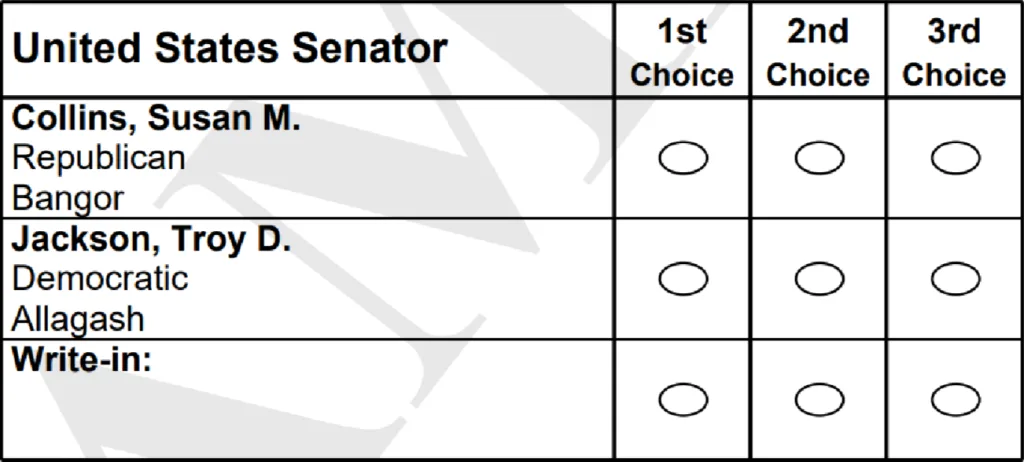
If a candidate wins a majority of first choices, they will be declared the winner without any RCV tally. However, Maine’s U.S. Senate and 2nd District races are expected to be close contests – where even a small share of voters ranking a write-in first, and/or leaving their first choice blank, could keep both major-party candidates below 50%. In that case, these races could go to an RCV tally.
If any race goes to an RCV tally, voters who ranked a write-in first are more likely to make a difference in the outcome. Our past analysis found that only 6% of voters with a blank first choice ranked any candidates, so these ballots are unlikely to be decisive.
When should we expect results in Maine’s ranked choice voting elections?
Results in Maine’s ranked choice voting races should come any time from election night to the following week. The biggest factor, as in any election, is how close the race is. If a candidate wins a majority of first choices, or leads by a wide margin, the winner will likely be clear on election night – or within a day or two. If not, it might take about ten days to learn the outcome. Maine physically transports, processes, and verifies all ballots and ballot data before running its RCV tally. The RCV tally itself takes just minutes at the end of the process.
Even if an RCV tally is needed, news outlets might call the race if a candidate has a large enough lead, and backup choices are unlikely to make a difference – as happened in 2024.
If a race goes to an RCV tally, Maine requires that the paper ballots or memory devices from each town are physically transported to the state capital of Augusta and counted there. Staff process and then check the votes; these steps – several of which are usually done as part of election certification, well after preliminary results are released – take several days. The state chooses to wait until all votes have been processed and verified before running its first RCV tally, which itself takes just minutes.
79% of RCV jurisdictions across the country release preliminary RCV results on election night or the day after. Maine could speed up its process by releasing – and regularly updating – a preliminary cast vote record, or preliminary RCV tallies, in advance of the final tally. The cast vote record is a digital record of all ballots cast; the media and election analysts can use this data to run unofficial RCV tallies.
Either option would let voters, campaigns, and the media follow the count, and in many cases could allow the outcome to be projected days earlier.
How long has it taken in the past?
The last two U.S. Senate races in Maine were called within a day or two of the election. The winners – Angus King in 2024 and Susan Collins in 2020 – each won a majority of first choices. This year’s race for the 1st Congressional District, generally considered safely Democratic, will likely follow a similar timeline.
A potential parallel to this year’s Senate and 2nd District races is the 2024 race for the 2nd District, which featured a Democrat, a Republican, and a declared write-in candidate. The day after the election, the Bangor Daily News and Decision Desk HQ called the race for Democrat Jared Golden based on his first-choice lead, and Golden declared victory.
However, the following day, Maine’s secretary of state announced that neither candidate had won a majority of first choices, so there would be an RCV tally. At the time, FairVote affirmed the Bangor Daily News and Decision Desk HQ’s projections; Golden had a large enough lead that he would almost certainly win the RCV tally. 10 days after the election, the tally was conducted and Golden was officially declared the winner.
To learn more about RCV in the Pine Tree State, visit Democracy Maine.