Poll: Portland, OR voters prefer ranked choice voting over old system

Portland, OR voters say ranked choice voting (RCV) and proportional representation gave them more voice and more choice in their city government, according to a new poll from FM3 Research. First reported by Axios Portland, the poll was conducted following Portland’s first use of RCV in 2024, when voters used single-winner RCV to elect their mayor and the proportional form of RCV to elect their City Council.
63% of Portland voters preferred using ranked choice voting to vote for mayor than the old, single-choice system – more than a 2-to-1 margin. For City Council races, 59% preferred using RCV.
Comparing this system to the prior system for electing a mayor and City Council
Overall, do you think the new system of ranked choice voting in the mayor’s race was better or worse than the previous system, in which voters only chose one candidate for mayor? Overall, do you think the new system for electing City Council members was better or worse than the previous system?
| Opinion | Mayor | City Council |
|---|---|---|
| Much better | 40% | 36% |
| Somewhat better | 23% | 22% |
| Total better | 63% | 59% |
| Total worse | 28% | 31% |
| About the same/Don’t know | 9% | 10% |
Portland voters prefer ranked choice voting because it gives them more power
The poll also asked voters why they preferred RCV. 64% of voters said they could more clearly express their preferences because of RCV. 56% said it felt like their vote mattered more than in previous elections.
It’s no wonder Portlanders say their votes matter more: 86,349 voters who picked a low-performing candidate as their first choice for mayor were still able to weigh in between the two finalists because of ranked choice voting. And the vast majority of voters – an average of 84% – ranked at least one winning council member in their City Council district.
Additionally, under the new system, Portland elected a historically diverse and representative City Council. Half of the new council members are women, five of 12 are people of color, three rent their homes, and their ages range from 28 to 70. Proportional RCV replaced the old system of electing one council member at a time citywide, which had long marginalized voters in East Portland – an area which is poorer and more racially diverse than the rest of the city.
Portland voters were overwhelmingly pleased with the switch to multiple districts – 84% of voters said that “electing council members by district will better represent my part of the city.”
Perceptions and attitudes on the Portland election
Please indicate whether you agree or disagree with each of the following statements regarding how you made your decisions in Portland’s election for mayor and City Council.
| Statement | Total agree | Total disagree | Don’t know |
|---|---|---|---|
| Electing council members by district, rather than citywide, will better represent my part of the city | 84% | 9% | 7% |
| I felt like I could more clearly express my preferences because of ranked choice voting | 64% | 33% | 2% |
| My vote felt like it mattered more than in previous elections | 56% | 34% | 10% |
In short, Portland voters see that ranked choice voting and multi-member districts empowered them to elect a more representative city government.
Vast majority of Portland voters felt confident and satisfied with ranked choice voting
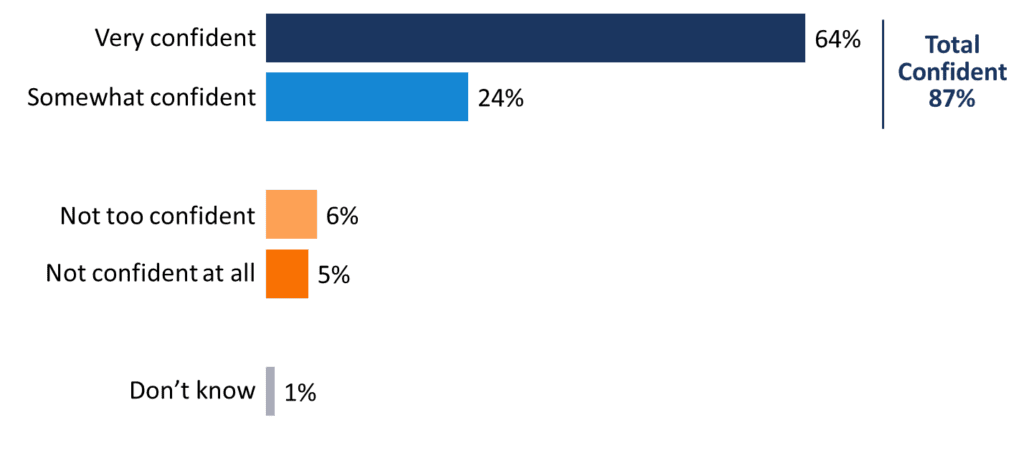
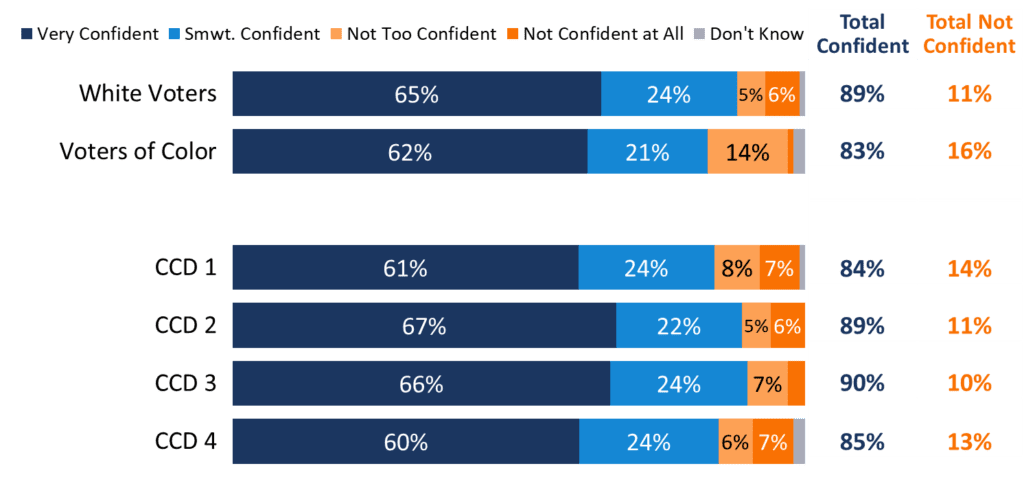
In a sign that Portland’s RCV rollout was a success, 87% of voters reported they were confident filling out their ballot. That confidence cut across race and council district lines.
The finding mirrors an earlier poll from the Portland city auditor, where 91% of voters said they understood how to fill out their ballots and 67% said they were satisfied with RCV.
Confidence in ranked choice voting
As you may know, this was the first election in Portland using ranked choice voting for key city offices. How confident did you feel about knowing how to fill out your ranked choice ballot this year?
Confidence by race/ethnicity and City Council district
More info for voters, fewer candidates in upcoming elections
There were over 100 candidates on Portland ballots this year. As we noted after the election, this large candidate field creates more work for voters; unsurprisingly, the FM3 poll finds that about 7 in 10 voters wished they had more information about the candidates running for office. Though RCV allows more candidates to run with no risk of playing “spoiler” or “wasting” votes, 30+ candidate fields may be challenging for voters.
Future Portland elections will likely have smaller candidate fields. The 2024 election was not just a switch to RCV; that switch was part of a larger reform package overhauling Portland’s entire city government. With no incumbents and many new open offices, there was bound to be an unusually large field of candidates.
Going forward, there should be fewer candidates for city races. Still, we’ve made two additional recommendations that would foster a candidate field that is wide yet fully manageable for voters:
- Implementing a small signature requirement for candidate entry
- Changing public financing and withdrawal deadlines so candidates can withdraw after they know whether they qualify for public financing.
With these changes, voters won’t have to research as much to decide who to rank on their ballots.
You can read more analysis of Portland’s first RCV elections here:
- The FM3 poll memo
- Study by the Data and Democracy Lab finding Portland’s elections performed “extremely strong… on measures of proportionality”
- FairVote analysis of the cast vote record
- FairVote analysis of how RCV impacted campaign dynamics and representation as well as voter engagement and turnout
- Exit poll conducted by the Portland City Auditor’s Office
- Cast vote record analysis from the Multnomah County Elections Division
- The Choice, a short film following candidates in Portland’s RCV election