How ranked choice voting is impacting the Washington, DC primary
June 16 will mark the historic first use of ranked choice voting (RCV) in the nation’s capital. RCV will help Washington, DC voters navigate several crowded primary elections and pick nominees with majority support.
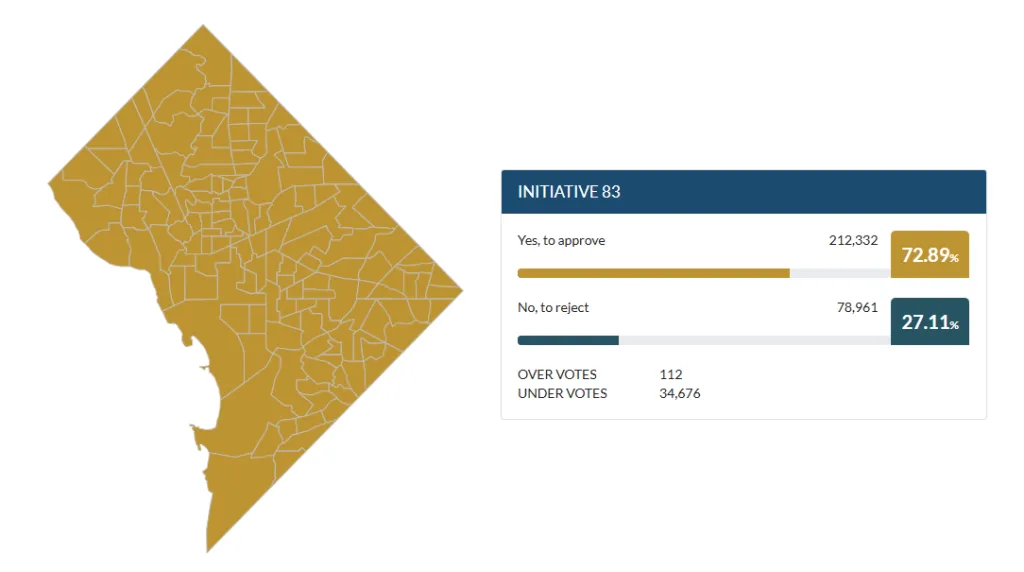
This change is coming to DC because voters overwhelmingly approved a ballot measure for ranked choice voting and semi-open primaries in 2024, with 73% in favor. The measure won with super-majority support in every ward, and majority support in every precinct.
Sign up for the latest news from the ranked choice voting movement, or get involved in your community.
Because DC is a heavily Democratic city, the winners of June’s Democratic primary are very likely to win in November. That means Democratic primaries tend to attract large fields of candidates.
In the past, crowded fields meant votes could be split between several candidates, and someone could win with well under 50%. For instance, recent DC elections have seen candidates win with as little as 23% and 30% of their constituents behind them. With RCV, voters will now be able to rank candidates in order of preference. If a voter’s first choice can’t win, their vote counts for their next choice.
When you rank, you send in someone who has support from the majority of voters. It’s really that simple.
– Lisa Rice, executive director of Grow Democracy DC
Below are updates on some of the most interesting primaries to watch this year, including the mayoral race and two District Council races.
DC mayoral primary
RCV may be especially consequential in the high-profile Democratic mayoral primary. With incumbent Mayor Muriel Bowser retiring, the seat is open for the first time in 12 years.
Seven candidates will appear on the ballot, but the two frontrunners appear to be Councilmember Janeese Lewis George and former at-large Councilmember Kenyan McDuffie. RCV will ensure that voters who pick a lower-performing candidate can still have their voice heard in the choice between frontrunners. Voters can vote their conscience and rank backup choices.
DC Council at-large primary
DC elects some of its District Council members from wards, and elects others at-large.
At-large Democratic Councilmember Anita Bonds is retiring this year, and nine candidates are running in the primary to replace her.
According to local news outlet WAMU, under the old system, “the most well-known candidates would have an advantage (in this race) simply because voters are familiar with their name,” but RCV “could allow other candidates with less traditional backgrounds to break through.”
Cross-endorsements and a “friendlier environment” in Ward 1
Eyes are also on the Ward 1 council race, where incumbent Democrat Brianne Nadeau is not seeking re-election. Five Democrats are vying for the seat, and a poll this month shows most voters are still undecided. It’s “exactly the kind of crowded situation” RCV is designed to handle, one that “incentivizes campaigns to leave no voter off the table, in hopes of earning a spot on their ballots as a second or third choice,” according to DC news outlet The 51st.
Just this week, the Ward 1 race made history with the city’s first cross-endorsement, with fellow candidates Rashida Brown and Miguel Trindade Deramo asking voters to rank each other first and second on their ballots. Cross-endorsements are a powerful example of how RCV makes campaigns more positive, as candidates strive to show common ground with their opponents and earn voters’ backup choices. As reported in City Cast DC:
The partnership is an early test of how ranked choice voting could reshape campaign strategy in the District. Instead of attacking competitors in the same ideological lane, Brown and Trindade Deramo are betting that their coalition will help them gain an edge…
The other Ward 1 candidates – Aparna Raj, Jackie Reyes Yanes, and Terry Lynch – have also discussed how RCV has “led to a friendlier election environment,” or publicly supported RCV’s implementation.
Other cities have seen the impact of cross-endorsements, too. In New York’s last mayoral primary, fellow candidates Zohran Mamdani and Brad Lander cross-endorsed and campaigned together. When Lander was eliminated in the RCV count, most of his ballots transferred to Mamdani, helping Mamdani earn a majority of the vote.
Voters and organizations embrace ranked choice voting
With June 16 approaching, the DC Board of Elections is conducting a robust voter education campaign – logging at least 130 educational sessions at places like high schools, neighborhood association meetings, and online.
Recording of a voter education event by the DC Board of Elections
At one senior center event, a resident said:
When I started to understand that it would give me more opportunities to elect someone that I prefer, even a candidate who may not have been my first choice, I thought that helped.
Advocacy groups, civic organizations, and candidates themselves have joined the effort to educate voters. Rank the District has hosted voter education events across the city, canvassed at major community events, and hosted trainings for candidates and League of Women Voters volunteers. And the owner of iconic DC restaurant Ben’s Chili Bowl recorded a short video sharing how voters can rank their ballots:
Jews United for Justice, DMV New Liberals, and Greater Greater Washington have issued ranked endorsements in some of these races, explicitly encouraging voters to rank more than one candidate on their ballots. This is a powerful signal to their followers of the importance of ranking, and also allows these groups to express their support for a wider range of candidates.
Washington, DC is one of several major U.S. cities that is giving voters more choices and better representation with RCV. FairVote will continue reporting news and analysis as DC’s first RCV primary unfolds – including more on voter education efforts. To learn more, visit Grow Democracy DC and Rank the District.