Hispanic and Latino voters want more choices in elections. Ranked choice voting can help.
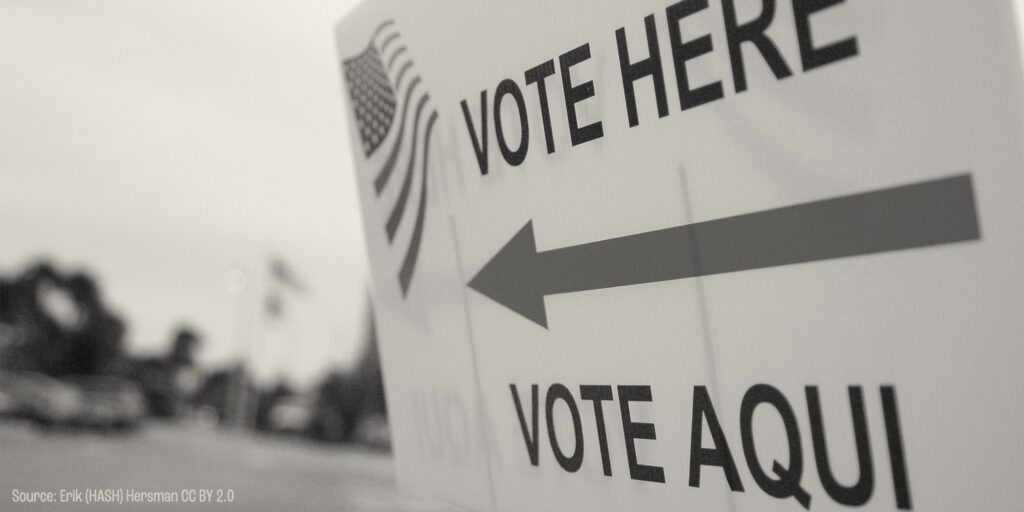
With the 2024 election just weeks away and amidst Hispanic Heritage Month, there’s a lot of discussion and prognostication about which candidate will win the “Hispanic vote” or “Latino vote.” Some pundits have even argued that “demographics are destiny” – suggesting that America will inevitably become more Democratic due to a growing Hispanic and Latino population. However, Hispanic and Latino voters have far more nuanced views than analysts often acknowledge. Ranked choice voting (RCV) could provide these voters with more choices and a greater opportunity for their diversity of views to be represented.
Hispanic and Latino voters have a diverse range of views that can’t be adequately expressed in binary choices. A Pew survey released this week found that just 43% of Latino voters are satisfied with the current presidential candidates; 49% feel very or somewhat uneasy about Kamala Harris, and 66% feel that way about Donald Trump.
This builds on previous evidence, including a 2021 Pew study that revealed that 10% of Latino voters who identified as Democratic or Republican shared political views that aligned with the opposing party, indicating that many Latino voters aren’t strictly on the “left” or “right.” A 2023 Unidos US survey asked Latino voters what issue they considered most important, and then asked which party would best address it. Across the top five issues, 10 to 20% of voters said neither major party would address it best.
Data from National Survey of Latino Voters by Unidos US
Despite voters’ hunger for more choices, the single-choice elections used in most of the U.S. discourage new voices from entering politics. Startup candidates are often warned that if they run, they’ll siphon votes from one of the major-party candidates (in a general election) or a stronger candidate (in a primary election), and “spoil” the race for a candidate who shares some of their ideological preferences.
Ultimately, voters deserve more choices in elections. Ranked choice voting is well-suited to provide just that. RCV lowers barriers for new candidates to run by ensuring they won’t be dismissed as “spoilers.” It allows voters to express their true preferences without fear of “splitting the vote” and helping the candidate they like least.
When paired with multi-member districts, RCV can deliver even more benefits – especially for political and racial minority groups. Voters can elect several representatives who reflect their range of perspectives, rather than one person to represent everyone. In a multi-member district, the vast majority of Hispanic and Latino voters would see someone they support elected to office – even though different members of the community may have different policy preferences.
In the 50 cities, counties, and states that already use RCV, Hispanic and Latino voters say they like RCV and take advantage of it. For instance, in New York City’s first use of RCV, 79% of Hispanic voters said they supported using RCV in local elections, and 64% said they ranked three or more mayoral candidates.
We’ve also seen historic numbers of Hispanic and Latino candidates run and win in RCV elections. For instance, in Bay Area cities that have implemented RCV, the share of elections won by Hispanic and Latino candidates has more than doubled since implementation. Notable winners include Jesse Arreguín, who was elected as the first Latino mayor of Berkeley in 2016; and Myrna Melgar, and first Latina to win a San Francisco Board of Supervisors seat without having first been appointed by the mayor.
Ranked choice voting is a powerful step toward giving Hispanic and Latino voters the choices and representation they deserve. We encourage more jurisdictions to adopt this better form of elections.