Plurality block voting
Plurality block voting is a winner-take-all system used to elect many local governing bodies across the United States, such as city councils, county commissions, and school boards. Members of these elected bodies represent their jurisdictions “at-large” instead of each representing a smaller geographic area within the jurisdiction – like a district or a ward.
Under plurality block voting, each voter can vote for as many candidates as there are seats up for election. If voters in the largest demographic or ideological group select the same candidates, that group can choose all the winners and effectively lock other groups out of representation. For example:
- In Lynchburg, VA, Republicans make up roughly 53% of voters but win 100% of the at-large city council seats.
- In Harrisonburg, VA, Democrats make up roughly 59% of voters but win 100% of the at-large council seats.
- In Georgia, Black residents make up almost a third of the state’s population, but the five-member, statewide Public Service Commission has only had one Black member in the body’s 145-year history.
Plurality block voting can also force voters to vote “strategically” instead of just picking their favorite candidates. Voters cannot express preferences between their top choices, so if a voter supports a second-choice candidate, that voter’s favorite candidate may be less likely to win. As a result, many voters choose to only vote for one candidate – a practice known as “bullet voting” or “single-shotting.”
Proportional ranked choice voting
Proportional ranked choice voting (RCV) is a multi-winner voting method that both ensures minority representation and eliminates strategic voting. It can improve representation for racial and issue-based groups alike.
With proportional RCV, voters can rank the candidates in order of preference. Candidates must reach a “threshold-to-elect” (i.e. a certain share of votes) based on the number of seats up for election. The more seats up for election, the lower the threshold.
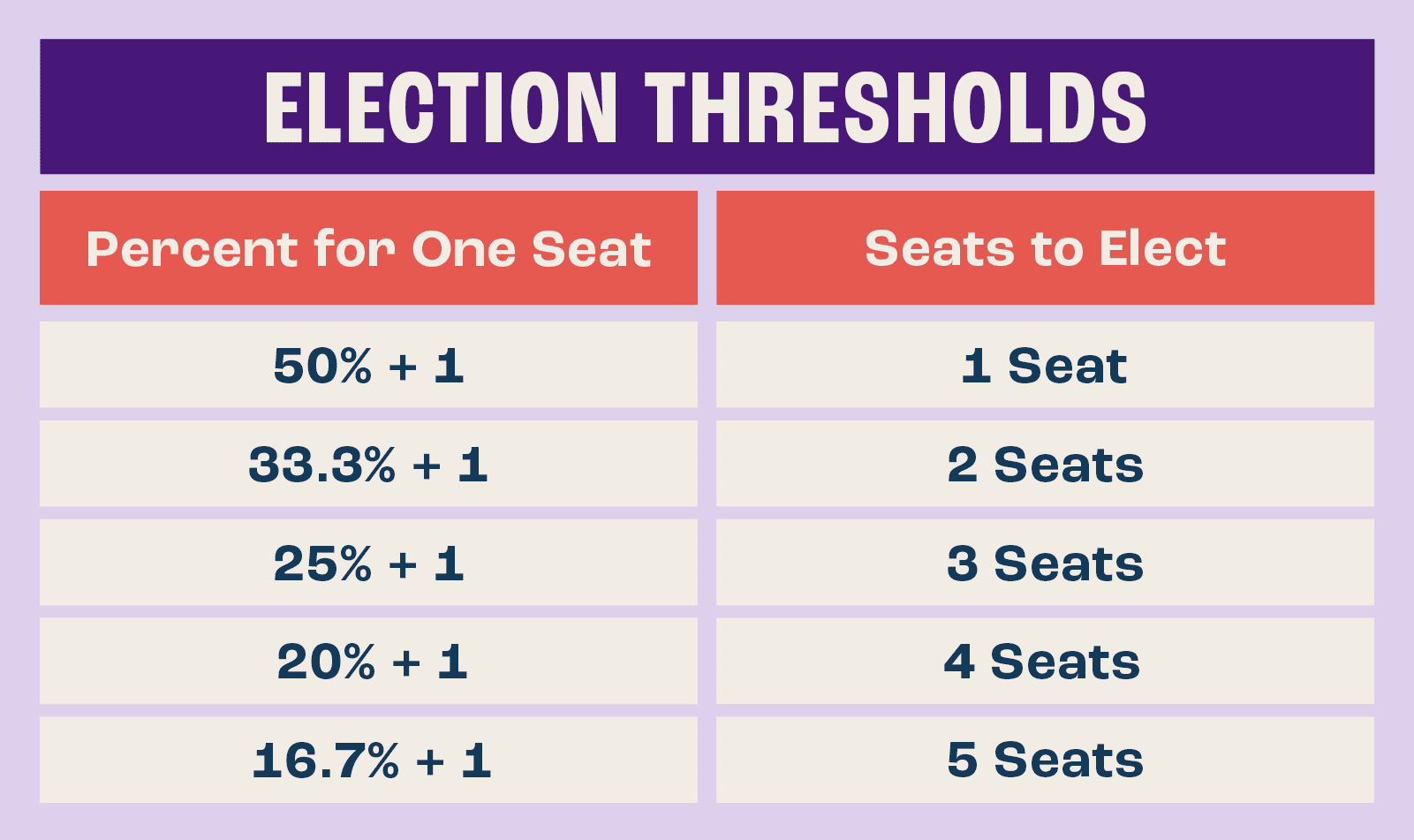
How the vote count works
Benefits of proportional RCV
Proportional RCV ensures both majority rule and minority voice. A majority voting block will still win a majority of seats, but large minority groups can also win their fair share of seats and be represented in an elected body – even if the group’s voters are geographically spread out across a city or state. Voters do not need to be concentrated in a district or ward to secure representation, which is why proportional RCV has been used as a remedy under the federal Voting Rights Act and is recognized as a remedy in several state voting rights acts.
Under proportional RCV, nearly every voter helps elect a candidate of their choice, even if that candidate is the voters’ second or third choice. In 2022, Albany, CA used proportional RCV to elect two winners from a field of four candidates, and 67% of voters saw their 1st-choice candidate elected to the council. 95% saw one of their top 3 choices elected.
Finally, because voters can rank candidates in order of preference, a voter can never hurt their favorite candidate by ranking backup choices – unlike in plurality block voting.
Proportional RCV is used across the world and, increasingly, across the United States. It is used to elect the Australian Senate, the Irish Parliament, and local governing bodies in cities such as Portland, OR; Cambridge, MA; Arlington, VA; and Minneapolis, MN. Charlottesville, VA will use proportional RCV for the first time in 2025.
Comparison table
| Proportional RCV | Plurality block at-large | |
|---|---|---|
| Philosophy | “Different groups should earn representation based on their share of the electorate.” | “The biggest group should have the power to win every seat.” |
| Threshold needed to win a seat | Depends on the number of seats to fill. | None. Candidates just need more votes than their closest opponent to win. |
| Avoids strategic voting? | Yes. If your top choice can’t win or gets more votes than they need to win, your vote counts for your next choice. | No. Ranking more than one candidate makes it harder for your favorite to win. |
| Ensures fair representation for minority groups? | Yes. Nearly every voter elects someone they support. | No. The largest group can win every seat and lock other groups out of representation. |
Proportional RCV vs. single-member districts
Historically, the most common remedy for the flaws of plurality block voting has been switching to single-member districts. If members of a minority group make up the majority of voters in a given district, the group can elect a candidate of its choice in that district.
Single-member districts aren’t always an effective remedy, however. If minority residents don’t live in compact neighborhoods, drawing majority-minority districts may be challenging – even if the minority group makes up a substantial portion of the population. For example, if Republican voters in a blue city don’t reside in the same neighborhoods, Republicans may not be a majority of voters in any of the single-member districts. Likewise, if Black residents are dispersed throughout a city, drawing a majority-Black district may not be feasible. In contrast, proportional RCV provides fair representation regardless of whether minority voters live in compact areas or are geographically dispersed.