What to expect from Super Tuesday: RCV, zombies, runoffs, and playing dirty

March 5 is Super Tuesday, the biggest day in this year’s primary calendar. And even in an election cycle when both major party’s presidential nominees are nearly effectively decided, there is a lot to watch for – including some locations that are making their elections even more “super” with innovations like ranked choice voting (RCV) that deliver better outcomes for voters.
Ranked choice voting in action in New England
Burlington, VT will use ranked choice voting in its mayoral contest for the first time since voters approved an RCV expansion in 2023. Four candidates are competing in the first open-seat mayoral race since 2012.
In Maine, voters will see RCV on their ballots for the presidential primary. In the Republican primary, voters will have the option to rank all five Republican candidates who qualified for the ballot. Although the Maine Republican Party has chosen to ignore their voters’ ranked preferences and award delegates based on first choices alone, Maine’s secretary of state will process the ranked ballots according to state law – giving voters greater choice, and giving election observers and campaigns additional insight into voter preferences.
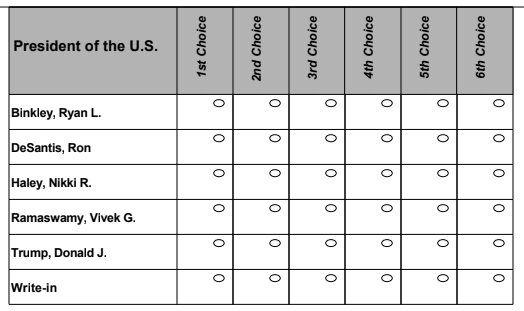
Sample ballot: Maine Republican presidential primary, 2024
The Democratic primary is less competitive, with just two candidates qualified for the ballot. Democratic primary voters will have the option to rank both candidates and a write-in if they choose.
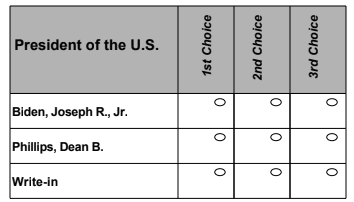
Sample ballot: Maine Democratic presidential primary, 2024
Beware of “zombie votes” in presidential primaries
Voters in 17 states and territories will vote in presidential primaries or caucuses on Super Tuesday, and at least some of those voters will cast “zombie votes.” In fact, some voters probably already have!
Zombie votes occur when a voter casts a ballot for a candidate who has already dropped out – but whose name is still on the ballot in their state. In presidential primaries – where states finalize their ballots early, the candidate field changes frequently, and some states allow early or mail voting – this is a big problem!
Three million Democratic primary voters cast zombie votes in 2020, and 700,000 Republicans did so in 2016. Over 5,500 New Hampshire Republicans cast a ballot in January for a candidate like Ron DeSantis or Chris Christie who’d recently dropped out. These names – and some of the other Republican contenders who’ve left the race – may be on the ballot in Super Tuesday states. Any votes for those candidates won’t make a difference in the meaningful contest between Donald Trump and Nikki Haley.
States and territories that use RCV for presidential primaries – like the U.S. Virgin Islands in 2024 and five state Democratic parties in 2020 – eliminate zombie votes. If a voter’s first choice drops out, their vote simply counts for their next choice!
Delayed runoffs will make election season run on
In addition to presidential primaries, five states will hold congressional primaries on Super Tuesday. Four of those (AL, AR, NC, and TX) will hold delayed runoff elections for races where no candidate clears a certain threshold, usually a simple majority. These primary runoffs will occur in April or May, with Texas’s May 28 runoff a remarkable 12 weeks after the first round. Our research on past primary runoffs indicates that turnout is likely to decline by 40%; in a majority of these runoffs, the winning candidate actually wins the runoff with fewer votes than they received in the first round, basically defeating their entire purpose of finding a winner with broad support.
Ranked choice voting selects majority nominees just like runoffs, but doesn’t require a second vote. If a voter’s top choice doesn’t make it to the final round, their ballot counts for whichever finalist candidate is ranked highest on their ballot. Military and overseas voters already use RCV in six states (AL, AR, GA, LA, MS, and SC), due to the difficulty of mailing a second set of ballots if a runoff occurs.
If these states extended that convenience to all voters, they could make their elections faster, cheaper, and better with RCV.
“Top-two voting” creates questionable incentives for California campaigns
California’s U.S. Senate primary is putting voters in a tough position. Candidates from all parties will compete against each other for the two spots in the general election.
In deep-blue California, a Democrat is expected to prevail in November. If the general election includes one Democrat and one Republican, the Democrat’s path is relatively easy. On the other hand, if two Democrats advance to the general election, either could win.
Democrat Adam Schiff did the math, and apparently concluded that his path to the Senate is simplest if his general election opponent is Republican Steve Garvey instead of another Democrat. Schiff has used television ads and campaign mailers in an attempt to boost turnout for Garvey. Fellow Democrat Katie Porter has followed suit, boosting a different Republican to take votes away from Garvey.
This 3-D chess match is a disservice to California voters – Schiff essentially hopes that voters will feel stuck with him as the “lesser of two evils” in order to defeat Garvey, and both Schiff and Porter are disingenuously supporting Republicans rather than trying to build their own base of support.
It begs a comparison to Alaska’s election system, where the top four candidates advance from the nonpartisan primary to a ranked choice voting general election – instead of just two. Voters get more choices on the November ballot, and it would render this sort of gamesmanship nearly moot – with Schiff, Garvey, Porter, and Democrat Barbara Lee all likely to advance and face the wider and more representative electorate.
In that RCV contest, candidates would seek to connect with more voters – including winning 2nd and 3rd-choice support from voters ranking an opponent Number 1. Voters, meanwhile, would be free to vote their conscience. If their favorite candidate couldn’t win, their vote could count for a backup choice.
Beyond Super Tuesday: RCV’s biggest year yet
Ranked choice voting isn’t just being used on Super Tuesday this year. We’re also watching one of the most significant years yet for RCV – from Alaska’s first use of RCV in its presidential general election to a historic implementation of proportional RCV in Portland, Oregon. Better still, at least two states will vote on adopting RCV statewide, and more could join them.
With so many exciting opportunities on the horizon, there’s never been a better time to get involved with the RCV movement! To get started, find an RCV group in your state, or check out this list of the most urgent actions taking place across the country.