Spotlight: Proportional RCV in Cambridge, Massachusetts

Image credit: JasonParis under Creative Commons license Attribution 2.0 Generic
Cambridge, Massachusetts uses proportional ranked choice voting (proportional RCV) to elect its city council and school committee, with a notable impact on politics and elections. Cambridge regularly elects candidates from historically underrepresented communities to positions on its city council, with more African Americans, women, and other underrepresented groups having the power to elect candidates of choice. 95% of voters typically see their first, second, or third choice elected to office.
History of proportional RCV in Cambridge
Cambridge has used the at-large form of ranked choice voting, an American form of proportional representation, to elect its City Council and School Committee since 1941.
Cambridge adopted ranked choice voting at a time when more than two-dozen cities across the United States, including New York, Cincinnati, and Cleveland, used proportional RCV to elect city councils and other positions in local government. Many of the cities that adopted RCV in that era abandoned it due to changes in voting technology and the increased ability of racial minorities to get elected under RCV, but the system remains in Cambridge.
Proportional RCV allows groups of like-minded voters to elect representatives in proportion to their share of the population, and has ensured fair representation of the city’s political and ethnic minority groups for over 70 years. In February 2014, FairVote published a report on the effects this system had on the city’s elections in 2013, and an op-ed in the Cambridge Chronicle discussing the use of this form of fair representation voting in the city.
Impact of proportional RCV in Cambridge
Voter satisfaction
Research has shown that voters like and understand RCV.
In the last 20 years, a median of 95% of Cambridge voters elect one of their top three choices to the city council. For more data on proportional RCV in Cambridge, see FairVote’s RCV Elections Database.
Voter turnout
Globally, countries using proportional representation typically see higher turnout, even when controlling for factors such as GDP, level of democracy, and level of competition (see studies here, here , and here ). Most estimates put this turnout boost in national elections at 5 to 7 percentage points.
In this study, George Pillsbury argues that turnout is higher in Cambridge because of voters’ increased degree of choice and improved ability to elect candidates of choice.
“Neighborhood representation” can arise naturally
Proportional RCV allows coalitions to shift, while still providing fair representation on the city council and school committee.
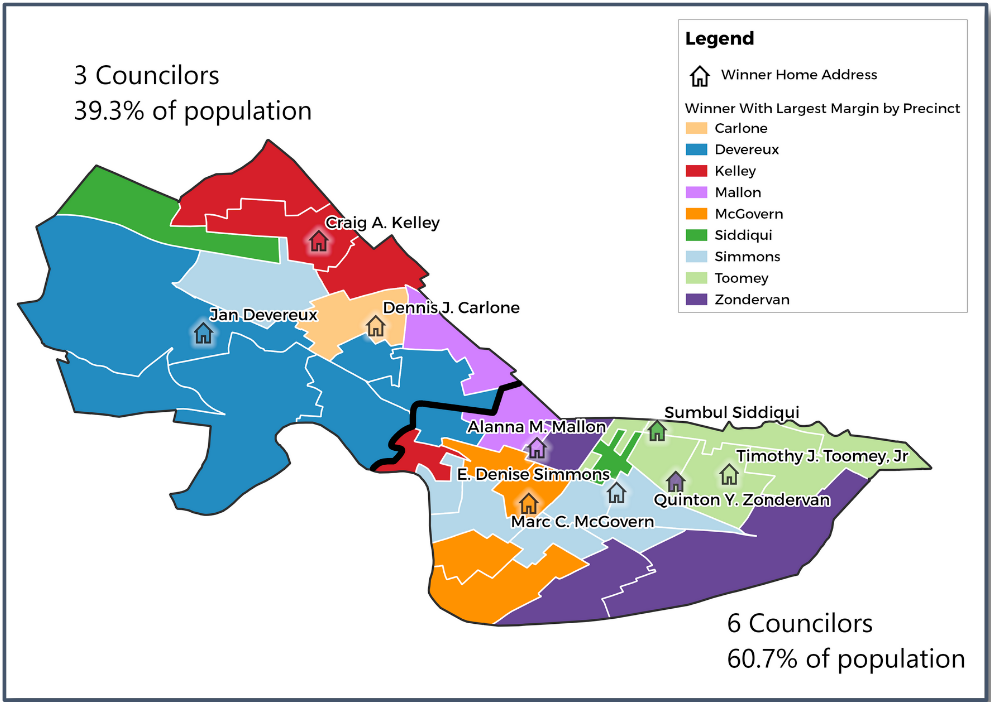
In the example below, the 9 members elected to Cambridge’s city council in 2017 each earned support from different precincts, with many of the winners demonstrating a clear “neighborhood” of support, while others had more crossover support in different portions of the city. Proportional RCV allows voters to form coalitions across a variety of issues or geographies, and ensure representation regardless of which issues bring together that bloc of voters. (All 9 councilors are chosen at-large, and the black line simply shows that the northern half of the city is less densley populated than the southern half).
Election thresholds help minority factions achieve fair representation
- Cambridge has a 9-member City Council, so the the threshold for election is 10% of the vote. Any candidate that can earn 10% support earns a seat.
- Cambridge has a 6-member School Committee so the threshold for election is 14% of the vote.
Voting rights
Representation for communities of color
The use of proportional RCV in Cambridge has enabled racial minority communities to succeed in local elections by lowering the threshold for election.
Since 1980, when Cambridge’s Black population crossed 10% of the town’s total voting age population, Black members have always had representation on both bodies, sometimes even with two representatives on a body.
Women’s representation
RCV has allowed women to achieve greater representation than in other methods of election. Since 1997, women have typically made up between one-third and two-thirds of both the city council and school committee.
For example, the 2021 Cambridge city council has a greater percentage of female councilors than similar nearby cities.
| City | Percent of women on City Council |
|---|---|
| Cambridge, MA | 44% |
| Somerville, MA | 42% |
| Medford, MA | 29% |
Racially cohesive voting in Cambridge
Voters in Cambridge tend to vote along racial lines (a common element of voting in the U.S.). Despite the existence of political “slate” endorsements, Black candidates on different slates will often receive support from Black voters. For example, in 2001, Denise Simmons and Ken Reeves’ 1st choice voters most often put the other candidate as their 2nd choice.
Precincts with high Black populations also gave the most support to African-American candidates. In 2001, Ward 2/Precinct 1 overwhelmingly gave its 1st choice votes to the African-American candidates for City Council and School Committee. This pattern appeared throughout the city.
This cohesive voting allowed Simmons and Reeves to both be elected in 2001, as Ethridge King, a third Black candidate, transferred enough votes to the other two when he was eliminated.
Ranked choice voting allows groups to elect candidates of choice in proportion to their share of the population without the need for race-conscious district drawing. In cities with single-winner city council districts, map-makers often create “majority minority” districts in order to ensure representation for communities of color. Proportional RCV achieves the same goals without the need for race-conscious districting.
Legal footing of proportional RCV
RCV has survived numerous legal challenges, including from the Supreme Court of Massachusetts which deemed proportional RCV to be constitutional in 1996. Learn more about legal challenges to RCV in our FAQ.
Further reading
For more on minority representation in Cambridge elections, read this series of blog posts: