Please note that this content was published several years ago and some of the information may not be updated. For up-to-date information on redistricting and gerrymandering, visit this page.
Congressional districts must be redrawn every 10 years (following a census) but the process is contentious, expensive and time-consuming. Even worse: It doesn’t work.
At FairVote, we think outside the box. We promote legislative reform that prevents gerrymandering and improves equal voting power and fair representation in multi-member districts. FairVote is working to end single-winner congressional districts. To end redistricting battles for good, we must reimagine how we elect our representatives.
Why redistricting isn’t working
Redistricting was intended to ensure legislatures keep pace with changing population trends. Instead, partisan lawmakers have used it to further political goals by drawing boundaries to protect incumbents, harm opponents and reduce competition.
When one party controls a state legislature or the U.S. House, lawmakers often use advanced computer software to manipulate district lines. The software is so precise that lawmakers choose their voters — instead of voters choosing them.
Redistricting reform
Congress must step in and reform the way we draw districts. The courts will not. In 2019, the U.S. Supreme Court held that partisan redistricting is beyond judicial purview. Writing for a 5-4 majority, Chief Justice John Roberts argued that “the framers gave Congress the power to do something about partisan gerrymandering,” abdicating any responsibility for the judiciary.
Various redistricting reforms attempt to address the legislative tendency to undermine electoral accountability through districting.
Independent redistricting commissions are a common solution. They put district-drawing power into the hands of private citizens rather than state legislators, easing incentives to draw lines that favor a certain political party. Independent commissions are typically required to draw districts based on a set of criteria, often including contiguity, compactness, and consistency with existing political boundaries (like towns and counties). There are ten states where independent redistricting commissions have primary authority to draw districts.
While independent commissions address the conflict of interest inherent in politicians picking their own voters, they can’t guarantee competitive elections, partisan and racial fairness, geographic coherence and accountable leadership — and sometimes fall short. In some cases, state legislatures overturn maps produced by independent redistricting commissions, leaving voters right back where they started.
In other words, we need to reform voting to reform redistricting.
Further reading

Voters Had Their Say. Partisans Ignored Them.
FairVote Senior Fellow Dave Daley argues in the New York Times that independent redistricting commissions are only the first step toward fair representation.
Multi-winner congressional districts
Our single-winner congressional districts are the root of the problem. In a winner-take-all district, 51% of voters can earn 100% of representation. This creates strong incentives to draw unfair districts so the party in power has a majority in as many districts as possible. As long as our districts are winner-take-all and our politics are polarized, we will not escape from the redistricting cycle.
We can solve this problem by electing multiple legislators from each district using proportional RCV to ensure all voters are represented. Multimember districts drastically reduce the gains that partisans can achieve by gerrymandering.
States electing five representatives or fewer would only need a single district, eliminating the need for district-drawing altogether.
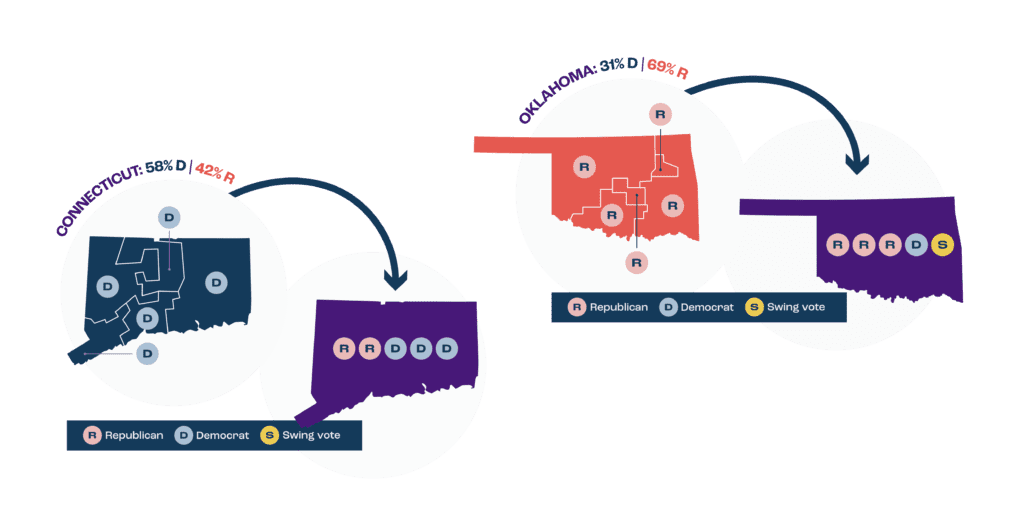
Other states would draw multiple districts that elect three to five representatives each, reducing the overall number of lines to be drawn.
Texas would have 8 multi-winner districts instead of 38 single-winner districts.
Research shows that multi-member districts with proportional RCV nearly eliminate gerrymandering.
Multi-member districts are the bold solution we need to end redistricting fights. Multi-member districts and proportional RCV will transform congress by making it less polarized and more functional — and better able to enact laws that reflect the will of the public. Learn more about proportional ranked choice voting here.