There are thousands of different ways to cast and count votes. We cast votes for candidates and political parties. We indicate our preferences by checking boxes, crossing out and writing in names, and ranking candidates in order of preference. We cast votes on paper, on punch cards, and on modern touch screens.
This page summarizes the most common electoral systems in the U.S. and around the world, and compares the features of different systems.
Electoral systems 101
Single-winner vs. multi-winner systems
Sometimes, electing only one person makes sense, like when electing a president or mayor. However, in legislative bodies, there is a choice between single-winner elections and multi-winner elections. That choice has profound consequences.
Multi-winner districts are associated with:
- Legislatures that more accurately reflect voters’ political preferences
- Greater gender parity in legislative office
- Districts with larger population
- Districts contested by multiple parties and candidates
- Governing by a coalition of parties rather than a single majority party
Common multi-winner systems include block voting, list proportional representation, multi-member proportional representation, and proportional ranked choice voting.
Single-winner districts are associated with:
- Smaller districts, with fewer constituents per elected representative
- Uncontested districts and two-party systems
- A lack of proportionality between votes cast across the country for a party and seats won by that party
- Governing by single-party majorities
- The election of fewer women to the legislature
Common single-winner systems include plurality voting, two-round runoffs, and ranked choice voting.
Proportional representation vs. winner-take-all
The two main families of electoral methods are known as proportional representation and winner-take-all. All single-winner elections are winner-take-all, but multi-winner elections can also be conducted with proportional representation.
Under proportional representation (PR), parties or factions gain seats in proportion to the number of voters who voted for them. For example, if a party wins 40% of votes, they would win 40% of seats in a proportional system.
The most common PR voting methods around the world are proportional ranked choice voting (RCV), party list PR, and mixed-member PR. Learn more about those methods here.
Winner-take-all methods allow a single majority group to control all seats. Consequently some voters are represented and others are not. In a five-winner district, for example, a single party can win all five seats, even if only a slim majority of voters support that party or candidate. This sort of outcome was common in early congressional elections, when many states elected their state legislatures using winner-take-all voting methods in multi-member districts. Winner-take-all election methods are often targeted under the Voting Rights Act because they can dilute the power of minority communities to elect candidates of their choice. Learn more about proportional RCV and voting rights here.
FairVote supports proportional representation for multi-seat bodies (like city councils, state legislatures, and U.S. Congress). Proportional representation gives more of a voice to all voters. It upholds the principle of “majority rule” and also ensures minority factions have a seat at the table too.
Election systems around the world
When it comes to election systems worldwide, our nation’s winner-take-all plurality method is relatively rare.
Internationally, proportional representation systems are the most common: Roughly half (90 of 195) of countries use it. An additional 34 countries mix proportional representation and winner-take all. Sixty-four use winner-take-all; of those 37, including the United States, the United Kingdom, and Canada, use plurality.
RepresentWomen, a nonprofit organization that tracks electoral systems through the lens of gender parity in political office, maps the world’s electoral systems in this graphic.
Additional Resources
- ACE Electoral Knowledge Network, Comparative Data
- International Institute for Democracy and Electoral Assistance), Electoral System Database
U.S. electoral systems
Historically, Americans have been innovators in the design of electoral systems. In its day, the Electoral College was considered innovative. Several vote counting methods, including Cumulative Voting, Bucklin Voting, Coombs’ Method, and Instant Runoff Voting (also known as ranked choice voting) originated in the United States. Today, the United States is less innovative at the national level, but there is still diversity in the systems used in state and local elections.
This map, which we created with our partners at the Sightline Institute, shows various systems across the United States.
Electoral reform is possible
Electoral systems and structures profoundly impact democratic governance. Reformers in the United States and around the world are striving to improve the way their governments are elected to ensure the public has the ability to shape the laws that govern their lives.
Most countries regularly reflect on how well their systems are working and consider structural improvements — and implement change more often than casual observers may realize.
In recent decades, New Zealand, France, Italy and Japan have adopted major electoral reforms. Scotland, Wales and Northern Ireland departed — in an electoral sense — from their peers in the United Kingdom by adopting their own parliaments and electoral systems.
For more information, see Electoral System Reform in Advanced Democracies by Matthew Shugart and Justin Reeves.
Comparing single-winner voting methods
The three most common methods in the United States are plurality voting (called “first past the post” voting); two-round runoffs, and ranked choice voting (also called “preferential voting” or “instant runoff voting”). Other methods have not yet been widely tested or gained traction in the U.S.
This chart compares the most widely discussed single-winner voting methods. Of countless possible evaluation criteria, this chart focuses on those that most impact the voter experience and deliver outcomes that reflect the will of the voters. No criteria, however, is more important than voters accepting the system on its terms and using it.
Find more details here on how we evaluated each method.
RCV vs. two-round runoffs
What are two-round runoffs?
Two-round runoff voting uses two elections. The first election narrows the field to two candidates, and the second election selects the winner from among the finalists. Like RCV, runoffs seek to uphold the principle of majority rule. But there are downsides.
Advantages of RCV compared to two-round runoffs
RCV saves taxpayer money.
RCV allows cities and states to condense two elections into one, saving taxpayer money. New York saved $20 million per election cycle by switching from two-round runoffs to RCV, according to the Independent Budget Office. Runoffs in Texas and Louisiana also come with multimillion-dollar price tags.
To compete in second elections, candidates must go back to their donors to quickly refill their campaign coffers.
RCV prevents dropoff in voter turnout.
Because two-round runoffs require voters to return to the polls, turnout often declines in the second election (by nearly 40% in congressional primary runoffs). What’s more, runoff voters are generally less representative of the voting population as a whole.
RCV enables more voters to participate in the decisive final round. Under RCV, voters rank candidates in order of preference. Some may not rank all candidates. These ballots become inactive if all ranked candidates are eliminated during the count. But even when taking into account these inactive ballots, RCV outperforms two-round runoff elections in final round turnout and representation.
This chart shows that two-round runoff winners often earn even fewer votes in the runoff than they earned in the first round, reflecting the small number of voters who participate in runoff elections.
| RCV elections (2004-2024) | Federal primary runoffs (1994-2022) | Statewide runoffs (2020) | |
|---|---|---|---|
| Number of elections | 445 | 276 | 22 |
| Elections where the winner increased their votes in the final round | 445 (100%) | 131 (47%) | 11 (50%) |
| Elections where the winner’s vote share is greater than 50% of total votes cast | 305 (69%) | 35 (13%) | 6 (27%) |
| Winner’s average vote share as % of first-round vote | 54% | 36% | 37% |
Example election: two-round runoff
In 2020, seven candidates ran in an open-seat board of supervisors race in San Francisco’s 7th district. This table shows first-choice results.
| Candidate | % first choice support |
|---|---|
| Joel Engardio | 24% |
| Vilaska Nguyen | 21% |
| Myrna Melgar | 20% |
| Stephen Martin-Pinto | 13% |
| Emily Murase | 12% |
| Ben Matranga | 9% |
| Ken Piper | 2% |
Because these voters voted using ranked ballots, we can simulate hypothetical head-to-head matchups based on ranked ballot data.
This table is best read across rows. The first row shows that 52% of voters prefer Joel Engardio over Vilaska Nguyen; 47% of voters prefer Endardio over Myrna Melgar, and so on.
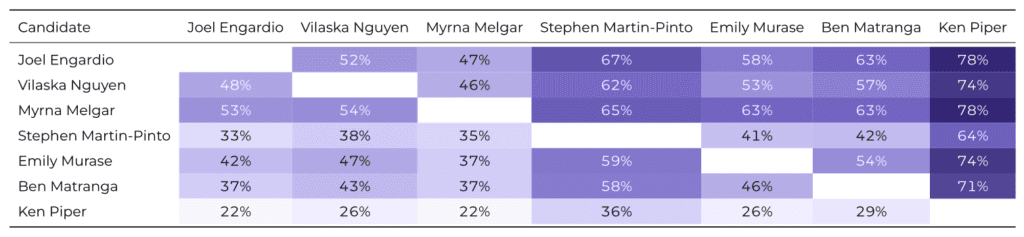
Myrna Melgar wins the head-to-head matchup against every other candidate, making her the consensus choice and the “Condorcet winner.”
Melgar would not have prevailed in a two-round runoff, however. In that system, Engardio and Nguyen would have advanced to the runoff election, and Engardio would have prevailed 52%-48%. In two-round runoffs, the consensus candidate will lose if they do not receive the most or second-most votes in the first round. Consensus candidates may also be undermined by vote-spitting in choose-one elections because their primary base of support may divide its support among similar candidates.
This table shows the results of the RCV election.
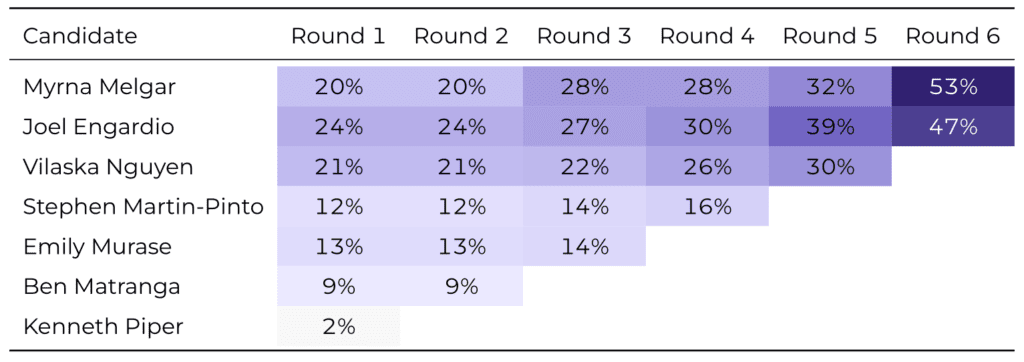
Melgar consolidates support as trailing candidates are eliminated and ultimately faces Engardio in the final round, where she defeats him 53%-47%.
RCV elected the consensus choice when a two-round runoff wouldn’t have.
RCV vs. STAR voting
What is STAR voting?
STAR voting (“Score Then Automatic Runoff”) combines score voting and two-round runoffs. In STAR voting, voters assign a score to each candidate (typically between 0 and 5) and the points are tabulated over two rounds. The two candidates with the most total points in the first round advance to a runoff. The finalist who is preferred by the higher number of voters wins the runoff.
STAR voting has not been used in any public elections for political office, but it has been used twice for political party elections in the United States. The Independent Party of Oregon used STAR in its 2020 primary election. Oregon’s Democratic Party used STAR in 2020 to select its delegates, though it used traditional, single-choice voting in the presidential primary.
Comparing RCV and STAR voting in practice
Ranked choice voting has a 100-year track record of delivering voter-preferred outcomes and improving representation. STAR Voting, by contrast, is untested in public government elections, yielding little evidence of how it would perform in real-world political elections.
FairVote collects data on all 500+ RCV elections held in this country since 2004. It is customary for most RCV jurisdictions to release a full cast vote record, allowing independent verification and analysis. In the interest of open data, FairVote has compiled those cast vote records for public viewing here.
Key findings from FairVote’s analysis of nearly two decades of RCV elections include:
- 73% of voters in RCV elections ranked the winner in their top 3 choices, representing strong mandates for the winners
- 68% of voters choose to rank multiple candidates in RCV elections
- Ballot error rate in RCV is comparable to that of choose-one elections
- Exit polling reveals that voters in RCV cities and states like using it, and prefer it to their prior voting method. See our Data on RCV page for more.
STAR voting has never been used in public elections so we have only limited evidence to gauge how it works in practice. Initial evidence from two party primaries in Oregon suggest that voters don’t use the system as it is intended — to express more nuanced preferences — and that fewer votes count in the final round under STAR than in RCV. Findings include:
- Most STAR voters don’t score multiple candidates. In the 2020 Oregon Independent Party primary, most voters expressed a preference about only one candidate. In the elections for president and secretary of state, 45% and 49% scored multiple candidates. In both cases, most voters treated it as a “choose-one” election. The secretary of state race stands out because 6 candidates ran (3 Democrats, 2 independents, and 1 Republican). In a crowded race including multiple candidates from the same party, voters should have had strong incentives to express multiple preferences, yet less than half engaged with the STAR ballot. For a more detailed analysis of this election, see the “example election” section below.
- Fewer votes count in the final round. In Oregon’s Independent Party primary, the rate of inactive ballots in the final round, also known as “no preference” votes, for president, secretary of state, and treasurer were 5%, 30%, and 16%, respectively. In RCV, in comparison, a median 5% of ballots don’t count in the decisive round. At best, from what little evidence we have, it appears STAR can perform on par with RCV in high-profile elections where voters have strong opinions, like presidential elections. But in other elections, STAR considers fewer voters’ preferences in the final round.
- Resources on STAR voting in practice: Oregon Independent Party presidential primary results, and Oregon Independent Party secretary of state primary results.
Advantages of RCV compared to STAR voting
RCV improves representation.
RCV has a demonstrated track record of improving representation for women and people of color. No evidence shows that STAR voting would have the same effect.
RCV is less susceptible to strategic voting.
In STAR voting, votes for a back-up choice can harm voters’ first-choice candidates. Expressing support for a second-choice candidate — say, by giving them four stars — can propel them into the runoff round, ahead of the voter’s first choice. This may incentivize voters to strategically treat STAR ballots like “choose-one” ballots. They might give stars only to their favorite candidate — and not to other candidates whom they find acceptable.
If many voters use this strategy, broadly acceptable candidates could lose out to fringe candidates who garner top marks from a dedicated base. Hypothetically, the existence of a final round could mitigate this incentive, but this strategy was common in the Oregon Independent Party’s STAR voting primary in 2020.
In RCV, by contrast, voters’ backup choices are only taken into account if their first choice is defeated, eliminating the incentive to strategically deny support for second-choice candidates.
STAR most likely increases the number of inactive ballots in the final round.
Both methods lead to some inactive ballots in the final round, but RCV appears to consider more ballots than STAR voting. In RCV, inactive ballots occur when voters don’t rank any finalists. In STAR, inactive ballots occur when voters don’t score either finalist or if they assign equal scores to both.
In RCV, 95% of ballots typically count in the decisive round. Early experiences with STAR voting suggest it may lead to many more inactive ballots in the final round. To learn more, see “STAR voting in practice” below.
STAR voting might not elect a majority-preferred candidate.
In STAR voting, backup preferences count at the same time as ratings for a voters’ first choice, and voters don’t all use ratings the same way. For these reasons, the preference(s) of the majority of voters may be overridden, with majority-preferred candidates not advancing to the final round.
Take an election with three Democratic candidates and two Republican ones in a heavily Democratic city. STAR voting could lead to a Republican victory because it does not necessarily prevent vote-splitting between similar constituencies. This example shows how STAR voting fails the Mutual Majority Criterion. Star voting also fails the related Majority Criterion.
Consider this 2016 election for state treasurer in Washington state, which uses top-two voting. In this contest, a clear majority of voters preferred Democrats, but three Democrats split the vote, causing only Republican candidates to advance to the final round.
| Candidate | Party | First round % | Final round % |
|---|---|---|---|
| Duane Davidson | R | 25% | 58% |
| Michael Waite | R | 23% | 42% |
| Marko Liias | D | 20% | |
| John Paul Comerford | D | 18% | |
| Alec Fisken | D | 13% |
This was not a STAR voting election and each voter was permitted to vote for only one candidate in the first round. However, the results are instructive when considering the impacts of STAR voting and help to explain the questionable Independent Party of Oregon primary results below.
If voters in a STAR voting election don’t assign scores to multiple candidates, the results could be similar to the choose-one results in the Washington election above, in which a clear majority for one party fails to advance any of their preferred candidates to the final round.
In RCV, voters may rank backup choices without fear that doing so will undermine their first-choice candidate. Therefore, a majority faction can consolidate around a frontrunner candidate from their party without splitting the vote.
Preferences are subjective in STAR voting.
Different voters may interpret “five stars” in different ways, giving them different amounts of power over the election outcome. Consider Amy and David, neither of whom is excited about any candidate on the ballot. Amy gives three stars to one candidate and 2 stars to the others to express her middling support.
David feels the same way as Amy, but gives four stars to one candidate and zero stars to the rest. In this case, David has more impact on the outcome than Amy because they express their preferences differently. Just as rating a film on a scale of one to five stars is highly subjective, rating candidates on the same metric yields inconsistent returns. When different voters interpret the rules differently, some voters have more impact than others.
With RCV, on the other hand, voters all interpret rankings in the same way.
STAR voting rewards strategic/savvy voters.
Savvy voters with robust understandings of STAR voting can ensure their vote is highly impactful, while other voters may miss out on this opportunity. Voters who are not excited about a candidate but want their vote to count more are incentivized to give their favorite candidate five stars and not rate any other candidates. Ironically, this system captures less nuanced preferences — the ostensible intention of STAR voting — and leads to fewer back-up choices on the ballot.
RCV, on the other hand, is less susceptible to strategic voting. Voters simply rank candidates in order of preference, knowing that a second-choice ranking will not harm their top choice, rather than worrying over exactly how much support to give to a second-favorite candidate.
RCV is on solid legal ground
Jurisdictions that adopt STAR voting are rolling the legal dice. Unlike RCV and other systems, STAR voting has never been evaluated through the legal lens.
As noted above, voters have very different electoral power based on how they interpret and use their scores. Some voters will cast more first-round points than others, giving some voters more of a say in the outcome.
RCV, in contrast, has been upheld against every federal constitutional challenge brought to date.
Example election: STAR voting
This is a deep dive into the Oregon Independent Party primary for secretary of state in 2020, which used STAR voting.
In the first round, Republican Kim Thatcher and independent Ken Smith earned the most points and advanced to the runoff round.
| Candidate | Party | Score (first round) |
|---|---|---|
| Kim Thatcher | R | 1478 |
| Ken Smith | I | 1240 |
| Jamie McLeod-Skinner | D | 1092 |
| Mark Hass | D | 937 |
| Shemia Fargan | D | 902 |
| Armand Vial | N/A | 801 |
The three Democrats split the vote and none of them made the runoff.
In the second round, Thatcher won with only 36% of the vote, followed by Smith with 34%. 30% of ballots were inactive because they either did not assign stars to either finalist, or assigned the same score to both.
| Candidate | Party | Final round % |
|---|---|---|
| Kim Thatcher | R | 36% |
| Ken Smith | I | 34% |
| Did not express a preference | 30% |
Of the 30% of voters who expressed no preference, some could have assigned each the same score and some may have chosen not to give a score to either finalist. Most of the voters whose ballots became inactive were those who preferred Democratic candidates.
According to STAR advocates, of the 30% inactive ballots:
- 21% would have preferred one or more of the Democratic candidates to either finalist.
- 6% would have preferred unaffiliated candidate Armand “Rich” Vial to either finalist.
- 1% preferred both finalists equally over all others.
In today’s highly polarized environment, it is highly unlikely that those Democratic-leaning voters genuinely had no preference between the Republican and Independent. Had they felt empowered to express sincere preferences — without fear that expressing support for the Independent would undermine Democratic candidates — the Independent would likely have easily overcome her two-point deficit in the final round and won the race, yielding a result that likely would better reflect voter preferences.
RCV vs. approval voting
Ranked choice voting (RCV) and approval voting are both election methods under consideration in the U.S. However, ranked choice voting has already been used for hundreds of elections and is well-tested in practice and in the courts. Approval voting is newer and has less evidence behind it. This page compares RCV and approval voting, including an examination of how they have worked in practice and research on both methods.
How approval voting works
Approval voting allows each voter to vote for as many candidates as they “approve” of. Voters may vote for as many candidates as they choose.
The candidate with the most “approvals” wins the election. Just like in traditional choose-one voting, there is no guarantee that the winner will have the support of at least half of the voters. Unlike “choose-one” voting, there is no guarantee that each voter will have the same number of votes.
Approval voting ballots look like typical choose-one ballots, but the approval voting races will include different voting instructions. The instructions will read something like, “vote for all the names you approve of.”
Explore more
For a more complete comparison, see the standalone page for RCV vs. approval voting.
RCV vs. score voting
What is score voting?
In score voting (also known as range voting), voters assign a score, typically between 0 and 5, to each candidate. The candidate with the highest sum (or sometimes the highest average) of scores wins.
Score voting has not been used in any U.S. jurisdiction in government elections. It is used in nongovernmental contests, such as certain sporting events in which judges assign scores to competitors.
Advantages of RCV compared to score voting
RCV improves representation.
No evidence finds that score voting improves representation among women and people of color.
RCV has a demonstrated track record of doing so.
Votes for a back-up choice can harm your first choice in score voting.
Expressing support for a second choice in score voting — say, by scoring a second-favorite candidate four out of five — can propel them ahead of the voter’s first choice candidate. This creates an incentive for voters to strategically use score ballots like “choose-one” ballots. When many voters adopt this strategy, broadly acceptable candidates can lose out to fringe candidates who garner top marks from a dedicated base.
In RCV, voters’ rankings for backup choices only count if their first choice is defeated. This eliminates the incentive to strategically deny support for second-choice candidates.
Score voting might not elect a majority-preferred candidate.
Take an election with three Democratic candidates and two Republican ones in a heavily Democratic city. Score voting could lead to a Republican victory because it does not necessarily prevent vote-splitting between similar constituencies.
For a real-world example of this issue in practice, consider the 2016 election for state treasurer in Washington state, which uses top-two voting. In this contest, a clear majority of voters preferred Democrats, but three Democrats split the vote, causing only Republican candidates to advance to the final round.
| Candidate | Party | First round % | Final round % |
|---|---|---|---|
| Duane Davidson | R | 25% | 58% |
| Michael Waite | R | 23% | 42% |
| Marko Liias | D | 20% | |
| John Paul Comerford | D | 18% | |
| Alec Fisken | D | 13% |
This was not a score voting election and each voter was permitted to vote for only one candidate in the first round. However, the results may be instructive when considering the impacts of score voting. If voters in score voting are unwilling to assign scores to multiple candidates, the results could be similar to the choose-one results above, in which a clear majority for one party fails to elect a candidate from that group.
In RCV, voters may rank backup choices without fear that it will harm their first choice candidate. Therefore, a majority faction can consolidate support around a front-runner candidate from that party rather than splitting the vote.
Subjectivity of preferences in score voting.
Different voters may interpret a score of 5 in different ways, giving them different amounts of power over the election outcome. Consider Amy and David, neither of whom is excited about any candidate on the ballot. Amy gives a score of 3 to one candidate and 2 to the others to express her middling support.
David feels the same way as Amy, but gives a 4 to one candidate and no points to any others. In this case, David has more impact on the outcome than Amy because they express their preferences differently. Just as rating a film on a scale of one to five stars is highly subjective, rating candidates on the same metric yields inconsistent returns.
With RCV, on the other hand, voters all interpret rankings in the same way.
Score voting rewards strategic voters instead of sincere preferences.
Savvy voters with robust understandings of score voting can ensure their vote is highly impactful, while other voters may miss out on this opportunity. Voters who are not excited about a candidate but want their vote to count more are incentivized to give their favorite candidate the highest score and not score any other candidates. Ironically, this system captures less nuanced preferences — the ostensible intention of score voting — and leads to fewer back-up choices on the ballot.
RCV, on the other hand, is less susceptible to strategic voting. Voters simply rank candidates in order of preference, knowing that a second-choice ranking will not harm their top choice, rather than worrying over exactly how much support to give to a second-favorite candidate.
Example election: score voting
In 2020, San Francisco’s board of supervisors used RCV to elect a member to its first district. The full round-by-round RCV results are as follows:

In this election, candidates Connie Chan and David Lee campaigned together in the final days of the campaign, asking voters to rank them as their first and second choices because they would both “fight for our Chinese American community.” Lee was eliminated in the final round, and just enough of his voters preferred Chan, delivering her a narrow victory.
This strategy worked because RCV allows voters to rank backup choices without fear that doing so will undermine their first choice.
Had this election used score voting, more Lee voters would likely have abstained from assigning scores to later choices, denying Chan the ability to consolidate support and win the race — and build political power for her community.
In score voting, scores assigned to second- or third-choice candidates can defeat a voter’s favorite candidate. As such, voters have a strong incentive not to assign scores to candidates who have any chance of defeating their favorite.
In effect, score voting suppresses voter preferences and representation in public office because it divides support among multiple choices. RCV, by contrast, helps communities build power and earn representation in public office.
RCV vs. Condorcet voting
What is Condorcet voting?
Condorcet voting methods (also known as “head-to-head” or “round robin” voting) use a ranked choice ballot that enables voters to rank candidates in order of preference just like with ranked choice voting (RCV), but have a different tabulation rule that downgrades the importance of a voter’s first choice.
RCV relies on a series of instant runoffs to determine a winner, with the last-place candidate removed from the count and ballots for that candidate going to the candidate ranked next on the ballot. Named after an 18th-century French mathematician, Condorcet methods instead use all ranking data at the same time in order to compare each pair of candidates. If there is one candidate that wins every theoretical head-to-head matchup, that person is the “Condorcet winner” – and Condorcet voting methods are designed to elect that person even if very few people rank that candidate first.
It’s possible for there to be no Condorcet winner due to a “Condorcet cycle.” Suppose, for example, that Juan beats Bill, Bill beats Sally, and Sally beats Juan. Theorists have proposed a variety of ideas for how a winner should be selected when there is such a cycle or a tie, including a simple instant runoff.
As a ranked choice ballot system, Condorcet Voting has attractive features. It also could be used with a separate runoff between the top two Condorcet candidates if a two-round system were acceptable. That said, FairVote prefers the traditional, instant-runoff form of RCV for elections to government offices.
Why RCV is preferred over Condorcet voting
Condorcet voting could elect a candidate that is no voter’s first choice.
Condorcet voting could produce an unexpected outcome: the election of a candidate that no voter (or very few voters) ranked as their first preference. Because Condorcet methods consider all rankings at the same time, the system could elevate candidates with a lot of second- or third-choice rankings over candidates with a strong base of first-choice support. In other words, even with honest voting, a Condorcet system could elect the candidate who would get the fewest votes in a single-choice, plurality election.
For voters who are used to a status quo in which your first choice is the only thing that matters, the election of a candidate who lacks substantial first-choice support could be unsettling. Moreover, an elected leader who fails to have the strong backing of any voting group could very well face challenges in governing.
In RCV elections, candidates must have both depth of support (to get enough first-choice support to remain in the race) and breadth of support (to earn a majority) in order to prevail. A candidate that fails to attract substantial first-choice support will always lose.
For a real-world example, consider the 2022 special election for U.S. House of Representatives in Alaska. The last place candidate in round 1, Nick Begich, was in fact the Condorcet winner. First choice preference are below:
| Candidate | Percent of first choices |
|---|---|
| Mary Peltola | 40.2% |
| Sarah Palin | 31.3% |
| Nick Begich | 28.5% |
This election used traditional (instant runoff) RCV, so Begich was eliminated first. A Condorcet voting method would have elected the last-place candidate, an unpalatable and counter-intuitive outcome for many voters.
RCV has proven easier to understand.
Condorcet voting methods have been proposed since the 18th century, but have had very limited uses to date. No governmental elections use Condorcet voting and only a few NGOs use it for their elections. In contrast, RCV has been widely adopted by governments, parties, and organizations for major elections for more than a century. This adoption by a wide mix of entities across the globe shows that RCV rules are viewed as intuitive and fair.
In the United States, American voters, candidates, and election authorities have increasing experience with RCV, including putting its implementation needs into federally tested software and in standards. Its tally logic – “the candidate in last place loses, and their votes are allocated to each voter’s next ranked choice” – simulates what is a common and familiar way to hold runoff elections, caucuses, and repeated rounds of voting at conventions.
RCV has been proven to elect the Condorcet winner in almost every instance.
Of the nearly 500 single-winner RCV elections in the United States since 2004 in which we have sufficient ballot data to identify the Condorcet winner (as of September 2022), the Condorcet winner won all but twice, for a Condorcet efficiency rate of 99.6%. In other words, RCV already reliably elects the Condorcet winner in the vast majority of cases, using a simpler and more intuitive system. And, in the rare situations where RCV does not elect the Condorcet candidate, that candidate – as noted above – will by definition be a candidate who lacks substantial first-choice support from any voting group.
In a 2025 analysis of roughly 4,000 real RCV elections in the U.S. and abroad, as well as millions of simulated elections using survey data from the Cooperative Election Study, researchers at the Institute for Mathematics and Democracy found that “in real elections, if a Condorcet candidate exists then IRV almost always chooses this candidate.” Their simulations show RCV has the potential to fail to select the Condorcet winner, but “still performs well” and that “due to candidate behavior, it is not clear how often this would occur in practice if more jurisdictions adopted (RCV).” The authors conclude that “regardless of context, (RCV) chooses ‘strong’ candidates by either selecting the Condorcet winner or choosing a candidate with a large base of core support.” (See: Empirical Analysis of Ranked Choice Voting Methods by David McCune, Andy Schultz, and Ismar Volić).
On the other hand, we do not know how Condorcet systems might work in practice, including – as discussed below – whether a formal Condorcet system is, on average, more or less likely to elect the Condorcet winner than an RCV system. Because we cannot guarantee that a formal Condorcet system will elect a genuine Condorcet winner more often than RCV, this is not a good reason to reject RCV in favor of Condorcet systems.
RCV is more ready for use.
Among considerations that are important, but not fundamental, Condorcet methods face administrative hurdles – ones that required years for RCV advocates to address. While Condorcet systems can be run on software, there is none ready for use in governmental elections. This will be all the more important because Condorcet systems may be seen by some as more of a “black box” – the inner workings of the counting and cycle-resolution processes are not as easily grasped as the RCV counting process, especially when a winner clearly loses head-to-head to another candidate or does very poorly in first choice support.
Condorcet advocates will also need to develop ways to present results in a format that is digestible to the public. Americans are used to results that capture the simple percentage of votes won by each candidate, as with RCV and plurality voting. Condorcet results would instead require presenting a series of simulated head-to-head matchups, the number of which would grow dramatically with the number of candidates. For example, five candidates would produce ten different simulated competitions. Seven candidates would produce twenty-one simulated competitions.
Condorcet voting is more susceptible to strategic voting and strategic campaigning.
Because Condorcet voting methods consider positive and negative rankings at the same time, voters can harm their favorite candidate by giving a high ranking to another candidate.
In elections where there is a clear Condorcet winner based on pre-election polling, there will be an incentive for other candidates to encourage their supporters to “bury” the Condorcet winner, or insincerely rank them last. This becomes an obvious strategy because it is the only chance for victory for every candidate except the likely Condorcet winner. When strategic manipulation is so readily apparent, the chances are higher that campaigns or voters will engage in it.
The possibilities for strategic exploitation are substantially greater in Condorcet voting than in RCV, where any attempt at strategic voting has a strong chance of backfiring. This is because under RCV, in any given round your vote only counts towards your highest-ranked candidate. Lower rankings are only counted when higher rankings have been eliminated.
This is supported by research from the Institute for Mathematics and Democracy. Their analysis found that RCV is “not susceptible” to strategic tactics such as bullet voting – ranking only a favorite candidate to avoid helping others – or burying – ranking a strong opponent lower to hurt their chances, while Condorcet voting is susceptible to both but especially burying.
Condorcet voting may fail to elect the Condorcet winner.
Under real-world conditions, Condorcet systems may also be subject to one particularly unexpected outcome: Condorcet failure. Condorcet failure occurs when the winner of each hypothetical head-to-head matchup ends up losing the election. Unfortunately, neither traditional ranked choice voting nor Condorcet systems can guarantee the election of a genuine Condorcet winner. But while it is clear from election data that traditional RCV almost always elects the Condorcet winner, it is unclear how often Condorcet systems would fail to do so.
It is possible for Condorcet methods to malfunction in this way because real-world outcomes depend heavily upon real-world political dynamics, such as the potential for strategic campaigning and voting.
In Condorcet elections where the genuine Condorcet candidate seems clear before the election, there will be an incentive for backers of other candidates to see the genuine Condorcet candidate as the greatest threat to their preferred candidate. As a result, campaigns and their allies may well urge voters to insincerely rank them lower than they would have done if they were voting sincerely. Doing so might risk electing the candidate they dislike the most, but campaigns, parties, and many voters might be willing to take that risk if it increases the odds that their favored candidate might win. (There are several examples from other contexts of candidates and parties strategically burying their most viable opponents and attempting to lift up weaker opponents, so it would be unsurprising to see this practice extended to any electoral system vulnerable to it.)
For example, suppose that in a high-profile race, polls indicate that a well-known independent candidate is clearly projected to be the sincere Condorcet winner. Rather than accept this outcome, rivals of the opposing campaigns (say, the Democratic and Republican candidates) would face strong incentives to encourage their supporters to bury the independent candidate as their last choice. If enough of these voters follow that advice, the sincere Condorcet candidate will no longer be the actual Condorcet candidate, and one of the other candidates would win.
RCV is compatible with a well-tested proportional voting method for multi-seat offices.
Ranked choice voting has a natural advantage over Condorcet voting and many other single-winner voting methods because its multi-winner form, proportional RCV (aka the Single Transferable Vote), is an accepted and well-tested method for ensuring proportional representation in multi-member districts. In jurisdictions that mix single- and multi-winner offices, RCV has the added benefit of simplicity: It offers a uniform voting experience that fills single-seat offices with majority-supported winners and allocates multi-winner seats proportionally. While there are proposed theoretical analogs to Condorcet, they have seen no real-world use and little study or advocacy.
Types of RCV for multi-seat bodies
For multi-seat bodies, FairVote advocates for proportional ranked choice voting and educates about other ranked choice options.
FairVote believes proportional ranked choice voting (PRCV) is the gold standard for electing multi-seat bodies in the United States, including city councils, state legislatures, and Congress. We also believe that ranked choice voting ballots in general give more power to voters and address problems with our elections, and we support them becoming the norm in our elections. Our current strategy is centered on two complementary goals: winning proportional RCV for electing Congress and bringing RCV to elections to other offices across the 50 states.
FairVote’s work interacts with elections for multi-seat bodies in several ways:
- We support PRCV as the best means of ensuring fair representation for all.
- We study the impact of other election methods and provide resources on the costs and benefits of other methods, including winner-take-all forms of RCV.
- We generally advise and assist people in jurisdictions or organizations who seek to implement any form of ranked voting, including both PRCV and winner-take-all RCV methods.
Below is an explanation of FairVote’s policy position and the principles that guide its approach to multi-seat RCV.
Proportional RCV is the gold standard for multi-seat legislative bodies
When electing a multi-winner body such as a city council, a key question is which voices will be represented. Election methods fall into two categories:
Winner-take-all election methods allow the majority faction to control all seats. A common type of winner-take-all voting in the U.S. is plurality block voting which is often criticized for denying representation to communities outside of the majority. Winner-take-all methods prioritize the voice of the majority rather than elevating an inclusive mix of voices. There are a number of different types of winner-take-all methods, some of which incorporate ranked choice voting.
Proportional election methods result in like-minded voters being able to elect their preferred candidates in proportion to their voting strength. FairVote believes that proportionality is important to provide a representative government and that it results in better governance. We have a particular reform focus on bringing proportional voting to congressional elections, where proportional RCV (otherwise known as the single transferable vote) is particularly appropriate given how it avoids “split votes” from smaller partners and given our political traditions like accommodating a diversity of views within major parties, nominating candidates in primaries, and expecting legislators to make their own choices about sponsoring and voting on legislation.
Ranked choice ballots have advantages even without proportionality
We acknowledge that there will be situations where local leaders, local organizers, and/or voters may prefer a winner-take-all method to a proportional method. In those cases, we believe that winner-take-all RCV is usually preferable to non-ranked-choice methods because of the intrinsic merits of ranked ballots even without the benefit of proportionality.
- RCV allows voters to express their full preferences
- RCV gives voters more power by preventing vote-splitting among similar candidates
- RCV increases incentives for candidates to engage with more voters and be more civil
Additionally, we believe that building familiarity with ranked ballots among voters, candidates, parties, and administrators can help pave the way for achieving our key goal of passing PRCV at the federal level.
For these reasons, there may be benefits to local partners adopting a winner-take-all form of RCV. FairVote recognizes these benefits at the same time we recognize that winner-take-all RCV carries with it the flaws of all winner-take-all formats, particularly its potential to shut out voices of minority factions and deny representation to communities of color when in the minority. We always seek to promote PRCV’s many benefits, always suggest that policymakers adopt PRCV, and never suggest that policymakers adopt winner-take-all RCV in jurisdictions where its winner-take-all nature is likely to create a cause of action under the Voting Rights Act.
Options for RCV in jurisdictions with winner-take-all elections
The section below outlines various forms of winner-take-all RCV and one semi-proportional method of RCV (“bottoms-up”). Two of these methods—sequential RCV and RCV with numbered posts—are currently in use in the United States and the others have been used historically. We believe these methods can make elections better for voters than non-RCV winner-take-all systems. At the same time, we always prefer Proportional RCV (PRCV) over any winner-take-all form of RCV, and we will not support efforts to adopt winner-take-all RCV in circumstances where their winner-take-all nature is likely to create a cause of action under the Voting Rights Act.
To assist in our policy of advocating for PRCV and educating about other multi-winner RCV methods, we’ve included a “Quick Comparison Guide” below that highlights the key advantages and disadvantages of each system.
Multi-winner comparison chart
Sequential RCV elects multiple winners by running a series of single-winner RCV tabulations based on the same set of ranked ballots. The ballot is just like a traditional RCV ballot. The first RCV tabulation identifies one winner in the same way as a traditional single-winner RCV election. Each subsequent seat is filled by an RCV tabulation which treats the already-elected candidate(s) as “eliminated candidate(s)” so ballots for those candidates count for the voters’ next choice in the first round. In this way, a voter can have their ballot count at full value for the first winner, the second winner, and so on. This can allow a majority faction to control 100% of the seats, as is the case with any winner-take-all voting method.
See this page for more information how on sequential RCV compares to proportional RCV.
RCV with numbered posts occurs when the same group of voters elects multiple winners in entirely separate (but overlapping) RCV elections. For example, one RCV election would elect city council seat #1 by a citywide vote from the set of candidates running for seat #1. A separate RCV election would elect city council seat #2 by a citywide vote from the set of candidates running for seat #2. When the same group of voters elects multiple winners, each in a winner-take-all contest, it enables a majority faction to win every seat, as is the case with any winner-take-all method.
Bottoms-up RCV elects multiple winners by running a traditional RCV tally and eliminating last-place candidates until the number of remaining candidates equals the number of seats to be elected. It differs from proportional RCV because it does not transfer surplus votes away from winning candidates. Bottoms-up RCV is sometimes referred to as a “semi-proportional” system: it is not a winner-take-all system, but it also may not lead to fully proportional outcomes. One unique risk of bottoms-up RCV compared to other forms of RCV is that a minority of voters may be able to control a majority of seats.
Conclusion
In conclusion, FairVote supports both proportionality and ranked ballots. For single-winner elections, there is no tension: We unequivocally support RCV on its merits.
For multi-winner elections, there can be tension between RCV and proportionality. We always advocate for proportional RCV over winner-take-all RCV methods as the preferred approach. We also believe that ranked ballots have intrinsic merits and support their consideration when jurisdictions are unwilling to embrace proportionality. Because that choice may come with certain hazards, however, we offer resources and tools for policymakers and advocates to weigh each system’s pro’s and con’s.