Proportional representation ensures elections are fair for all voters and that every voice is heard. Instead of electing one legislator, different groups of voters elect winners in proportion to their share of the votes cast. For instance, if 60% of votes go to conservatives and 40% go to liberals, then about 60% of seats go to conservatives and 40% go to liberals.

Join us today Join us today Join us today Join us in our missionJoin us today Join us today Join us today Join us today Join us today Join us today Join us today Join us today Join us today Join us today Join us today Join us today
What does proportional representation do?
Proportional representation stops gerrymandering, protects voting rights, and ensures nearly every voter elects a candidate of their choice. Read more about its benefits below.

Ensures representation for all
All across the United States, there are conservative voters in majority-Democratic communities and progressive voters in majority-Republican communities. There are rural Democrats and urban Republicans waiting to be heard. Instead of being shut out, these voices will earn their fair share of representation along with each party’s base.

Ends gerrymandering
Proportional representation effectively eliminates gerrymandering, both intentional and unintentional. Multi-member districts with proportional representation allow most voters to elect candidates they support, which means an area’s political left, right, and center earn their fair share of representation.

Protects voting rights
Research shows that proportional representation makes representation more accessible for women and people of color. Six state voting rights acts recognize proportional ranked choice voting as a remedy to discriminatory voting methods. Several cities have implemented proportional RCV to resolve voting rights complaints.
Research on proportional representation
- Proportional representation in multi-member districts for Congress would improve representation for voters of color, regardless of how the lines are drawn.
- Even the most gerrymandered maps in the nation would produce fair representation if existing districts were simply combined into larger multi-member districts with proportional representation.
- Proportional representation tends to increase voter turnout.
- Proportional representation strengthens accountability by making elections more competitive.
- Sample maps show that proportional representation with multi-member districts would provide fair representation for both major parties, increase the number of competitive seats, and vastly expand the map of areas where communities of color can elect candidates of their choice.
- Districts produce better racial representation when they elect more candidates at a time.
Proportional RCV works for American elections
FairVote supports efforts to move toward any type of proportional representation, but we identify proportional ranked choice voting (RCV) as the gold standard for legislative elections in the U.S. Our north-star legislation, the Fair Representation Act, would establish proportional RCV as the method for electing the House of Representatives.
Proportional RCV has been in use around the world for over 100 years. It is used for national elections in Australia, Ireland, and Malta, plus local elections in other countries like New Zealand and the United Kingdom.
While FairVote supports many types of proportional representation, we believe proportional RCV is particularly well-suited for elections in the United States because:
- Proportional RCV is candidate-focused, instead of party-focused like many European proportional voting methods.
- Proportional RCV allows voters to express more detailed preferences than simply voting for a party slate.
- Proportional RCV works well for both partisan elections, like U.S. federal elections, and nonpartisan elections, like many U.S. municipal elections.
- Proportional RCV breaks down barriers and improves representation for people of color. While other PR methods may improve representation, much of that depends on decisions by party leaders. Proportional RCV allows voters of color to directly elect candidates of their choice.
How proportional RCV works
Use the sliders or read the description below to see how proportional RCV works.
Voting and vote counting under proportional RCV is similar to ranked choice voting, with one exception: Instead of one candidate winning with a majority of the votes, several candidates win with smaller shares.
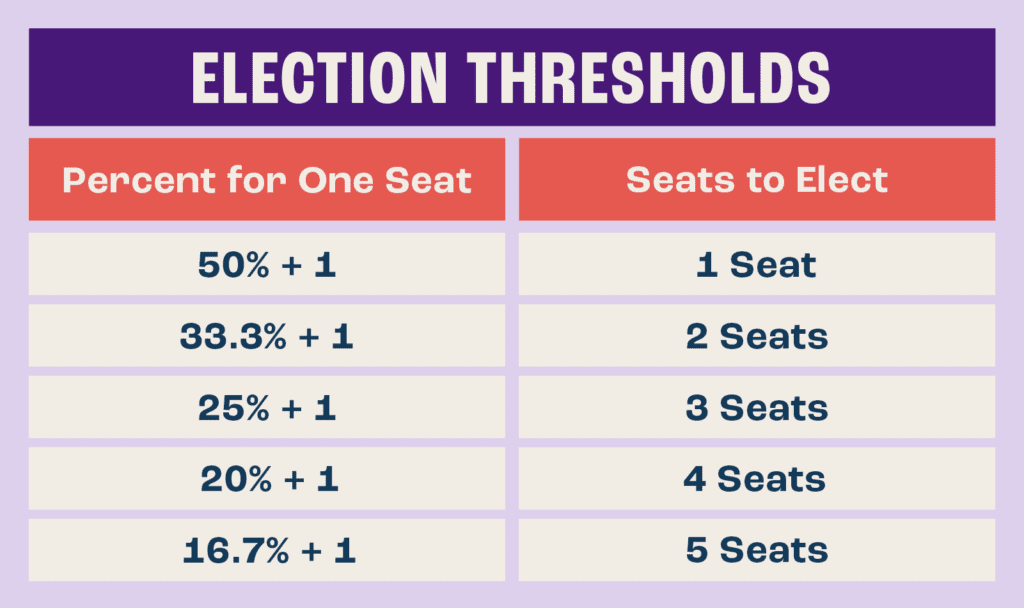
It’s straightforward for voters: Rank candidates in order of choice. Candidates who receive a certain share of votes — the “threshold” — are elected based on the number of open seats.
For example, if there are three seats to fill, any candidate who gets more than 25% of the vote earns a seat. Surplus votes (those above the threshold) are then counted for the voters’ second choices, ensuring that no votes are wasted. After surplus votes are distributed, the candidate with the fewest votes is eliminated. Votes for the eliminated candidate then count for those voters’ second-choice candidate. This process continues until all seats are filled.
To learn how proportional RCV is working around the country, visit FairVote’s proportional RCV information page.