Proportional RCV is a voting method used around the world and widely considered to be fairer, more inclusive, and more democratic than the winner-take-all voting systems we typically see in the United States. Adopting proportional RCV in more places within the U.S. would help to solve many of the problems currently afflicting American elections, including low turnout, gerrymandering, lack of competition, and the underrepresentation of women and minorities.
For a quick overview of key facts and research findings, see FairVote’s Proportional RCV Primer.
Where is proportional representation used?
Using proportional ranked choice voting
- Albany, California: In use for City Council and School Board elections since 2022.
- Arden, Delaware: In use for Board of Assessors elections since the early twentieth century.
- Arlington, Virginia: In use for County Board elections when multiple seats are up for election. First used in a primary in 2023, with first general election use expected in 2027.
- Cambridge, Massachusetts: Adopted in 1941. Used to elect all nine at-large city council seats and the six at-large school committee seats.
- Charlottesville, Virginia: First piloted in the 2025 city council primary.
- Minneapolis, Minnesota: Adopted in 2006 and used since 2009 for at-large seats to two municipal boards (council and other offices are elected in single-winner RCV elections).
- Portland, Oregon: Adopted in 2022 for city council elections, with first use in 2024.
Upcoming implementations of proportional RCV
- Newburgh (Town), New York: Adopted in 2026. First use scheduled for 2027.
- Oak Park, Illinois: Adopted in 2024, with first use expected in 2027.
- Portland, Maine: Passed a ballot measure in 2022 authorizing proportional RCV for multi-winner elections.
- Skokie, Illinois: Adopted in 2025, with first use expected in 2027.
Historical uses of proportional ranked choice voting
The first U.S. city to adopt proportional ranked choice voting for its city council was Ashtabula, Ohio in 1915. During the first half of the 20th century, proportional ranked choice voting spread rapidly as part of the progressive movement. At its peak, some two-dozen cities adopted it, including Cincinnati, Cleveland, Boulder, Sacramento, and even New York City. New York City continued to use ranked choice voting for its school board until 2002 when those school boards were abolished.
As the progressive era transitioned into a period characterized by racial tensions and fear of communism, proportional ranked choice voting became a victim of its own success. In Cincinnati, ranked choice voting enabled the election of two African American city council members in the 1950’s. In 1951, African American attorney Theodore M. Berry won with the highest percent of the vote, which ordinarily would result in him becoming mayor. Instead, the city council chose one of the white councilmen to become mayor. Finally, Cincinnati repealed ranked choice voting in 1957 in the fifth Republican-led repeal attempt. Following civil unrest stemming from racial tensions in the 1960’s, the Kerner Commission cited the repeal of ranked choice voting and its effect on African American representation as one cause of the city’s violence.
Similarly, in New York City, proportional ranked choice voting cut off the stranglehold previously held by the Democratic Party in the city. In the last election before adoption of choice voting, Democrats won 99.5% of the seats on the Board of Alderman with only 66.5% of the vote. Under ranked choice voting in 1941, Democrats won 65.5% of the seats with 64% of the vote, a much fairer result. However, ranked choice voting enabled representation of minor parties, including members of the Communist Party. During the Cold War, the Democratic Party took advantage of fears of communism to make a successful push for repeal of proportional ranked choice voting. That repeal successfully prevented the election of communists to the city council, along with members of all other minor parties, but it also brought back an era of unrepresentative elections to New York City.
How proportional RCV works
Voting and vote counting under proportional RCV is similar to ranked choice voting, with one exception: Instead of one candidate winning with a majority of the votes, several candidates win with smaller shares.
It’s straightforward for voters: Rank candidates in order of choice. Voters can rank as many candidates as they want, without fear that doing so will hurt their favorite candidate’s chances. Ranking a backup choice will never hurt a voter’s favorite candidate, so voters have no reason to “bullet vote” for only one candidate.
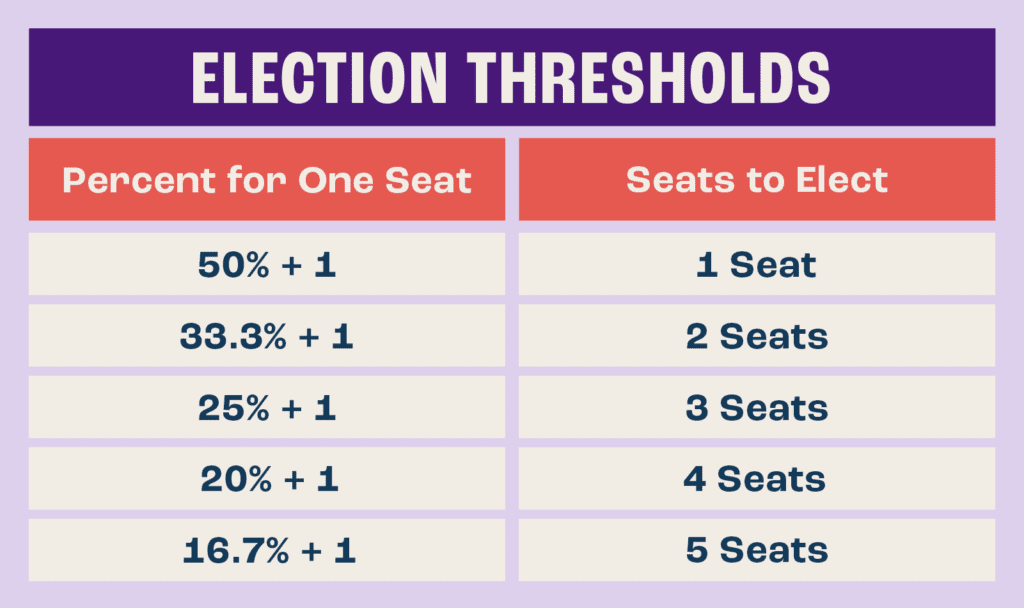
Candidates who receive a certain share of votes — the “threshold” — are elected based on the number of open seats. For example, if there are three seats to fill, any candidate who gets more than 25% of the vote earns a seat. Excess votes (those above the threshold) are then counted for the voters’ second choices, ensuring that no votes are wasted. After excess votes are distributed, the candidate with the fewest votes is eliminated. Votes for the defeated candidate are then allocated to voters’ second choice candidate. This process continues until all seats are filled.
Proportional RCV FAQ
Q: What is the difference between single-winner ranked choice voting (RCV) and proportional ranked choice voting?
A: RCV and proportional RCV both make our elections better and fairer by allowing voters to rank candidates in order of preference. RCV elects one winner who has over 50% of active votes and ensures a broadly popular winner for a single-seat office. Proportional RCV elects multiple winners, each of whom meet a threshold based on the total number of seats to be filled. Even after a candidate reaches the threshold, the election continues until all seats are filled. Proportional RCV ensures that candidates are elected in proportion to their level of support.
All forms of ranked choice voting ensure a majority of voters are represented in their government. Proportional ranked choice voting goes even further by ensuring nearly every voter is represented.
Q: How is the threshold to elect calculated?
A: The threshold to elect a candidate depends on the number of seats to fill. It is the minimum number of votes required to fill all seats, while also ensuring no additional candidates can earn enough votes to cross the threshold. The mathematical formula is called the The threshold of votes required to win one seat under certain forms of Proportional Representation, including most implementations of proportional RCV (also known as single transferable vote). The formula for the threshold is the sum of one and the quotient of the total number of votes cast and the sum of one and the number of seats to be elected.…Droop Quota.
Q: Why does proportional RCV transfer surplus votes?
A: Transferring surplus votes ensures that every ballot has the greatest possible impact on the race. No ballots are “wasted” on candidates that have already been elected, and everyone’s vote counts the same. Imagine your vote is one dollar. If you only had to pay 90 cents to get your favorite candidate elected, wouldn’t you like to use the extra 10 cents to help a backup choice?
Without surplus transfer, a small subset of voters could have a disproportionate impact on election results. By using this mechanism, we ensure the results are as representative of the voting public as possible.
Consider an example of what could happen if the tabulation did not include surplus transfer:
Imagine an election in a city where five candidates are running for three seats. 60% of voters support the Pizza Party (no matter what kind of Pizza) and 40% prefer the Ice Cream Party (no matter what kind of Ice Cream). If most Pizza Party voters choose Pepperoni as their first choice, Pepperoni Pizza will earn the first seat. The remaining two seats would go to the two Ice Cream candidates. In this scenario, the Ice Cream party earns two out of three seats even though they only represent 40% of the electorate.
Because Pizza voters consolidated around just one candidate, they were deprived of a majority of seats, despite comprising a majority of the electorate. Surplus transfer prevents this kind of scenario. With surplus transfer, after Pepperoni Pizza crosses the 25% threshold and wins a seat, everyone who voted for Pepperoni has a fraction of their vote transferred to Veggie Pizza or Pineapple Pizza, allowing the Pizza party to control two seats and Ice Cream to control one – and ultimately resulting in better treats for everyone.
Q: Why do surplus votes get transferred before eliminating candidates?
A: Eliminating candidates is always a last resort. When transferring surplus votes, it is possible for a trailing candidate to grow their share by enough that they stay in the race. Therefore, candidates are only eliminated from a proportional RCV tally after there are no surplus votes left to transfer.
Q: Will proportional RCV change who gets elected?
A: Proportional RCV allows like-minded voters to elect their preferred candidates in proportion to their voting strength. Because proportional RCV has a lower threshold to elect (such as 25% of the vote in a 3-winner election), some voter groups will gain representation that they did not have before. Proportional RCV preserves majority rule, and also awards a fair number of seats to minority factions.
Q: Will proportional RCV elect extremists?
A: Proportional RCV elects candidates who cross a minimum threshold of support (such as 25% in a 3-winner election) so fringe candidates will be unlikely to earn a seat. For congressional elections, most candidates would need more votes with proportional RCV than they need in our current single-winner congressional districts. In our current system, 80% of seats are “safe seats” for one party, where the winner only needs to win a plurality of votes in a low-turnout primary election consisting of heavily partisan voters. With proportional RCV, a winning candidate must earn a sizable vote share from the full electorate during a general election.
The threshold to win seats in proportional RCV is also higher than the threshold used by most European countries for their own forms of proportional representation.
Q: How does proportional RCV impact the voting power of people of color?
A: Proportional RCV gives greater voting power to people of color by establishing a fair threshold-to-elect. For example, in a single-winner plurality contest, a group needs to make up more than half of the electorate to have deciding power over who wins. This means that in jurisdictions where people of color are in the minority, a candidate could win without a single vote from a person of color.
Because proportional RCV has a lower threshold to elect (such as 17% of the vote in a 5-winner election), people of color have power to elect candidate(s) of their choice in proportion to their share of the electorate. Voters of the same ethnic or racial group, of course, do not act as monolithic voting blocs, but proportional RCV means that elections cannot be decided without voters in the minority having a say.
Since the Voting Rights Act of 1965, “majority-minority districts” have been key to advancing representation for people of color. However, voting rights protection is becoming increasingly dependent on courts that seem increasingly averse to race-conscious district-drawing. Proportional RCV is another option to secure fair representation for people of color, without the need for drawing race-conscious districts.
Q: Does proportional RCV impact women’s representation?
A: Proportional RCV will most likely lead to more women in elected office. Various forms of proportional representation have benefitted women around the world. Analysis from FairVote and RepresentWomen indicates that women would be likely to earn 40% more seats in the U.S. House of Representatives than they hold today if we implemented proportional RCV for Congress. Additional research examines the history of proportional RCV in the U.S. and present-day uses of the single-winner use of RCV and finds that both are beneficial for women candidates.
Q: How does proportional RCV impact the major parties?
A: In partisan elections, proportional RCV will ensure that the major parties win seats in proportion to their levels of support. For example, in a district that is 60% Democratic and 40% Republican, proportional RCV would preserve the Democratic majority but also award a fair number of seats to Republicans (whereas in single-winner plurality contests, Republicans would not get any representation at all). With proportional RCV in partisan elections, voters from each party will have a true voice in every election.
Q: How many candidates can be elected at a time with proportional RCV?
A: Proportional RCV can elect any number of candidates, but we typically recommend it for elections with 9 winners or fewer. In an election for 10 or more seats, the ballot could become too long and could increase the cognitive burden on voters. For larger bodies like a state legislature or the U.S. House of Representatives, we recommend splitting the jurisdiction into multi-member districts and using proportional RCV within each district, which also leads to proportional outcomes overall. Research has shown that proportional RCV leads to fair partisan outcomes and fair racial representation outcomes.
Q: How does proportional RCV interact with “multi-member districts”?
A: Proportional RCV does not require multi-member districts but often complements multi-member district configurations. For smaller legislative bodies, proportional RCV is often used without any districts at all. For example, Cambridge, MA uses proportional RCV to elect its 9-member city council and the 6 at-large members of its school committee, all elected city-wide. For larger legislative bodies, we recommend combining proportional RCV and multi-member districts. For example, voters in Portland, OR will soon vote on whether to use proportional RCV in 4 city council districts, each of which would elect 3 members.
Q: What would it take to bring proportional RCV to the U.S.?
A: Some U.S. jurisdictions already use proportional RCV, and single-winner RCV can be a great segue into proportional RCV. Further, one of FairVote’s key reform priorities is the Fair Representation Act. It would establish proportional RCV for the U.S. House of Representatives, with each representative being elected from a three- to five-member district. Learn more about the Fair Representation Act at FairVoteAction.org.
Voting rights and proportional representation
Strong democracies are fair democracies: They reflect — and are accountable to — all citizens.
Equality in voting makes fair democracy possible; without it, our public officials have little incentive to respond to the public and develop laws and policies that support and include all people.
FairVote advances proportional ranked choice voting (RCV) to ensure fair representation for all.
Proportional RCV is the gold standard for how to conduct legislative elections in the United States. It ensures both majority rule and fair representation, while giving voters more choices and a more empowering way to vote. Proportional RCV advances descriptive representation and strengthens voting rights by preserving and enhancing the power of communities of color to elect candidates of their choice.
This page will explain how voting rights historically have been protected and will show how proportional RCV can achieve even stronger and fairer racial representation in government.
The Voting Rights Act of 1965
Section 2 of the Voting Rights Act of 1965 (VRA) guarantees that racial, ethnic, and language minority citizens have an equal opportunity to participate in the political process and elect representatives of their choice. This prohibits laws that dilute the voting strength of minority communities, even when not enacted with discriminatory intent.

Lawsuits seeking to preserve voting rights often target block voting systems (aka “at-large systems”), a common form of voting in U.S. cities that has harmed communities of color. Block voting is “majoritarian,” in that it allows a single majority group to control all seats of a legislature. If White voters constitute the majority (as they do in many U.S. cities) and vote differently than voters of color, then block voting can exclude communities of color. For this reason, block voting has been systematically struck down.
Typically, cities or states that are targeted under Section 2 of the VRA (or under a state Voting Rights Act) must change their election method to preserve the voting rights of minority communities. Single-winner districts are a typical remedy in these cases, but other methods support even better representation.
Single-winner district shortcomings
Single-winner districts are the most common remedy for vote dilution under the VRA because they allow map-makers to create “opportunity districts” — those where the minority population is large enough to elect its preferred candidates. Opportunity districts have improved representation in the U.S. Congress and in state legislatures, particularly for Black and Latino voters.
However, single-winner districts have several drawbacks.
- Single-winner districts are susceptible to gerrymandering and must be periodically redrawn, a process that is often contentious, time-consuming and expensive.
- As populations shift, single-winner districts fail to keep pace with changing demographics. Even a district map created with the best intentions can quickly become outdated.
- Achieving voting rights through single-winner districts requires concentrated populations. If a minority community is evenly distributed throughout the population, it may be impossible to draw a district or districts that ensure it has the power to elect candidates of their choice.
- Each single-winner district is majoritarian, meaning a 51% majority is the only voice represented from each district.
Proportional RCV creates fair representation
Proportional RCV leads to fair outcomes for all. It can be used in at-large elections, meaning one city-wide election can elect multiple representatives. Or it can be used in multi-member districts, meaning each district in a city or state elects multiple representatives. In both cases, every community has the power to elect a number of representatives proportional to the size of that community.
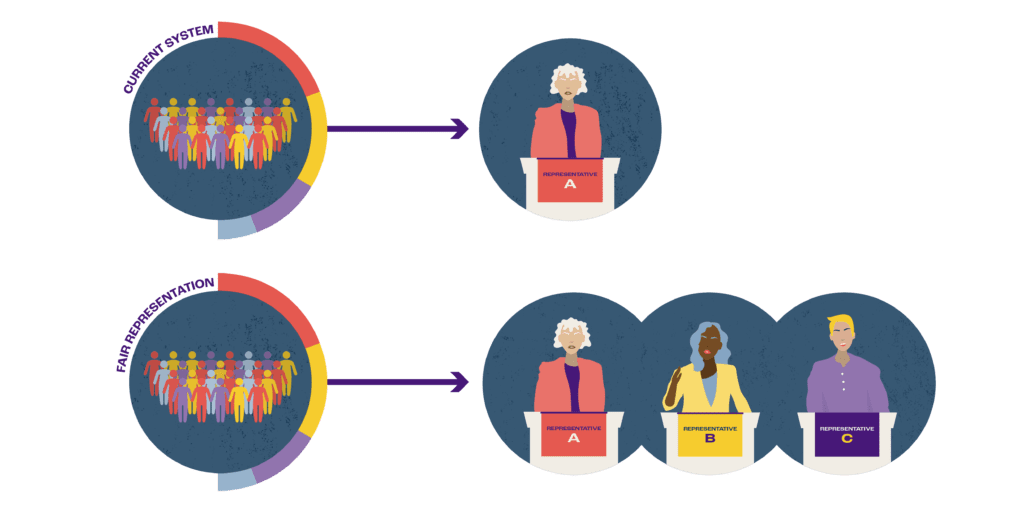
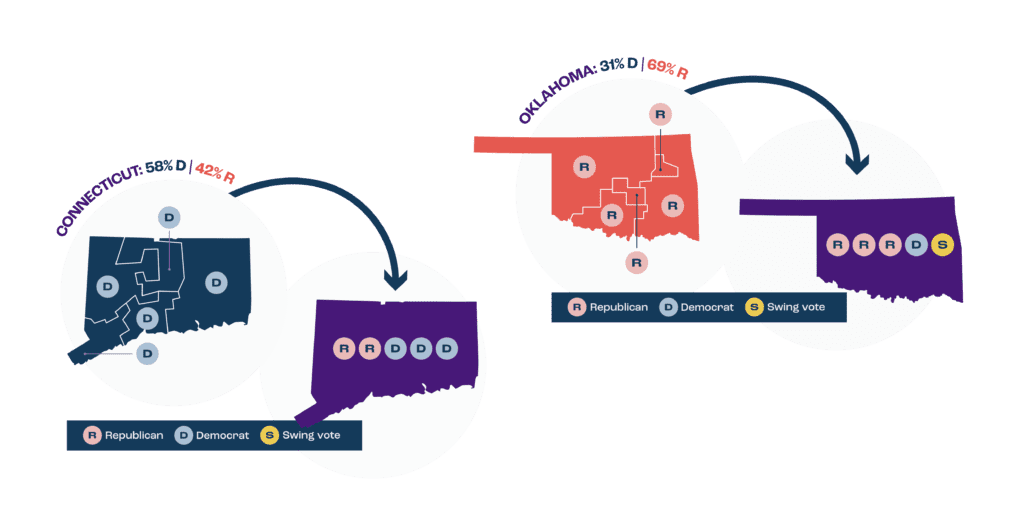
Proportional RCV is approved as a remedy for the problem of vote dilution under the Voting Rights Act. It was first used as a VRA remedy in Eastpointe, Michigan, in 2019 in response to a vote dilution lawsuit. Read the Eastpoint case study below.
Election thresholds increase diversity
Candidates win a seat in proportional RCV if they meet an election threshold determined by the total number of seats to be filled. This differs from block voting, in which candidates in multi-winner contests typically need support from the majority faction.
Proportional RCV’s lower election threshold allows for more diversity in a legislature, such as a city council or state legislature. For example, in a proportional RCV contest electing five seats, the threshold is 17% of the vote (determined using the “Droop Quota”). Therefore, any group comprising over 17% of the voting population can elect a representative of its choice. Groups comprising more than double the threshold have the power to elect multiple representatives.
Too often, political analyses treat members of demographic and identity groups as monoliths – speaking as though members all share the same views and vote as a bloc – though we know there is immense diversity of opinion in every community in the nation. A key benefit of proportional ranked choice voting is that it allows people to bring their whole selves to the voting booth and express more nuanced views with their votes.
Research highlights
- Proportional RCV provides proportional or slightly better representation for the relevant minority group in each of four case studies, while the effectiveness of single-winner districts varies widely, according to a 2021 study.
- Proportional RCV drastically reduces partisan gains from gerrymandering, and multimember districts as small as two seats have positive impacts for fair representation, according to a 2021 study.
Fair representation and VRA remedies
Typically, cities and states in violation of Section 2 of the Voting Rights Act must change their election method to preserve the voting rights of minority communities. Single-winner districts are often the remedy in these cases, but “fair representation” methods are frequently used as well.
These remedies include proportional RCV, cumulative voting and A Semi-Proportional voting method used in Multi-Winner elections. Voters have fewer votes than the number of seats to be filled, but sometimes more than one vote. Counting is identical to a plurality election, with the candidates with the highest vote totals winning the seats. When voters have only one vote, it is also known as the Single Vote method or the Single Non-Transferable Vote (SNTV).Limited Voting. Cumulative voting and limited voting are sometimes considered “semi-proportional” methods because they allow minority communities to elect candidates(s) of choice if voting cohesively. Proportional RCV is the most proportional option for a fair representation remedy.
Numerous lawsuits have resulted in fair representation remedies. The list below includes jurisdictions which have moved to fair representation remedies, sometimes known as “modified A type of electoral jurisdiction where representatives are elected from the whole political region, such as a whole city, county, state, or nation. Compare to elections by District.At Large” remedies.
Case study: Eastpointe, Michigan
Eastpointe, Michigan, is the first city to use proportional RCV as a voting rights remedy. Eastpointe, a suburb of Detroit, adopted the method in 2019 as part of a settlement with the U.S. Department of Justice in response to a lawsuit under the Voting Rights Act.
The lawsuit claimed that Eastpointe’s elections were discriminatory, with White voters consistently opposing and defeating the preferred candidates of Eastpointe’s sizable Black community. One-third of Eastpointe residents are Black, but there had never been a Black candidate elected to the city council at the time of the lawsuit.
One option under consideration was to divide the city into four districts so geographically distinct communities would each get one seat on the four-member city council. However, Eastpointe and the Justice Department opted instead to use proportional RCV because it prevents the need to divide Eastpointe into districts, allowing the whole city to have a say in each council member while still improving representation.
Further reading
RCV and proportional representation: Successes from Eastpointe, Michigan

Eastpointe, a short documentary film directed by Grace McNally.
State voting rights acts
States are increasingly enacting their own voting rights laws to strengthen protections for communities of color beyond the federal VRA. States that have enacted such laws include California, Washington, Oregon and Virginia. Proportional RCV is an ideal remedy to state VRA violations because it protects minority communities that are too small or too diffuse to elect their preferred candidate in a single-winner district.
All states should incorporate provisions that identify proportional RCV as a remedy for vote dilution into state voting rights acts. New York, for example, has introduced legislation that distinguishes between traditional “at-large” systems and “alternative” methods of election — such as RCV, cumulative voting, and limited voting — and explicitly states that remedies may include these alternative methods. Others must follow suit.
Campaign Legal Center, a nonprofit organization that strengthens democracy through law, also advocates for state VRAs to include “remedies like proportional RCV that make it difficult for governments to gerrymander away a minority community’s voting power.” To learn more, read Campaign Legal Center’s report on state voting rights and model legislation.
Courts should interpret state VRAs so they fulfill their purpose and are inclusive of proportional RCV. In 2019, FairVote submitted a brief arguing that the California Voting Rights Act (CVRA) does not compel local governments to adopt single-member districts because several modified at-large voting systems comply with the CVRA, including proportional RCV.
And in 2020, FairVote advanced the argument, along with Asian Americans Advancing Justice and plaintiffs, that the thresholds under modified at-large systems, including proportional RCV, can serve as benchmarks for establishing vote dilution under the CVRA, and that the CVRA grants courts wide discretion to implement such remedies.
These interpretations of the law are gaining traction. Palm Desert, California, used proportional RCV in 2022 as part of a CVRA lawsuit.
Resources and links
Report: The Fair Representation Act gives communities of color more power
Analysis: Plurality block voting vs. proportional ranked choice voting