New York City cast vote record: An initial analysis of the 2025 Democratic mayoral primary

New York City’s third election cycle with ranked choice voting (RCV) had the second-highest turnout in city primary history. Most voters reported that they found RCV simple and wanted to keep or expand it. Now we have the cast vote record, released by the NYC Board of Elections July 24 – an anonymized digital record showing how each ballot ranked the candidates.
FairVote’s initial analysis of the results (before the cast vote record was available) can be found here. The benefit of a cast vote record – particularly in an RCV election – is the depth it provides about voters and their behaviors and preferences.
There were 20 contests with three or more candidates across 38 contested Democratic and Republican primary elections. In this blog, we will focus on the Democratic mayoral primary. The cast vote record shows that a supermajority of voters embraced ranking candidates, followed cues from candidates and campaigns, and ultimately had a greater impact on the election results.
The mayor’s race
In the 11-candidate Democratic mayoral primary, RCV enabled voters to express their preferences among an array of choices. As a result, 95% of voters weighed in between frontrunners Zohran Mamdani and Andrew Cuomo. Below is the round-by-round RCV tabulation for the mayor’s race, including individual candidate eliminations that the city Board of Elections did not include in its official results.
Key data findings include:
- 78% of voters ranked multiple candidates.
- On average, voters ranked 3.5 candidates. 48% used all five rankings on their ballot.
- 80% of voters ranked Mamdani or Cuomo first, but 95% of voters expressed a preference between Mamdani and Cuomo – meaning RCV led to a 15-point increase in the number of voters who helped decide the winner. This represents 159,619 New York voters.
- Voters largely followed candidate cues, including cross-endorsements between Zohran Mamdani and both Brad Lander and Michael Blake; the active “DREAM” campaign that encouraged voters to rank several candidates other than Andrew Cuomo; and Andrew Cuomo’s frontrunner status and lack of an RCV campaign strategy.
- 92% of voters who ranked a candidate other than Mamdani or Cuomo first ranked at least one other candidate.
- 91% of voters who ranked Mamdani first ranked at least one other candidate.
- 55% of voters who ranked Cuomo first ranked at least one other candidate.
- The “DREAM” campaign and Working Families Party encouraged voters to rank Mamdani, Lander, Adrienne Adams, and Zellnor Myrie. This campaign also added Michael Blake to its slate in the days before the election. The campaign specifically discouraged voters from ranking Andrew Cuomo.
- 70% of voters who ranked Lander, Adams, Myrie, or Blake first had their vote count for Mamdani in the final round, compared to 30% for Cuomo.
- Of voters who ranked Brad Lander first, 75% went to Mamdani and 25% went to Cuomo. When Lander was eliminated in the RCV tabulation, 73% of those votes went to Mamdani. (Both of these bullet points exclude inactive ballots.)
- In State Assembly Districts that voted more heavily for Cuomo, there was a significantly higher share of voters who ranked only one candidate.
- When analyzing demographic variables, race and income were not significant indicators for using two or more rankings. In Assembly Districts with a higher Latino population, voters used more rankings overall.
Case study: Cross-endorsements
RCV allows candidates to “cross-endorse” each other – meaning they advise their voters to rank the other as a backup choice, and sometimes even campaign together.
Cross-endorsements make campaigns more positive and provide useful cues for voters. Most notably, Zohran Mamdani and third-place finisher Brad Lander cross-endorsed each other in the mayoral primary, and their supporters appear to have followed their advice.
- Mamdani and Lander were the most popular second choice of each other’s supporters.
- 65% of Mamdani’s voters ranked Lander second, and 74% ranked Lander in their top three.
- 40% of Lander’s voters ranked Mamdani second, and 52% ranked Mamdani in their top three.
- Overall, 61% of Lander’s voters preferred Mamdani to Cuomo, 20% preferred Cuomo to Mamdani, and 19% did not express a preference between the two.
This data is consistent with evidence from other RCV elections that voters listen to cues from candidates, and that cross-endorsing is a beneficial strategy for candidates.
Head-to-head comparisons
The cast vote record data allows us to determine how each mayoral candidate would perform in a head-to-head matchup against every other candidate.
Zohran Mamdani was the “Condorcet” winner in this primary, meaning that he would defeat every other candidate in a head-to-head matchup. The RCV and Condorcet winner are the same in 99.8% of RCV elections.
Notably, we see the power of cross-endorsements and candidate cues in these potential head-to-head matchups. Both Brad Lander and Adrienne Adams would defeat Andrew Cuomo in a hypothetical matchup – effectively, they were ranked higher on more ballots than Cuomo despite trailing him significantly in first-choice support.
This likely reflects a combination of their efforts to collaborate with the Mamdani, Myrie, and Blake campaigns, while Cuomo did not make an effort to win voters’ backup-choice support. Notably, 76% of voters who ranked Adams, Blake, Lander, Mamdani, or Myrie first ranked another “DREAM” candidate as their second choice, compared to only 6% who ranked Cuomo second.
The chart below shows hypothetical head-to-head matchups between different candidate pairs, based on voters’ rankings. If you’re using a mobile device, hold it horizontally for the best display.
Who was most likely to rank candidates?
To better understand voter behavior, we examined how voters ranked candidates by New York Assembly District, combined with demographic data on the voters in each district. This helps us determine whether some voters were more likely to rank multiple candidates than others. Using Assembly district-level (rather than precinct-level) data allowed us to add income and education as variables.
We started by focusing on the mayoral primary. Notably, voters’ ranking behaviors varied by contest in both 2021 and 2023; in the coming weeks, FairVote will analyze down-ballot races to fully understand how New Yorkers engaged with RCV up and down the ballot.
The data showed an extremely strong relationship between ranking Andrew Cuomo first and voters’ overall likelihood to rank multiple candidates. On average, voters in the mayoral election ranked 3.5 candidates, but voters who ranked Cuomo first only ranked 2.4 candidates, meaning on average, they ranked 1.1 fewer candidates. 78% of all voters ranked multiple candidates, compared to only 55% of Cuomo voters.
This may reflect both Cuomo’s campaign style, such as his decision not to rank any other candidates on his own ballot, as well as his frontrunner status. There is evidence that voters who pick a frontrunner candidate as their first choice are less likely to rank additional candidates, as they are confident that their choice will make it to the final RCV tabulation.
In the graph below, each point represents an Assembly district. “Bullet voting” refers to the number of voters who rank only one candidate.
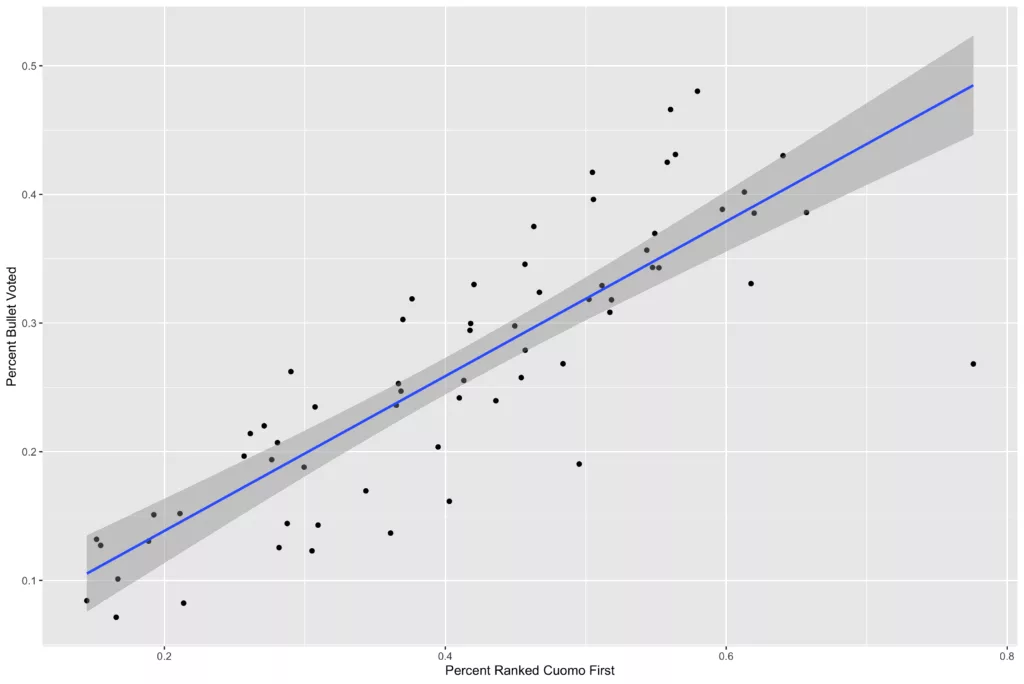
According to our regression models, bullet voting was not statistically associated with any racial group when controlling for income and education. In other words, the tendency to rank multiple candidates appears generally similar across racial groups. Assembly districts with a higher percentage of voters with a high school diploma or less appear to have bullet-voted at higher rates, but this does not appear to have impacted those voters’ influence over the final results (see next section).
Coefficient-level estimates for bullet voting model (Democratic mayoral primary)
| Predictors | Estimates | p-value |
|---|---|---|
| Intercept | .1379 | 0.22902 |
| Black | .07067 | 0.34079 |
| Hispanic or Latino | -.04030 | 0.62990 |
| Asian American or Pacific Islander | -.07422 | 0.45387 |
| Native | -185.1 | 0.65503 |
| Income | -.0000003.630 | 0.60282 |
| Education | .4750 | 0.00579* |
| Observations | 65 | |
* p<0.05
Income is the median household income, education is measured as the percent of the population over 25 with a high school diploma or less, and the remaining categories are the percentage population of each racial group in each Assembly district. Percent White is excluded to serve as a baseline for comparison.
We also examined the number of rankings that voters used. The model below measures the total number of candidates that voters ranked; the model above simply measures whether voters ranked 2+ candidates or not.
According to these regression models, Latino voters tended to use more rankings than White voters in the mayoral race, when controlling for income and education. In the two other citywide Democratic primaries – which we will examine in further detail in upcoming analysis – a higher percentage of Black, Latino, and Asian American voters in an Assembly district was also associated with using more rankings.
Coefficient-level estimates for number of rankings model (Democratic mayoral primary)
| Predictors | Estimates | p-value |
|---|---|---|
| Intercept | 3.53 | <0.001* |
| Black | 0.12 | 0.726 |
| Hispanic or Latino | 0.78 | 0.043* |
| Asian American or Pacific Islander | 0.72 | 0.112 |
| Native | 4.28 | 00.819 |
| Income | -1.98 | 0.010* |
| Education | 0.000002 | 0.555 |
| Observations | 65 | |
* p<0.05
Which voters most impacted the final results?
While it is valuable to measure whether voters rank multiple candidates, arguably a more important measure is how voters’ voices are heard in an RCV election. In this case, voters who ranked either Zohran Mamdani or Andrew Cuomo had their ballot remain “active” for the entire RCV tabulation.
A total of 95% of voters weighed in between Mamdani and Cuomo by ranking at least one on their ballot, including at least 91% in every assembly district.
Notably, this number is statistically higher in Assembly districts with a higher percentage of voters with a high school diploma or less. In other words, voters in these districts were more likely to have either Cuomo or Mamdani on their ballot, and therefore have their vote count in the final round of RCV tabulation.
This may reflect the trend noted earlier, where voters ranking a frontrunner first may be less likely to rank other candidates without encouragement to do so – because they do not need a backup choice. In our model, there was no association with race or income when controlling for other variables.
Coefficient-level estimates for active ballot in final round model (Democratic mayoral primary)
| Predictor | Estimate | p-value |
|---|---|---|
| Intercept | 0.9365 | < 0.0001 |
| Black | -0.0161 | 0.1861 |
| Hispanic or Latino | -0.0140 | 0.3062 |
| Asian American or Pacific Islander | -0.0118 | 0.4666 |
| Native | 0.0285 | 0.9664 |
| Education | 0.0716 | 0.0105* |
| Income | -0.00000002552 | 0.8224 |
| Observations | 65 | |
* p<0.05
Income is the median household income, education is measured as the percent of the population over 25 with a high school diploma or less, and the remaining categories are the percentage population of each racial group in each Assembly district. Percent White is excluded to serve as a baseline for comparison.
Conclusion
Last month, New Yorkers reported that they like and understand RCV in an exit poll. Once again, the cast vote record data backs that up.
Voters from all backgrounds used the opportunity to rank multiple candidates. As a result, more voters got a say in the choice between frontrunners. Voters also largely followed cues from their favorite candidates.
This cast vote record joins an extensive body of data showing how RCV can empower voters and deliver more representative elections. FairVote will offer more analysis on this race – and the other RCV contests in New York City – in the weeks and months to come.