Learning from Portland: what candidates should know about running in ranked choice voting elections

Robin Ye is a seasoned campaign operative in Portland, Oregon. He served as a Portland Charter Review Commissioner from 2021-2022, where he chaired the Elections Committee that crafted the proportional representation system now in effect for the November 2024 general election. He worked on the campaign to pass Measure 26-228 Portland Charter Reform in 2022, and in 2024 was an active candidate for Portland City Council District 3 before departing the race in May.
Executive Summary
Top-seven takeaways for candidates in proportional ranked choice voting elections:
- The traditional gatekeepers have less control –There is less gatekeeping of political talent and less deterrence for newcomer candidates. Institutional and establishment actors have less power to limit participation.
- More candidates can run – With less fear of playing spoiler and more pathways to win, more candidates can enter the race and share their voice and unique perspectives.
- More salient election issues in play – Traditional power holders can’t as easily narrow the set of issues the election revolves around. More organizations and issue advocacy groups seize the opportunity to participate.
- Collaboration is king – Voters desire collaboration between their candidates (and future elected officials). Multi-member districts have helped shape the notion that each district can elect a “team” of leaders that reflects the district and will work together to represent diverse constituencies. The incentive to viciously attack rival candidates is also reduced.
- Include voter education in your plan – Many voters will find out about the election system through candidates they like. By educating voters, candidates can help ensure the public is ready to engage with RCV effectively and make their voices heard.
- Slates matter – A slate is a group of candidates who are aligned on issues and often choose to campaign together. With a large field of candidates and multiple positions to elect, voters will rely on endorsements and slates to map their support.
- Always fight for voters’ 1st choices – Some things stay the same: Even as they try to appeal to their opponents’ supporters as a backup choice, candidates should still make a positive case for why voters should rank them first. Name recognition is also still crucial, as voters cannot rank you first if they aren’t aware of your candidacy.
While all eyes are on the race for the White House, exciting elections are also taking place in the Pacific Northwest. This November, Portland, Oregon will use proportional ranked choice voting for the first time to elect its new city council, and single-winner ranked choice voting to elect its mayor and auditor. Even before ballots have been cast, the new system – which voters approved in 2022 – has already transformed Portland’s political culture and created opportunities for a new kind of representation in the Rose City.
Proportional RCV has been in use around the world for over 100 years. It is used for national elections in Australia, Ireland, and Malta, plus local elections in countries like New Zealand and the United Kingdom. In the mid-twentieth century, several major American cities also conducted elections with proportional RCV, much to the dismay of party bosses. Portland’s charter reform efforts have breathed new life into the push for proportional representation throughout the country, and many proponents are closely watching what comes out of Portland this November.
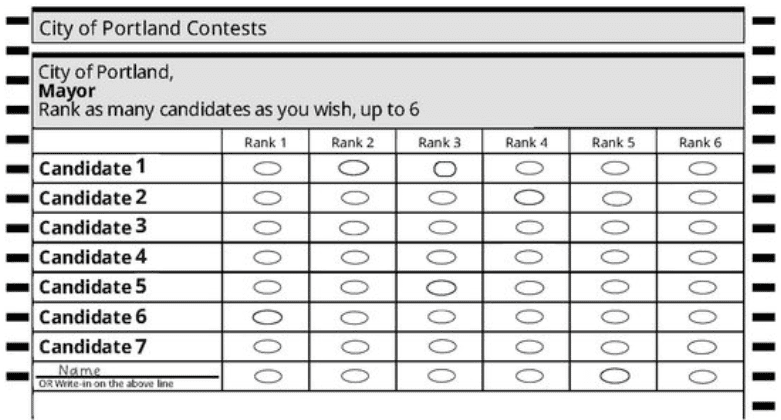
Portland’s new voting method
Portland voters will use proportional ranked choice voting to elect 12 city councilors – three each from four council districts. In a three-seat district, the threshold to elect a seat is 25% of the vote plus one vote, giving communities of color (and other political interests and coalitions) a greater chance to elect candidates of their choice. RCV will also save the city money by eliminating its primary and allowing the city to hold a single, nonpartisan election on a high-turnout general election day.
Portland has adopted other reforms to lower barriers to entry for candidates from underrepresented communities. For instance, Portland offers the Open and Accountable Elections public financing program that matches eligible Portland resident donations at a 9:1 rate. This public financing program has reduced the influence of big money donors and PACs, and brought a more diverse array of campaign contributors into Portland politics.
Campaigning overhaul: what has changed
How candidates campaign helps set the tone for political culture and governance once they’re in office. This means how we pick our leaders affects what those leaders can accomplish, and how effective they are in delivering for the people.
This November, Portland voters will be allowed to rank up to six candidates on their ballots for city council and mayor. It’s clear that campaigning in Portland has already improved thanks to RCV.
With less fear of playing spoiler and more pathways to win, more candidates than ever are running – including 98 council candidates for 12 spots. Some have been running since August 2023, while others joined the fray as late as August 2024. In other words, there is less gatekeeping of political talent and less deterrence of newcomer candidates. The “invisible primary” is dead, and voters have more choices.
(Portland also has an unusually low threshold for ballot qualification that – — together with public matching, the lack of any incumbents, and this being the first election with our new voting system – — has driven a high number of candidates. There is much that can be learned from this inaugural proportional RCV election. The city might consider requiring a small number of signatures to show a basic level of support in the district; this could balance the desire for more candidates with keeping candidate fields from becoming unwieldy.)
More organizations and issue advocacy groups – from unions to pro-bike groups – are seizing the opportunity to participate. These organizations have correctly picked up on the fact that traditional power holders can’t as easily narrow the set of issues that the election revolves around. While cost of living, housing affordability, drug addiction, and behavioral health have certainly achieved universal salience among voters, there is also ample appetite – potentially from at least 25% of Portland voters in certain districts – for candidates who prioritize issues such as environmental justice, public health, and small business development.
Overall, fewer factors can be definitively locked in at the beginning of the election cycle, leading to more competitive elections. Institutional and establishment actors still certainly have influence due to their resources and political muscle, but they have less determinative power at the outset.
Qualitatively, attitudes toward campaigning have also shifted in the city, as voters desire collaboration between their elected officials. Multi-member districts have helped shape the notion that each district can elect a “team” of leaders that reflects the district and will work together to represent diverse constituencies. Campaigns are also jointly pursuing and sharing the same limited base of volunteers who can assist their campaigns. More joint events, joint fundraisers, and newsletters that lift up fellow candidates dot the scene than in past election cycles.
The incentive to attack rival candidates is also reduced. With RCV, even if you’re not a voter’s first choice, you can still be their second, or third, or fourth choice; going negative against your opponents may hurt you with their voters. Reflecting the incentive for teamwork and collaboration, Portland candidates – even ones who have some significant policy differences – have made concerted efforts to socialize and publicly appear together. Candidates are no longer penalized for running in a race alongside others with similar policy stances. Rather than cannibalize each other and crowd out similarly positioned candidates, candidates competing in similar lanes can collaborate with each other and grow the segment of voters interested in their priorities.
Given that RCV is new in Portland, it’s a good idea for candidates to inform voters about the new voting method. Many voters will find out about the election system through candidates they like. By educating voters, candidates help ensure the public is ready to rank candidates and make their voices heard.
The advent of candidate slates in Portland
In a crowded field, it is imperative for candidates to stand out. Breaking through is paramount – and endorsements from trusted community voices help Portlanders narrow down large lists of candidates into a more manageable group to choose from. Candidates seeking endorsements is nothing new, but with multi-member districts and ranked choice voting, organizations and individuals making endorsements have more creativity and strategy at their disposal.
With a large field and multiple positions to elect, Portland voters will rely on endorsements and slates to map their support. A slate is a group of candidates who are aligned on issues and often choose to campaign together. Slates can be formed by candidates, or can come in the form of endorsements from local organizations. With fewer incumbents and lower name recognition, candidates themselves have had less influence in determining slates this cycle.
In Portland, slates are not identified on the ballot, and the city council elections are all non-partisan. Voters vote by mail over a three-week period from the comfort of their homes. Many voters will rely on the nonpartisan state-issued voter pamphlet, as well as communications that they receive from candidates and independent groups.
The slates in Portland include a range of interest groups and coalitions, like United for Portland backed by the local chamber of commerce, the Northwest Labor Council backed by a coalition of public and private unions, and a BIPOC-led table of community organizations.
Slates are campaigning together to reach voters at their doors; their staffs are collaborating to turn out volunteers and execute event logistics.
Some things stay the same
Regardless of the voting method used, some things stay the same: Candidates should still make a positive case for why voters should rank them first. Name recognition is also still crucial, as voters cannot rank you first if they aren’t aware of your candidacy.
Without negative campaigning to rely on, plus the logistics of crowded contests, candidates running in proportional ranked choice voting races need to really hone their case for their candidacy. Candidates must focus on making an affirmative, proactive case for why they should occupy one of voters’ precious top rankings.
To be successful in this system, candidates need to cultivate an energetic base and demonstrate a particular niche for why they are running. Candidates can’t be everything to everyone (nor should they want to) and they don’t need to focus solely on the “median voter” to win. Candidates must also show what they bring to the table for their district (and the three-person team they seek to be part of), whether that’s policy knowledge or governing experience.
With any voting method change comes shifting dynamics and new ways of thinking about campaigns. Campaign culture changes. Systems change. Candidates adjust. Innovations flourish. And winners of the 2024 Portland elections will write new chapters for the city’s political playbook.