FairVote news update: June 25, 2026

This month, Washington, DC used ranked choice voting (RCV) for the first time, and Maine used RCV for important primaries for governor and Congress.
In both places, ranked choice voting delivered majority winners and made more votes count meaningfully. And in a new SurveyUSA poll, supermajorities of Washington, DC voters say that ranked choice voting is simple and they support it.
Read on for key takeaways from this month’s primaries, and other quick-hit election reform news.
New poll of Washington, DC voters shows strong support for RCV
A new SurveyUSA poll of likely and actual voters finds that supermajorities of DC voters understand and support RCV. Key findings include:
- 78% of Washington, DC voters say their ranked choice voting ballot is simple to complete, with just 15% saying it is difficult. Among the respondents who had already voted, that number rises to 87%.
- 74% say they support the ability to rank candidates on their ballots, with just 18% opposed.
- 69% say they ranked two or more candidates in at least one race on their ballot, with 24% saying they only ranked one candidate.
Takeaways from the Washington, DC primary
In Washington, DC’s first ranked choice voting primary, two Democratic Council races went to RCV counts because no candidate earned a majority of first choices.
Across the two races that went to RCV counts, 90% of voters expressed a preference among the finalists. In both races, 71% of voters whose first choice was eliminated still had their ballot count for one of the finalists — including about 30,000 voters in the at-large Council primary.
At-large Council primary results
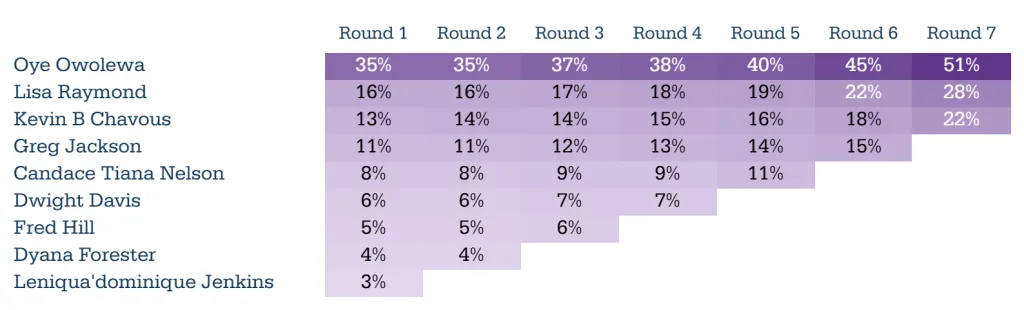
Turnout in this election was high. Over 139,000 votes have been counted so far in the Democratic mayoral primary — the highest number since 1994.
For more on the DC election, check out these pieces FairVote has published covering the RCV results, voter opinions of RCV, and voter education ahead of Election Day. Our partners at Grow Democracy DC also shared a statement after polls closed.
Takeaways from the Maine primary
In Maine, Hannah Pingree won a “come-from-behind” victory in the Democratic primary for governor. Turnout increased by 55% from the last competitive gubernatorial primary, with record primary turnout on the Democratic side. Pingree benefited from a cross-endorsement with two fellow candidates, and won the most votes of any Democratic nominee for governor in Maine history.
Democratic gubernatorial primary results

Because Maine uses ranked choice voting, 91% of voters weighed in between the two finalists in the Democratic gubernatorial primary, and 77% did so on the Republican side. That includes approximately 114,000 voters who ranked another candidate first, but still ranked one of the two finalists on their ballot. RCV gave voters in both parties more choice and more voice.
Read our analysis of Maine’s election results, and see what voters thought about RCV in the video below.
Other election reform news
- Maryland and New York held important primary elections on Tuesday that saw candidates win with as little as 32% of the vote. Read more.
- Georgia held runoff elections for several statewide offices, and some saw turnout decline by over 60%. Read more.
- Senior Fellow David Daley shared his take on the Maine primary in The Boston Globe. Read more.
- After former Detroit Mayor Mike Duggan ended his independent campaign for Michigan governor, FairVote’s Avram Reisman discussed why it’s so difficult for independents to run for office. Read more.
- Neither major party was locked out of California’s general election – but the state should still adopt RCV to end its lockout problem for good. Read more.
- In The Hill, professor Spencer Overton shared how proportional representation offers a “durable” solution to the gerrymandering wars. Read more.