Takeaways from the first ranked choice voting election in Washington, DC

This article was updated on June 18.
On June 16, Washington, DC voters used ranked choice voting (RCV) for the first time, with voters picking nominees for mayor, U.S. House delegate, and DC Council. This came after 73% of voters supported a 2024 ballot measure to bring RCV to the District – with supermajority support in all eight of the District’s wards.
With RCV, voters were able to rank up to five candidates in order of preference. Winners will have majority support – a far cry from the District’s history of elections being won with a small plurality of the vote.
The DC Board of Elections is continuing to process late-arriving mail ballots. The Board is releasing voters’ first choices as ballots come in, and is expected to release RCV tallies by Sunday, June 21. Here are some initial takeaways from Washington, DC’s historic first use of ranked choice voting.
Join us today Join us today Join us today Join us in our missionJoin us today Join us today Join us today Join us today Join us today Join us today Join us today Join us today Join us today Join us today Join us today Join us today
Voters respond positively to ranked choice voting
Major local news outlets reported from polling places across the District, speaking with voters, election administrators, and elected officials to get their take on how voting went.
The reviews are in: Most voters felt the process worked, and felt positively about voting with RCV.
Local radio station WTOP spoke to several voters after they cast their ballots, including current Mayor Muriel Bowser – who opposed the implementation of RCV:
I think [ranked choice voting] is great for democracy, and I’m excited that we got it here in DC.
– DC voter Harrison Kreisberg to WTOP
For some of the [races], I had a very clear [favorite candidate], and I just kind of left it that way. But for the [races] where I did have a couple of candidates I really liked, it was nice to be able to kind of prioritize.
– DC voter Michael Rawlings to WTOP
It was fairly straightforward.
– Washington, DC Mayor Muriel Bowser to WTOP
Voters told local TV news station ABC 7 that they appreciated that RCV gave them the ability to support multiple candidates, rather than just one:
I thought the ballot was super easy to read and straightforward. So, I didn’t have a problem with it… I like being able to weigh in on multiple people. I like to have a first choice, of course, but there are other people I like proposals from, or ideas from, and so it’s nice to be able to put my support behind them as well.
– DC voter Caroline Nodus to ABC 7
[Ranked choice voting is] something I strongly support. I think that the other approach, called first past the post, is deeply flawed and largely responsible for the bitter divide in our politics today. Everybody likes ranking stuff, favorite basketball players, favorite action movies, you name it. This is just the same idea.
– DC voter Stephen Wallant to ABC 7
NBC Washington also heard from voters who praised poll workers and volunteers for their assistance:
WAMU reporter Alex Koma noted voters’ positive reaction to RCV:
Happy Election Day! It was a quiet start here at Turkey Thicket Rec Center in Northeast but it’s starting to pick up. A running theme from the handful of voters I spoke to: ranked choice has been easier to navigate than they initially feared. pic.twitter.com/CXEvbThcqd
— Alex Koma (@AlexKomaDC) June 16, 2026
Anecdotally, some voters shared that they were uncertain whether they had to rank all five candidates or could rank a lower number; other voters expressed that they wanted more information about the candidates in crowded races.
Voter education & election administration
Rank The District placed volunteers at vote centers across DC to speak with residents as they entered the polls, and to answer any questions they might have about RCV. DC residents can choose among several voting methods – including mail-in voting, in-person voting, and putting their ballot in a secure drop box.
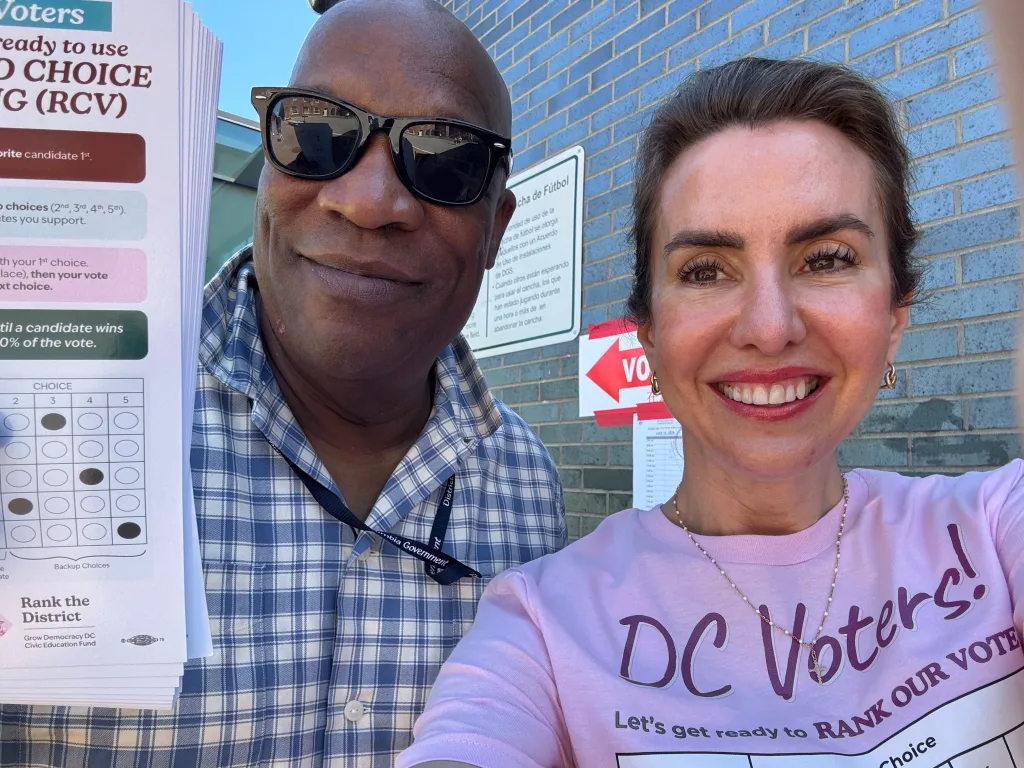
Voting largely went smoothly across Washington, DC during early voting and on Election Day – with some routine hiccups like printers running out of ink, and some polls staying open past 8pm with a late rush of voters. As in previous years, the DC Board of Elections did not release results until well past the 8pm poll close time.
Ahead of the election, the Board of Elections and Rank The District held hundreds of education events in all parts of DC to make sure residents were ready to rank the vote. Candidates, individuals, and private organizations also supported voter education with events, outreach, and media and social media campaigns demonstrating how to fill out an RCV ballot.
I’m grateful for the DC Board of Elections and partners for their strong implementation and voter education efforts across all eight wards. Thanks to our dedicated election workers, our voting centers largely ran smoothly from early voting through tonight. Rank the District volunteers spoke with thousands of voters as they entered poll sites, and most were familiar and comfortable with ranked choice voting. The most common question was whether voters had to rank all five choices, or if they could rank fewer.
– Lisa D. T. Rice, CEO of Grow Democracy DC and the Proposer of Initiative 83
Initial results from the Washington, DC elections
At time of writing on June 17, the Associated Press estimates that around 64% of votes have been counted. Races where no candidate wins a majority of first choices will proceed to a ranked choice voting count – most likely the at-large Council and Ward 1 Democratic primaries. With RCV, all nominees will have support from a majority of their party – as will the winner in an at-large Council special election.
Mayor
In the closely watched mayoral race, Councilmember Janeese Lewis George leads with 52.8% of voters’ first choices, followed by former Councilmember Kenyan McDuffie at 36.6%. McDuffie conceded the race on the morning of June 18.
Congressional delegate
Five candidates ran in the Democratic primary to succeed retiring Delegate Eleanor Holmes Norton. Councilmember Robert White won that election with 63.2% of first choices. Councilmember Brooke Pinto came in second with 21.5% of first choices.
At-large Council Democratic primary
Nine candidates ran for the Democratic nomination to succeed at-large Councilmember Anita Bonds. No candidate has won a majority of first choices. Oye Owolewa leads with 33.8%, followed by Lisa Raymond at 15.2% and Kevin Chavous at 13.8%. The result will likely be determined by a ranked choice voting count.
| Candidate | Share of first choices |
|---|---|
| Oye Owolewa | 33.8% |
| Lisa Raymond | 15.2% |
| Kevin B Chavous | 13.8% |
| Greg Jackson | 11.0% |
| Candace Tiana Nelson | 7.7% |
| Dwight Davis | 6.0% |
| Fred Hill | 5.4% |
| Dyana N. M. Forester | 3.7% |
| Leniqua’dominique Jenkins | 3.0% |
| Write-in | 0.4% |
In a choose-one election, Owolewa would have won the nomination despite 66% of voters voting for another candidate. In 2022, for instance, Councilmember Anita Bonds won the Democratic primary for this seat with only 36% of first choices. Now, ranked choice voting will ensure the nominee – whether Owolewa or someone else – has majority support.
At-large Council special election
In the special election for at-large Council, former Councilmember Elissa Silverman is leading with 54.8% of first choices, followed by appointed Councilmember Doni Crawford and Board of Education President Jacque Patterson, with 25% and 19% respectively. If Silverman maintains a majority of first choices, there will be no ranked choice tabulation.
Ward 1
In the competitive Democratic primary for Ward 1 councilmember, Aparna Raj leads with 47% of first choices. Depending on remaining ballots, Raj may win with a majority of first choices, or the winner may be determined by a ranked choice voting count.
| Candidate | Share of first choices |
|---|---|
| Aparna Raj | 46.7% |
| Miguel Trindade Deramo | 20.3% |
| Rashida Brown | 17.2% |
| Jackie Reyes Yanes | 10.0% |
| Terry Lynch | 5.8% |
| Write-in | 0.1% |
Notably, in three Council races – the at-large Council Democratic primary, at-large Council special election, and Ward 1 Democratic primary – candidates cross-endorsed each other, asking voters to rank each other on their ballots. Past elections show that voters often listen to cross-endorsements by candidates they support, so it’s possible candidates who cross-endorsed will benefit when their races go to RCV tallies.
DC’s ranked choice voting elections offer a sharp contrast with the District’s recent past, in which candidates regularly won key primaries without majority support. Since 2012, every districtwide office and six of the eight wards have seen Democratic primaries won with less than 50% of the vote. Since 2020, Ward 2 and Ward 7 have had Democratic Council primaries won with less than 30% of the vote.
FairVote will post more analysis of the DC election over the coming week. In the meantime, visit Grow Democracy DC to learn more about RCV in DC.