The Fair Representation Act (H.R.4632) is the bold, comprehensive solution that solves the problems of partisan gerrymandering and uncompetitive elections for U.S. House. It combines three main components:
- Multi-member districts for congressional elections
- Ranked choice voting in these elections
- New requirements for congressional redistricting
Our traditional, winner-take all politics polarizes legislative bodies, making it difficult to pass legislation the majority of the public supports. It also makes it more difficult to diversify legislative bodies and ensure all people are represented in government.
The Fair Representation Act has the power to transform our political system and create a more inclusive and deliberative government which respects and empowers all voices. Voters can ask their representative to support the act here.

The U.S. House is most in need of the Fair Representation Act because of its high levels of partisan division. This reform will incentivize good governance, comity, consensus and compromise for the greater good — ideals upon which our nation was founded.
Every elected leader should be free to govern with the knowledge that they will be rewarded at the ballot box for responding to our nation’s most pressing challenges and effecting change. The Fair Representation Act will apply this reform to all elections to the U.S. House, aka The People’s House, and improve its legislative function — and our democracy.
Find sample maps for how the Fair Representation Act might look in all 50 states, see why leading academics have endorsed it, and learn how it improves representation for voters of color everywhere in the country.
Join us today Join us today Join us today Join us in our missionJoin us today Join us today Join us today Join us today Join us today Join us today Join us today Join us today Join us today Join us today Join us today Join us today
Impact

Ensures representation for all Americans
The Fair Representation Act creates more opportunities for Americans across the political spectrum to be represented in government, no matter their zip code. This means greater inclusion for people of color, urban Republicans, rural Democrats, Independent and third-party voters, major party bases and other voters across the political spectrum. With the Fair Representation Act, far more Americans will be represented by an elected official who is incentivized to make decisions that reflect the will of all of their constituents.

Reduces polarization
Under the Fair Representation Act, our Congress would look much different than it does today. Rather than lawmakers lumped into warring camps of “red” and “blue,” with disproportionate representation at both political extremes, our Congress would reflect our country’s actual ideological composition. We would elect more Democrats who oppose abortion rights, for example, as well as more Republicans who support gun safety and more political Independents — and all would work within various coalitions to pass meaningful legislation.

Ends gerrymandering
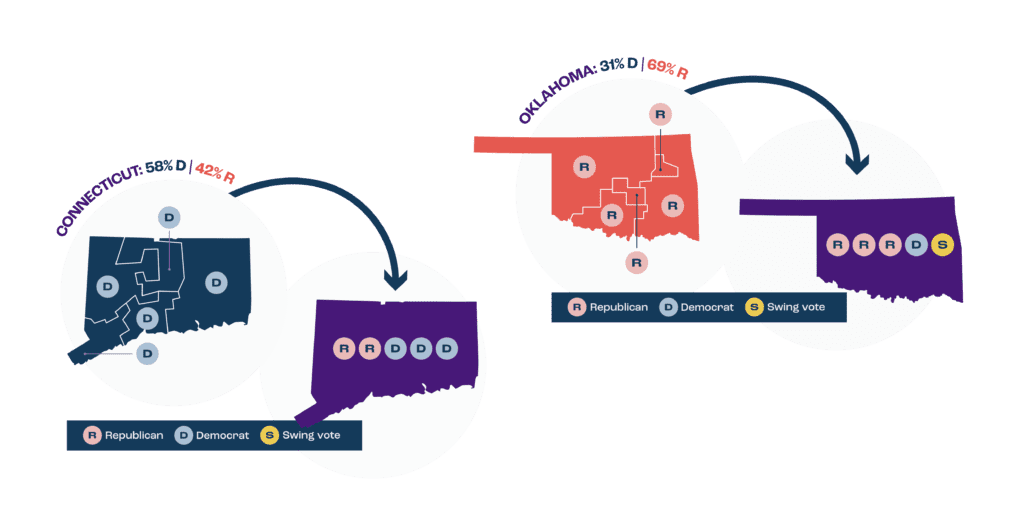
The Fair Representation Act effectively eliminates gerrymandering, both intentional and unintentional. Multi-member districts with ranked choice voting allow most voters to elect candidates they support, which means an area’s political left, right and center earn their fair share of representation in Congress.
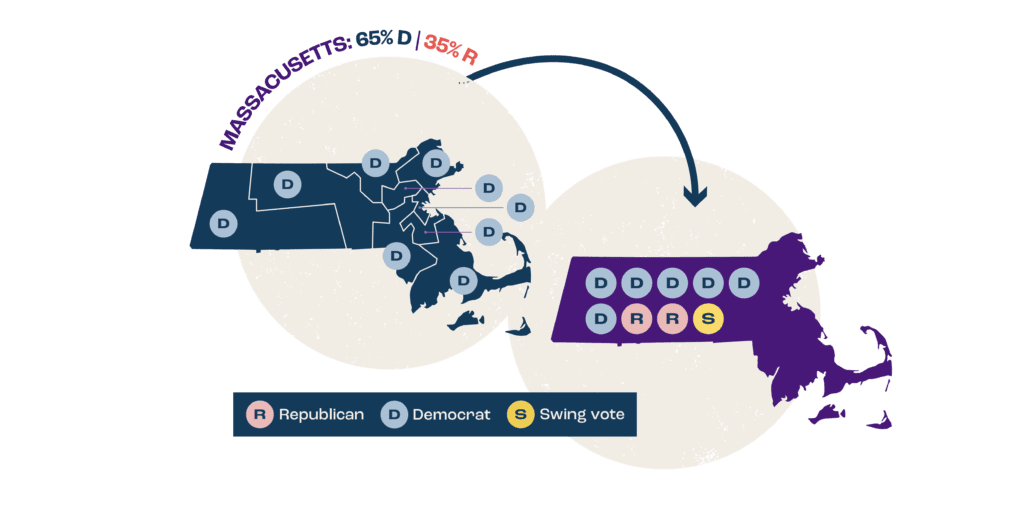
For example, Republicans typically earn 30% to 40% of the vote in Massachusetts elections, yet all nine of the state’s U.S. House members are Democrats. No map-makers could possibly draw district lines to allow Republicans a fair number of seats, simply due to the state’s geography. The Fair Representation Act would solve that problem.
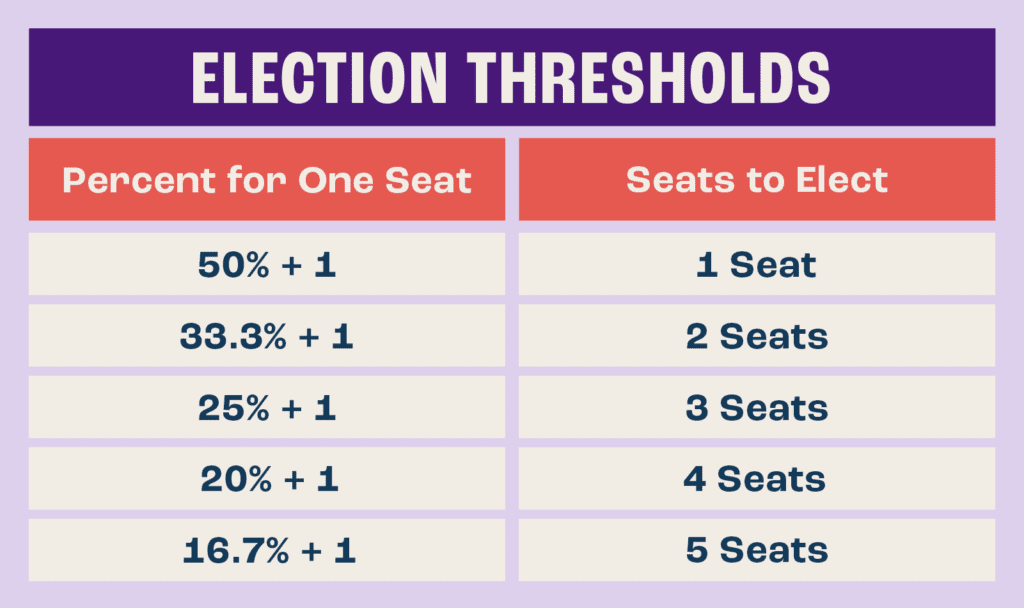
Additionally, partisan legislators sometimes gerrymander district maps to dilute the voting power of communities of color. With multiwinner districts, any group of voters whose size exceeds the election threshold (typically 17% to 25% depending on the district’s size) has the power to elect a representative of their choice. Voters of color would have the power to elect candidates of their choice simply by ending the power of gerrymandering.

Promotes good governance
Our representatives are trapped in a winner-take-all political system, where efforts to reach across the aisle often end their political career.
The Fair Representation Act ensures that incumbents are held accountable not only for their views or how well they battle opponents, but how effectively they govern. This system would free lawmakers from binary political factions and enable them to better negotiate with colleagues and address problems.
How the votes are counted
Voting and vote counting is similar to ranked choice voting, with one exception: Instead of one candidate winning with a majority of the votes, several candidates win with smaller shares.
It’s straightforward for voters: Rank candidates in order of choice. Voters can rank as many candidates as they want, without fear that doing so will hurt their favorite candidate’s chances. Ranking a backup choice will never hurt a voter’s favorite candidate, so voters have no reason to vote for only one candidate.
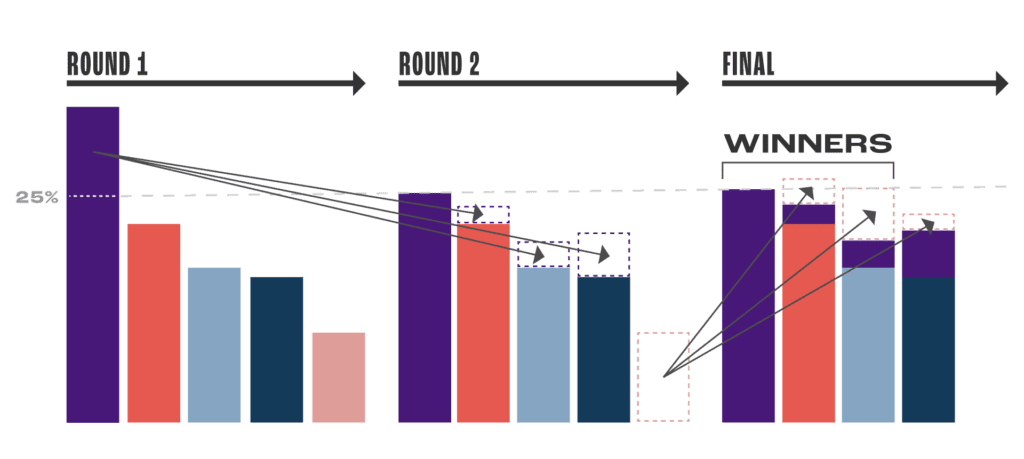
Candidates who receive a certain share of votes — the “threshold” — are elected based on the number of open seats. For example, if there are three seats to fill, any candidate who gets more than 25% of the vote earns a seat. Excess votes (those above the threshold) are then counted for the voters’ second choices, ensuring that no voters are wasted. After excess votes are distributed, the candidate with the fewest votes is eliminated. Votes for the defeated candidate are then allocated to voters’ second choice candidate. This process continues until all seats are filled.