Did the “second Dan Sullivan” affect Alaska's U.S. Senate election?

No, retired teacher Daniel J. Sullivan did not change the result of Alaska’s Senate election. Sullivan won just 1.7% of voters’ first choices – less than one-half of the 4.3-point margin between winner Mary Peltola and incumbent Senator Dan S. Sullivan. If the race had proceeded to a ranked choice voting tally, more Daniel J. Sullivan voters preferred Peltola – 34% of his voters ranked Peltola ahead of Senator Sullivan, compared to only 23% who ranked Peltola above Sullivan.
Here’s more on what happened.
First choices in Alaska’s 2026 U.S. Senate race
| Candidate | # of first choices | % of first choices |
|---|---|---|
| Mary Peltola | 144,573 | 50.10% |
| Dan S. Sullivan | 132,054 | 45.76% |
| Gerald L. Heikes | 6,229 | 2.16% |
| Daniel J. Sullivan | 4,829 | 1.67% |
| Write-in | 886 | 0.31% |
Two candidates named “Dan Sullivan” were on the ballot for Alaska’s U.S. Senate election. A New York Times report found that the “other” Dan Sullivan – a teacher named Daniel J. Sullivan – was recruited by Democrats to play “spoiler” and take away votes from the incumbent, Senator Dan S. Sullivan.
Across the country, it’s common for parties to prop up lesser-known candidates to “take away” votes and deny the election to a front-runner, including this election cycle. According to Axios, Democratic- and Republican-aligned Super PACs spent over $16.5 million this cycle promoting independent and third-party candidates across more than 40 Senate and House races – with the goal of siphoning votes from major-party opponents. In many cases, these Super PACs’ spending greatly exceeded the candidates’ own spending.
However, this type of gamesmanship is far less effective in Alaska – because the state uses ranked choice voting (RCV) in its general elections. Even though the Alaska Division of Elections distinguished the two Sullivans on the ballot, any small number of uncertain voters could rank both on their ballot, and their vote would count for the stronger candidate – in this case, Senator Sullivan.
Sample ballot for Alaska’s U.S. Senate election
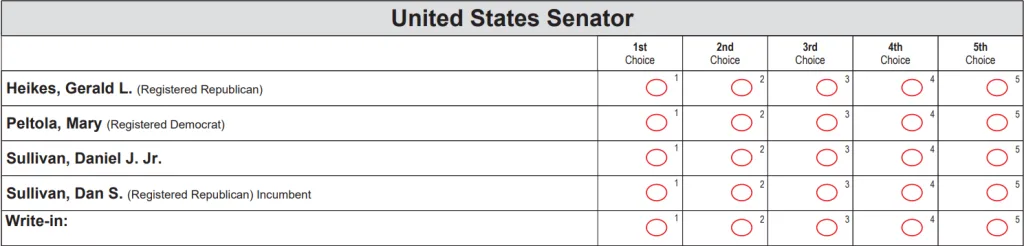
As it turned out, Daniel J. Sullivan’s candidacy had no bearing on the outcome. Democrat Mary Peltola won more than 50% of voters’ first choices, negating the need for an RCV tally. Even if every vote for Daniel J. Sullivan – and another minor candidate in the race, Gerald Heikes – had instead counted for Senator Sullivan, it would not have been enough to defeat Peltola.
That said, Alaska publishes a cast vote record – an anonymous, digital record of how each voter ranked the candidates – which shares how voters ranked their ballots. This allows us to run an unofficial ranked choice tally, and determine who Daniel J. Sullivan voters preferred as their backup choice.
34% of Daniel J. Sullivan’s supporters ranked Peltola above Sen. Sullivan, while 23% ranked Sen. Sullivan above Peltola. Another 6% ranked Republican Gerald Heikes as a backup choice, but neither Sen. Sullivan nor Peltola. Meanwhile, most Heikes voters preferred fellow Republican Senator Sullivan as their next choice – 41% ranked him above Peltola, compared to just 18% who preferred Peltola.
Ballots that ranked Daniel J. Sullivan or Gerald Heikes first, broken down by which candidate they would count for in the final round
| First-choice candidate | Transfers to Peltola | Transfers to Sullivan | Ranked neither |
|---|---|---|---|
| Daniel J. Sullivan | 34% | 23% | 43% |
| Gerald Heikes | 18% | 41% | 41% |
Daniel J. Sullivan supporters’ choices in the governor’s race helps explain the split. Most Daniel J. Sullivan voters who ranked Peltola above Sen. Sullivan (73%) also ranked the Democratic candidate first for governor, which suggests that many of them were Democratic-leaning voters casting some form of protest vote. By contrast, 75% of those who preferred Senator Dan S. Sullivan ranked a Republican candidate first for governor.
In other words, Alaska voters knew what they were doing, and used their ranked ballot to express their full range of preferences. RCV blunted the impact of gamesmanship and potential voter confusion. Ultimately, though, Peltola wins – no matter how Daniel J. Sullivan’s voters ranked the other candidates.
To learn more about Alaska’s 2026 RCV elections, check out FairVote’s analysis of all three statewide races.