Book Review: “The Seven Democratic Virtues” by Christopher Beem
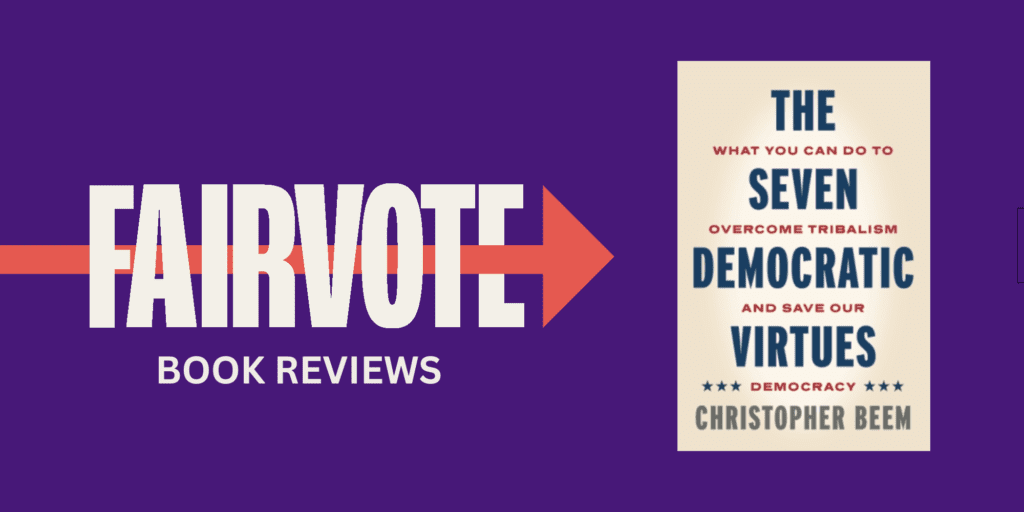
Why do many Democrats and Republicans distrust each other, and what can be done about it? Many political scientists have studied the trend of increasing affective polarization: the tendency for partisans to dislike those from the other party. In The Seven Democratic Virtues (“democratic” in the “small-d” sense), Christopher Beem offers a theoretical companion to this empirical work, both diagnosing what ails the United States and prescribing solutions. Beem makes a compelling case for several democratic virtues that the Fair Representation Act could help promote among elected officials and ordinary citizens alike.
Beem argues that the major threat facing American democracy is the vice of “tribalism”: when our sense of us and them becomes so overpowering that “we shirk our responsibilities or lose touch with reality” (p. 28). To combat tribalism, Beem offers seven virtues broken down into three categories. The democratic thinking virtues are honesty, humility, and consistency; democratic acting includes courage and temperance; and democratic beliefs necessitate charity and faith.
Two of Beem’s seven virtues stand out for supporters of electoral reform: humility and courage. The chapter on humility is particularly compelling, because it captures several empirical findings showing how humility counterintuitively encourages skills worth bragging about. Summarizing research from Samantha Deffler and her colleagues, Beem concludes that “humility is associated with more careful reading comprehension, especially of opinions that one does not agree with, and a more accurate accounting of what one does and does not know” (p. 73). Then, turning to research from Tenelle Porter, Beem concludes that humility is associated with higher grades in school and general intelligence. Humility is also important for leadership, as it “distinguishes CEOs of highly successful organizations.” (p. 74) Looking beyond academic and professional achievements, he even concludes “that people who are humble tend to have better and more successful romantic relationships” (p. 74).
Beem agrees with author Lee Drutman that the United States is in a “doom loop” of political polarization; as the political parties become more polarized, they have more incentives to break democratic norms, increasing tensions and driving yet more polarization in a negative tit for tat. Ultimately, Beem concludes, it will take courage for both sides to step out of this doom loop and fortify democracy (p. 125).
Drutman’s prescription to ending the doom loop is institutional reform similar to the Fair Representation Act, so what should we make of Beem’s cultural approach? Beem acknowledges institutions matter but argues that “the prerequisite to reforming our politics is the reform of our own actions and behaviors.” (p. 4). Others may argue institutions are more important; James Madison, for example, makes a compelling institutional case in Federalist 51, writing, “If men were angels, no government would be necessary. If angels were to govern men, neither external nor internal controls on government would be necessary.” A potential synthesis between the two approaches could be to acknowledge that culture influences institutions and vice versa.
To illustrate this synthesis, consider the democratic virtues that the Fair Representation Act would incentivize political leaders to embrace. If the bill were passed, most districts in the country would elect members of both major parties. It requires humility to share representation with someone who disagrees with your ideology and acknowledge that they might have some good ideas worth embracing. It also takes courage to run for office in the first place. The Fair Representation Act would incentivize new candidates from diverse backgrounds to run by offering the promise of more competitive elections and more proportional outcomes.
As warning signs flare about the state of American democracy, we should consider both cultural and institutional solutions. Beem’s The Seven Democratic Virtues is an empowering text that gives readers actionable steps to promote democracy through their individual behavior. If enough leaders and ordinary citizens embrace the virtues he presents, we can be optimistic about the potential for political reform, peace, and prosperity in the years to come.