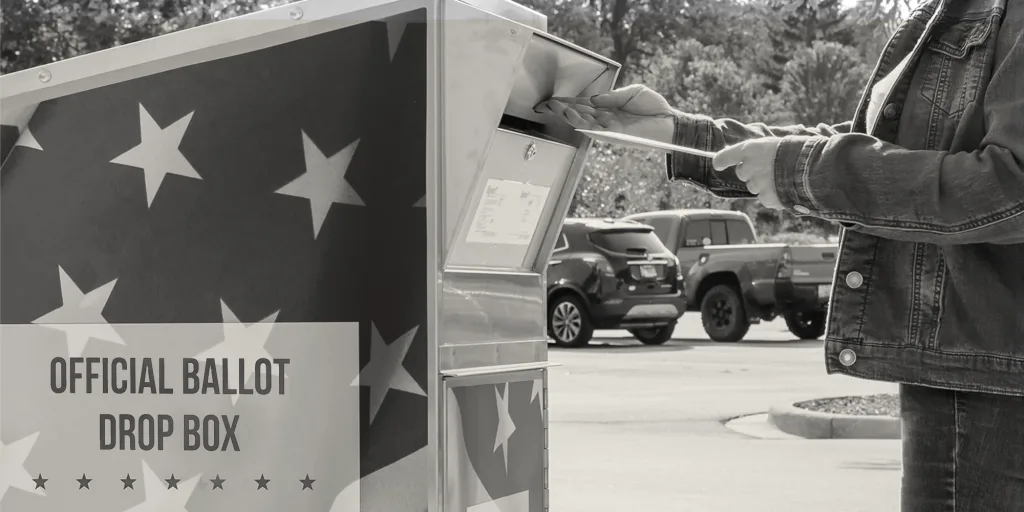
Americans think democracy isn’t working. Ranked choice voting can help.
Summer 2025 update: Since this post was first published, many more polls have measured Americans’ frustration with our political system – including a June 2025 Pew survey that found 62% of Americans are dissatisfied with our democracy, and a January 2025 Ipsos poll that found 88% of Americans say our political system is broken.
Read on to learn how ranked choice voting (RCV) can provide the real change to our politics that Americans are hungry for. A more comprehensive list of poll results is available at the bottom of the post.
A new Pew Research poll finds that just 19% of Americans believe our country is “a good example of democracy.” 8% say it has never been a good example, while a whopping 72% of us believe it used to be a good example, but no longer is.
This is just the latest indication that a growing number of Americans believe democracy isn’t working. Recent polls have also found that the number of Americans satisfied with democracy has reached a historic low, and President Joe Biden just dropped his re-election bid amidst polls showing that voters were unhappy with both presumptive nominees. At a time when politicians spend more time attacking each other than working on the issues that matter to voters, and the legislative process has ground to a halt, it’s no wonder Americans are so frustrated.

No one reform is a silver bullet, but improving our elections can help lower the temperature and create a more cooperative politics. Ranked choice voting would encourage politicians to reach across the aisle and deliver for their constituents, while giving Americans more voice and more choice in elections.
Americans think democracy isn’t working
There are worrying signs that Americans don’t believe our democratic institutions are working. According to a January 2024 Gallup poll, only 28% of U.S. adults are satisfied with the way democracy is working in the country – a record low. That’s seven points lower than just after the January 6, 2021 attack on the U.S. Capitol (35%).
Moreover, a troubling PRRI poll last fall found that a growing share of Americans believe political violence might be necessary to protect the country. 23% said that “because things have gotten so far off track, true American patriots may have to resort to violence in order to save our country” – up from just 15% in 2021. In the wake of the horrific assassination attempt on former President Trump this month, it feels as though toxicity in politics has reached a fever pitch.
RCV can move elections away from the mentality of “us vs. them.” Candidates have an incentive to show common ground, since they may need to earn second- or third-choice support from their opponents’ voters to win. Campaign cycles, debates, and platforms become less toxic, because candidates must appeal beyond their base.
Polling has repeatedly shown that Americans in RCV jurisdictions are more satisfied with the conduct of campaigns than Americans in non-RCV jurisdictions.
Americans want more choices in elections
It’s not just democracy writ large; before Biden dropped out, polls found that many Americans felt unrepresented and frustrated by the choices in this year’s presidential race. A July Pew poll found 53% of voters believed both candidates should be replaced – up from 49% in April – and a third of each candidate’s supporters said their own candidate was embarrassing.
Frustration appears particularly strong among Gen Z voters, many of whom feel as though their voices aren’t being heard in the election. This May, Gen Z and Millenials polled as the least likely age groups to vote in the 2024 general election: Only 69% stated they are likely to vote (compared to 82% of Gen X and 89% of Baby Boomers). The University of Chicago’s GenForward Survey (also produced in May) asked 18-29 year olds who do not think they will vote why they won’t. Among those respondents:
- 23% said they feel like their vote doesn’t matter.
- 22% said the presidential candidates do not represent their political beliefs and ideas.
- 13% said they don’t like any of the candidates.
Ranked choice voting could facilitate the greater power and choice that younger voters demand. That’s because it addresses the “spoiler problem” that plagues our choose-one elections anytime more than two candidates enter a race. Voters could rank their favorite candidates in order of preference, without fear of actually helping their least-favorite candidate get elected. They wouldn’t be accused of “wasting” their vote, or told only to choose the “lesser of two evils.” It’s no wonder young voters are among the strongest supporters of RCV.
Thankfully, ranked choice voting and other electoral reforms are gaining momentum around the country. Structural reform can help America move towards the stronger democracy many of us desire.
RCV is already being used from coast to coast – in 48 cities and counties and statewide in Alaska and Maine, where both states will use it to award their presidential electoral votes this year. The rest of the country should follow these states’ lead!
Recent surveys capturing Americans’ low marks for our democracy include:
- This August 2025 Gallup poll, in which just 31% of Americans say they are satisfied with the direction of the country. The partisan gulf in how Americans view the direction of the country is wider than ever; 76% of Republicans say they are satisfied with it, compared to just 1% of Democrats and 25% of independents.
- This June 2025 Pew Research Center survey, in which 62% of Americans say they are dissatisfied with how democracy is working in the country, compared to just 37% who are satisfied. By contrast, in Australia, which uses ranked choice voting, 61% of respondents say they are satisfied.
- This April 2025 Bright Line Watch survey, in which Americans rate the country’s democratic performance at just 49 out of 100 – the lowest rating since Bright Line Watch began tracking in 2018
- This January 2025 New York Times / Ipsos poll, in which 88% say our political system is broken – including 89% of Democrats and 91% of Republicans
- This April 2024 Pew poll, in which 85% of Americans said most elected officials don’t care what people like them think
- This January 2024 Gallup poll, in which a record-low 28% were satisfied with how democracy is working
- This September 2023 Pew poll, in which only 4% said our political system is working very or extremely well
- This July 2023 AP-NORC Center poll, in which 53% of Americans said Congress is not upholding democratic values, and just 10% said democracy is working very or extremely well