2024 Democracy Solutions Summit recap

Much of this post was adapted from communications by Alissa Bombardier Shaw, Outreach Manager at RepresentWomen.
Earlier this month, I was proud to join RepresentWomen’s third annual Democracy Solutions Summit.
Especially exciting for Women’s History Month, the summit stands out as the only one of its kind to feature only women speakers – bringing together women leaders strengthening democracy around the world!
Over 400 registrants tuned in on each day of the Democracy Solutions Summit and heard from 37 impressive women experts, including U.S. Senator Lisa Murkowski, U.S. Representative Mary Peltola, prominent political journalists Judy Woodruff and Amy Walter, and nine women leaders from around the world.
Below is a recap of each of the three days of fantastic virtual panels focused on solutions to build a 21st-century democracy that reflects today’s needs and values:
Day 1: Ranked choice voting
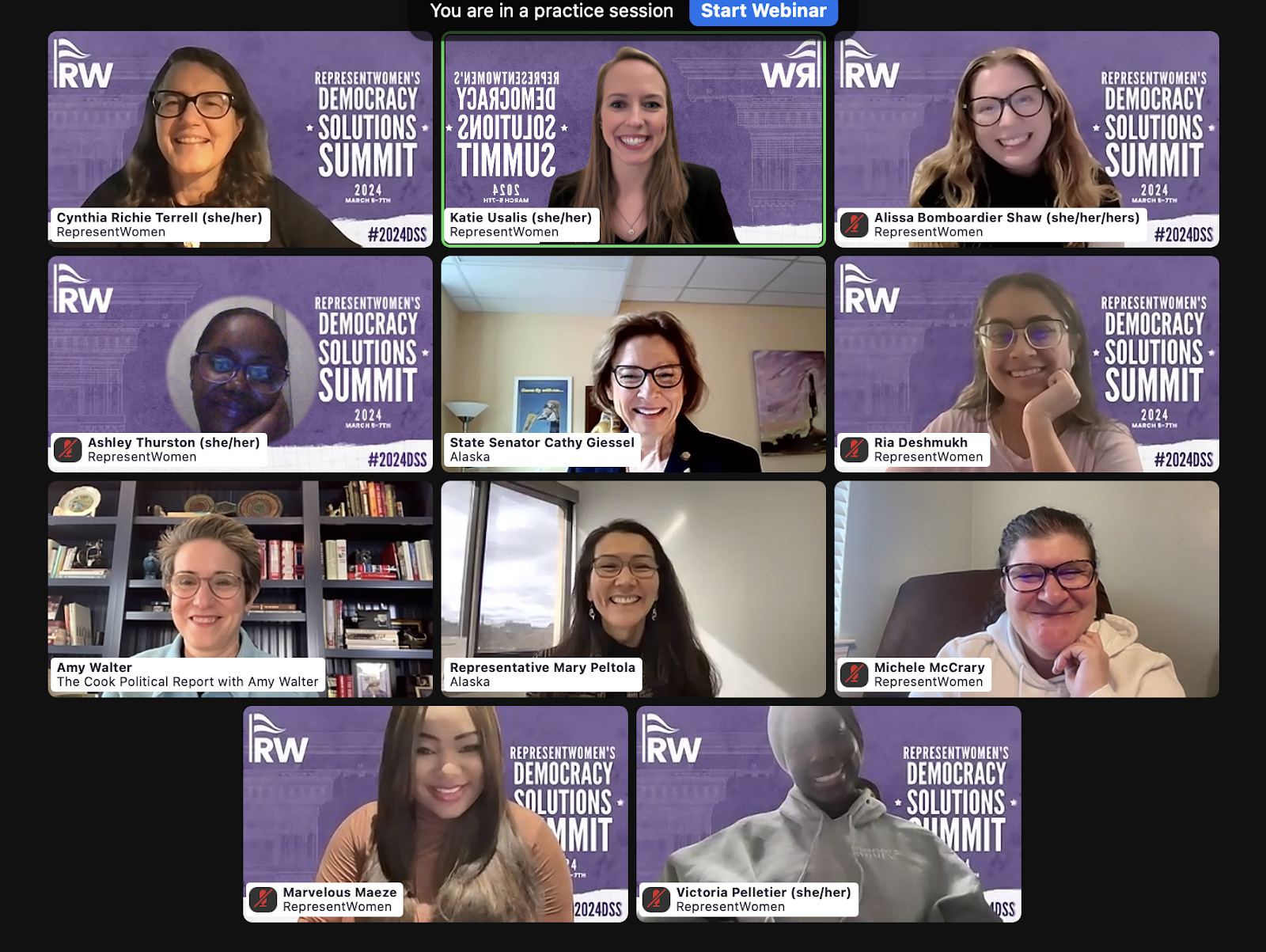
The RepresentWomen Team backstage on Day One of the Summit with State Senator Cathy Giessel, U.S. Representative Mary Peltola, and Amy Walter.
I was proud to moderate one of the four panels on Day 1, which homed in on ranked choice voting (RCV) as the most promising and immediate solution for the problems facing American democracy:
More women ran as candidates than in the 5 previous election cycles put together. This open primary and ranked choice voting blew the door open for all kinds of people.
– Senator Cathy Giessel, Majority Leader of the Alaska Senate
Changing the system and changing the structure of how people get elected… is something that all of us as citizens of democracy can get our heads around.
– Laura Arnold, Philanthropist and Co-founder of Arnold Ventures LLC
We cannot have a thriving, active, healthy democracy if we do not have equal representation.
– Emily Lockwood, Women in Political Power Strategy Lead at Pivotal Ventures
Ranked choice voting is a better way to give voters more choices and have their votes really count. It’s something that really appeals to [voters], and they are very excited about having more women and more people of color in office.
– Lisa Rice, Chair, Make All Voices Count DC campaign
Day 2: Ranked Choice Voting & the presidential race
This was a timely discussion, held just days after Nikki Haley became the first woman to win a GOP presidential primary (and on the exact day she dropped out of the race).
Participants heard from women about what it’s like to run for higher office in the United States, the barriers women face, and the solutions that could remedy those barriers. Panelists noted that young people are more disheartened than ever with the prospects for our country, and highlighted how ranked choice voting for presidential primaries levels the playing field for women candidates. A “Take Action Panel” addressed the ambition myth and the gauntlet of challenges women hopefuls must overcome to run for office.
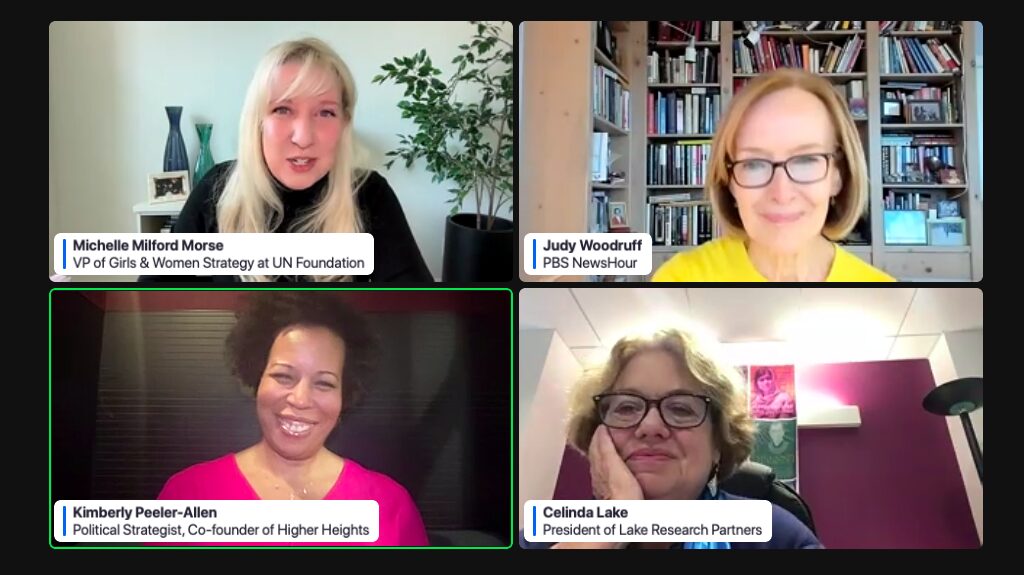
Michelle Milford Morse introducing the first panel on Day Two, Running for President as a Woman in the U.S., with Judy Woodruff, Kimberly Peeler-Allen, and Celinda Lake.
We must all be disruptors. And raising our voices is what makes our democracy strong.
– Kimberly Peeler Allen, Political Strategist and Co-founder of Higher Heights for America
Now is your moment. This is the time. I think there is a critical frustration across the board that we haven’t emerged with women’s leadership. I think people want changed leadership.
– Celinda Lake, Political Strategist and President of Lake Research Partners
Nobody should have to work harder, and nobody should have to overcome more obstacles or spend more, to serve.
– Gowri Ramachandran, Deputy Director of the Brennan Center’s Democracy Program
Day 3: Global Solutions
Around the world, people are challenging the status quo and demanding a new way of governing that doesn’t involve binary choices, zero-sum thinking, and aggressive competition. Panels on Day 3 focused on electoral and non-electoral strategies that have proven to level the playing field for women to run and serve.
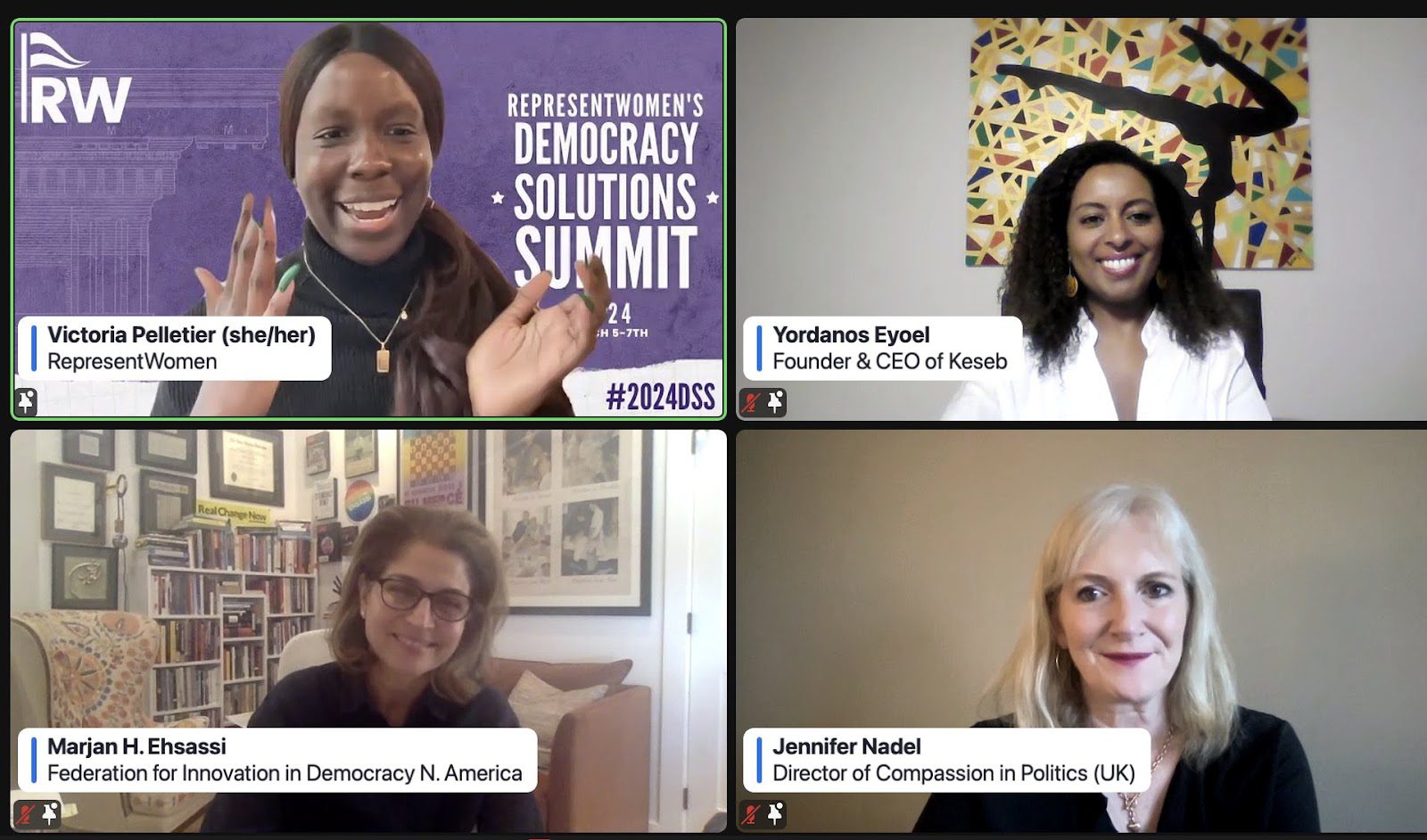
RepresentWomen’s National Partnerships Manager Victoria Pelletier moderating a brilliant conversation with Marjan Ehsassi, Yordanos Eyoel, and Jennifer Nadel on how women are crafting a new and improved way of governing.
Our system needs to change. It’s very difficult for a minority of women to change a system that is designed really to exclude them… Of course the more women we have, the better the chance of changing the system, but it is the system that needs to change.
– Jennifer Nadel, Co-Director of Compassion in Politics
Even if sometimes elected officials feel that the gap between what they actually do and what the public gets to see is, to some extent, unfair or a detriment to their to their mental well-being, they still consider it a privilege [to serve] and they still want to pursue producing positive impacts for their communities.
– Natalia Herbst, Director of Latin America Strategy and Development at Apolitical
The Democracy Solutions Summit wrapped up with a fireside chat about two of the most powerful policy solutions that have a proven track record of removing barriers for women to run and win: gender quotas as well as proportional ranked choice voting. Women experts from countries that deploy these systems shared how these policy solutions work, and the impact they’ve had on women in their countries.
Recordings from all three days are available on the Democracy Solutions Summit website, along with more detailed bios of this impressive gathering of speakers and moderators.
To follow up on the inspiration generated throughout the summit, RepresentWomen encourages listeners to take action, starting with:
- Applying for the Women’s Power Collaborative (WPC). The WPC brings advocates, leaders, and elected officials together to network, strategize, and share resources to build women’s political power.
- Sharing the Women Experts in Democracy Directory, which lists leaders with expertise ranging from candidate training to election security, campaign finance, ranked choice voting, and more. To be featured in the directory, or to nominate someone for inclusion, use this form.