FairVote is at the forefront of one of the most urgent battles in our lifetimes: driving better elections that give all of us better choices, fairer representation, and better government. Yet the work of electoral reform is complex, full of uncertainty, and constantly changing. How does FairVote navigate these challenges and deliver results?
FairVote does this by becoming a learning organization, constantly iterating and improving toward our important goals. Adaptation is key: If your plan stays the same, you haven’t learned. The principles and practices we follow as a learning organization are explained below.
Principles
- Evidence: We use evidence based on qualitative and quantitative data to inform our planning and decisions.
- Learning: Learning is at the center of all that we do. Learning is an iterative, non-linear process that allows us to navigate complexity and uncertainty. We “fail fast” – when something isn’t working, we learn and pivot.
- Participation & inclusion: Our spaces and learning conversations bring all relevant staff and stakeholders to the table – so we get the right information, the right perspectives, and the right contributions to make meaningful change.
- Accountability: We hold ourselves accountable for achieving defined and measurable results and ensuring efficient use of resources.
Practices
- People
- We invest in a culture of curiosity by encouraging staff to ask harder questions of themselves and their colleagues.
- We enable conditions and foster greater trust across our teams, partners, and stakeholders. We “fail fast” – and improve fast – when we can openly discuss and learn from challenges.
- Spaces
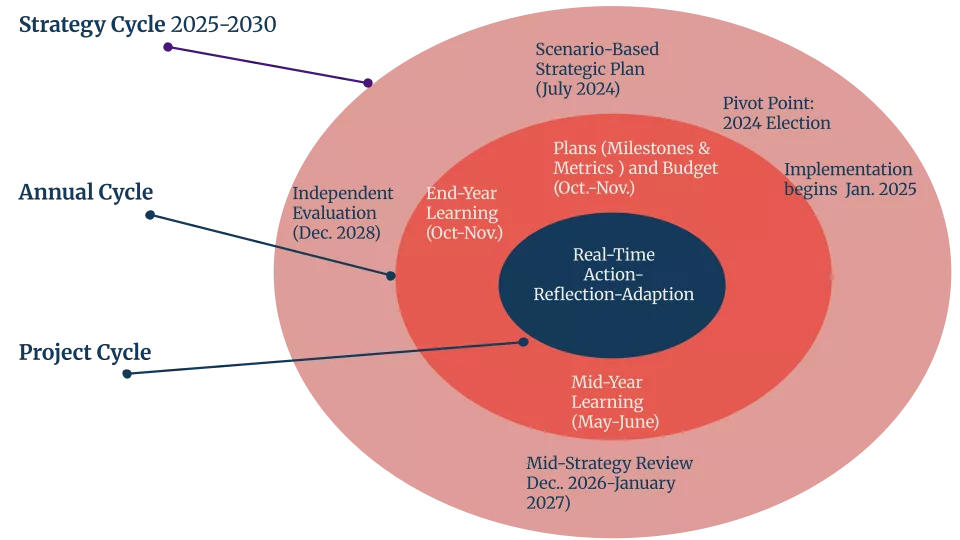
- We create intentional spaces for learning and decision-making throughout the year, including real-time learning, after-action reviews, twice-yearly participatory progress and learning reviews across the organization, quarterly light touch reviews by the Leadership Team, and strategy updates with the Board. These spaces focused on both strategy (are we doing the right things?) and tactics (are we doing things right?).
- These spaces are not just more bureaucracy; they are intuitive and nimble, with discussion rooted in the information we gather daily.
- Defined milestones
- In line with our strategy, we clearly identify our annual priorities – what we want to achieve by the end of each year and how. This provides clear direction for our day-to-day work.
- Iterative learning and adaptation: As a learning organization, we regularly collect and analyze progress and context data. We review this data in real time, and in our defined learning spaces. This practice grounds our work in data and evidence.
- Learning studies and evaluation
- We undertake learning and case studies as the need emerges, such as the 2024 Ballot Measure Learning Study. We plan to undertake an independent mid-strategy evaluation for our 2025-2030 strategic plan.
To learn more, contact Suvarna Hulawale, our Director of Strategy and Learning, at [email protected].