What to expect in November’s RCV elections: Part 1

With less than a week left until Election Day 2024, let’s take a look at what to expect from ranked choice voting (RCV) elections and ballot measures. This November, voters in two states and 12 cities will use RCV to elect their leaders. Additionally, voters in four states and several cities will vote on ballot measures to bring RCV to their elections.
This post will focus on statewide ballot measures and RCV elections. Highlights include:
- Voters in Colorado, Idaho, Nevada, Oregon, DC, and two other cities will vote on ballot measures to adopt RCV.
- Alaska and Maine will use RCV to award their presidential electoral votes and choose their members of Congress, including a U.S. senator in Maine. Alaska will also use RCV to elect its state legislature.
Stay tuned for an update on local RCV elections and ballot measures in the coming days.
Statewide RCV ballot measures
- Colorado, Idaho, and Nevada will vote on adopting open primaries and RCV general elections for state and federal offices. Colorado and Idaho’s open primaries would advance four candidates to the general election, while Nevada’s would advance five. Nevadans already voted YES on this reform in 2022, but citizen-initiated constitutional amendments must pass twice in Nevada to take effect.
- Oregon and Washington, DC will vote on adopting RCV in both party primaries and general elections. Oregon’s ballot measure would apply to all statewide and federal offices, and DC’s would apply to all offices. Both would include RCV for the presidential election.
- Any of the four states where RCV is on the ballot – Colorado, Idaho, Nevada, or Oregon – would become the most populous state to adopt the reform.
- Alaska will vote on whether to repeal RCV and open primaries, which were adopted by voters in 2020 and first used in 2022. Missouri lawmakers snuck a provision to ban ranked choice voting into a ballot measure to ban noncitizen voting, even though noncitizens already cannot vote in Missouri and no Missouri cities use RCV. The lawmakers likely hope Missouri voters will support the measure without reading the whole thing.
RCV elections in Alaska
Alaska voters will use RCV for president, Congress, and state legislative races. Voters have the option to rank up to eight candidates for president.
Alaska is one of two states that uses RCV for the presidential election. Unlike in single-choice elections, third-party and independent candidates can run without playing “spoiler,” and all voters can rank their favorite candidate first without “throwing away their vote” – giving voters more choices. Donald Trump has led recent Alaska polls by several percentage points.
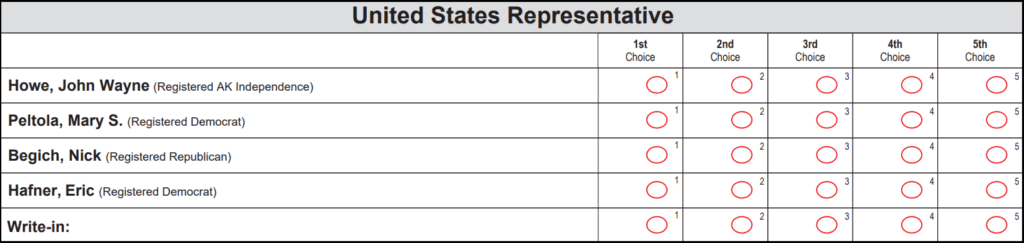
In the congressional race, we’ll see a rematch between Representative Mary Peltola (D) and Nick Begich (R), with two other candidates also in the race. In 2022, Peltola beat Begich in both a special election and a regular election for this seat, winning the most 1st-choices in each contest and then earning a majority in the ranked choice voting count. Polling shows that this race will be close.
In addition to the federal elections, Alaska is using RCV for its state legislative elections. In Senate Districts D, F, and L, Republican incumbents in the Alaska Senate’s bipartisan majority caucus face opponents from both the Democratic and Republican parties.
Alaska has many late-arriving ballots due to the size of the state and slowness of transporting ballots from rural areas. Be ready to wait a week or more before we know the results of the RCV ballot measure, and 15 days before we know the outcomes of any races that go to an RCV tabulation due to a choice by the Alaska Division of Elections to not conduct RCV tabulations until every ballot is received.
RCV elections in Maine
Mainers get to use RCV for president, U.S. Senate, and U.S. House this year.
The presidential race includes five candidates. Because Maine splits its electoral votes by congressional district, it is likely that Kamala Harris and Donald Trump will each earn electoral votes in the state. Harris is favored to win the two votes awarded to the statewide winner, and the vote from the 1st Congressional District. Trump is favored to win the vote from the 2nd Congressional District.
RCV will also be used in Maine’s U.S. Senate race, where independent Angus King is running for a third term. He is being challenged by both a Democrat and a Republican. Unlike in other races around the country, Maine’s Senate race can accommodate three candidates without fear of one candidate playing “spoiler.”
In Maine’s 1st Congressional District, incumbent Democrat Chellie Pingree is facing Republican and independent challengers. In the 2nd District, there are only two candidates on the ballot – Democratic Rep. Jared Golden and Republican Austin Theriault. Theriault has sought to portray himself as a moderate, running an ad promising to put “people over politics” and break from his party if they try to ban abortion nationwide or cut Social Security or Medicare. Rep. Golden is also running on a moderate record. Because there are only two candidates on the ballot, the race is unlikely to go to an RCV count – though there is a third declared write-in candidate.
The campaign is a marked difference from the previous two cycles, when former Rep. Bruce Poliquin (R) borrowed former President Donald Trump’s “America First” slogan and positioned himself as a staunch ally of Trump and former right-wing Governor Paul LePage. Maine’s 2nd Congressional District is the subject of a recent paper on how RCV encourages bipartisan behavior in competitive districts.
Expect Maine to report only first-choice results on election night due to election administrators’ preferences – with RCV results reported several days later.