Voting Rights at the Court: Another Test for Section Two
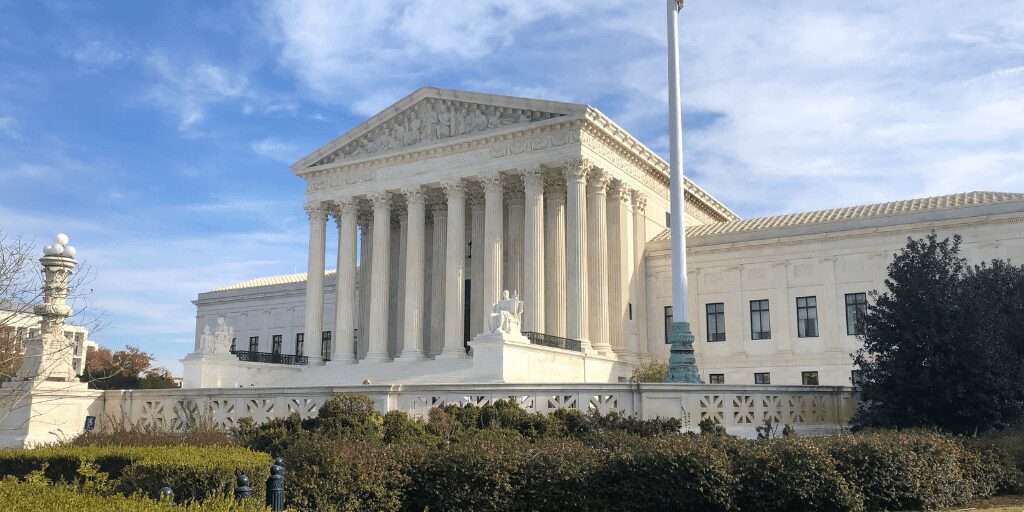
This morning, the U.S. Supreme Court heard arguments in a pivotal voting rights case out of Alabama, Merrill v. Milligan. In this case, the stakes are high–the future of the Voting Rights Act (“VRA”) and legal protections for minority communities may well depend on how the Court rules.
For a full discussion about the VRA, FairVote has recently provided a historical background of the law on this year’s anniversary of Bloody Sunday, and greater legal context on this year’s anniversary of the Shelby County decision. Here, it is important to establish that Section 2 of the VRA prohibits state voting laws that discriminate on the basis of race, color, or language spoken. Crucially, racial discrimination can (and often does) occur without explicit, documented intent; and that the only way to effectively prove and remedy racial discrimination is to acknowledge that race, as a socially important factor, does in fact exist.
However, during the 1970s the Supreme Court began to read into the text of the VRA a requirement that a successful challenge show an intent to discriminate. To correct this interpretation, in 1982 Congress amended the VRA to clarify that discriminatory intent is not required to strike down a map that may result in a denial or abridgment of the right to vote on account of race or color. Last year, in a separate line of case law Sec. 2 was also weakened in Brnovich v. Democratic National Committee when the Court read into the text new and arduous standards for challengers of election laws under Section 2 of the VRA. And now, in Merrill v. Milligan, the Court may again weaken the VRA’s Section 2, or possibly render it useless altogether.
This case from Alabama began how most gerrymandering cases begin; the state needed to draw new districts after the census was conducted, Alabama produced a map, and shortly thereafter a suit was filed in federal court. The central issue boils down to the new map containing only one Black opportunity district out of the state’s seven congressional seats—about 14%—whereas Black Alabamians compose 27% of the state’s population. Much of Alabama’s Black population is packed into that single opportunity district while the rest is cracked among six districts that are otherwise dominated by white voters. As FairVote’s Dave Daley wrote when touring the new boundaries, “These lines neatly trace, and perpetuate, Alabama’s history of racial injustice…”
In response, the State of Alabama argued that not only did they not use race as a predominant factor when creating the new maps, but that plaintiffs must provide a “race-neutral” map to make their case. Here Alabama furthered the legal concept of “race-blindness”: the idea that the best way to end racial discrimination is to pretend that race as a concept no longer exists. Unfortunately for Alabama here and the rest of society, we cannot unring the bell of race as a socially, politically, and legally relevant concept. “Race” as such has existed in what is now the United States since Europeans began their genocidal campaign against Natives in the mid-1500s, and since they began bringing enslaved people here in the early 1600s. Alabama’s quarrel with the jurisprudential considerations of race should not lie with the Court’s interpretation of the VRA, but instead with genociders and slavers of centuries past.
Appropriately, in January a unanimous federal district court disagreed with Alabama and held that Section 2 required the state to create two minority opportunity districts in order to provide Black voters an equal opportunity to elect their preferred candidates. In February, however, the Supreme Court stayed that decision, allowing the map to be used in the 2022 midterm elections, until the Court can fully decide the case on the merits. At that time, Justices Kavanaugh and Alito wrote seemingly in favor of reconsidering whether Section 2 of the VRA allows for any racial considerations, while Chief Justice Roberts signaled an interest in reconsidering the 1986 Thornburg v. Gingles decision, an important Section 2 precedent.
Today, Alabama (and amici) presented the Supreme Court with two options: either interpret the VRA in such a way as to render it completely useless, or find the VRA itself unconstitutional. During oral arguments, however, the Justices appeared skeptical of Alabama’s most extreme positions, and will likely reject the invitation to overrule existing precedent or overturn the law. A range of other worrisome options exist–including increasing the evidentiary burden for plaintiffs bringing Section 2 claims–which could make VRA cases nearly impossible to win for those seeking to challenge state action. Last, while Justice Jackson is likely to find herself in a dissent in this case, she made powerful points articulating that the 14th Amendment itself is not race-neutral, and therefore does not require statutes grounded in its authority to be race-neutral, either.
As we wait for the decision in the case, likely to be released sometime early next year, Congress need not wait: our representatives can act at any time to ensure the VRA is preserved, strengthened, and extended. The John Lewis Voting Rights Advancement Act would do just that, and deserves our continued support and advocacy.