Twelve locations to hold RCV elections on November 8th
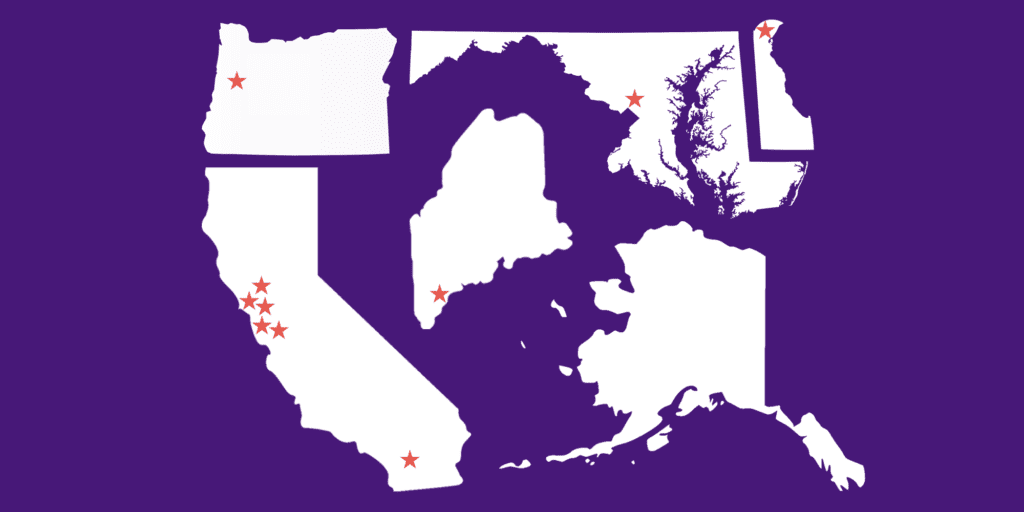
Two states and ten cities will use ranked choice voting (RCV) on November 8th to select their elected officials. RCV will be used for Senator, Governor, District Attorney, Mayor, and more.
Three locations are using RCV for the first time:
- Corvallis, Oregon adopted RCV by a city council vote in 2022.
- Palm Desert, California adopted proportional RCV as part of a California Voting Rights Act settlement.
- Albany, California adopted proportional RCV by ballot initiative. 73% of voters supported the initiative after the city council voted to place it on the ballot in 2020.
This post is your preview into which locations are using RCV and what we can expect.
Alaska
Alaska will use RCV to elect its Governor, Lieutenant Governor, U.S. Senate and House members, and state senate and house members. Alaska combined RCV with top-four open primaries, meaning the top four candidates for each seat get to compete in the general election. This election follows Alaska’s first use of RCV in August.
One race to watch is the Senate contest, where incumbent Lisa Murkowski (R) faces off against Republican Kelly Tshibaka and Democrat Pat Chesbro. With another member of her own party challenging her from the right, Murkowski’s path to reelection involves winning first-choice support from independent-minded and centrist voters. Murkowski famously won a write-in campaign in 2010 after losing the Republican primary to a Tea Party-backed challenger.
Another race to watch is the rematch for Alaska’s seat in the U.S. House of Representatives. In a special election in August to fill a vacancy for a partial term, Democrat Mary Peltola defeated two Republicans, Sarah Palin and Nick Begich. This November, the same three candidates are joined by Libertarian Chris Bye to determine who will fill the seat for the full two-year term.
Maine
In Maine, voters will use RCV for U.S. House of Representatives, after also using it in partisan primaries in June of this year. Maine voters began using RCV in 2018.
The race to watch in Maine is for the 2nd congressional district, where a rematch is occurring between incumbent Jared Golden (D), former Representative Bruce Poliquin (R), and independent Tiffany Bond. The same three candidates competed for this seat in 2018, along with an additional independent, when Jared Golden won a come-from-behind victory in the second round.
Corvallis, Oregon
Voters in Corvallis will use RCV for the first time for mayor and for ward 9 city councilor.
The race to watch is the mayoral election, where two-term incumbent Mayor Biff Traber is stepping down. All three candidates have served on the city council together.
Palm Desert, California
Palm Desert voters will use proportional RCV for the first time after the city adopted it as part of a California Voting Rights Act settlement. Palm Desert is now divided into one large district with four city council members and one smaller district represented by a single city councilor. The four-member district will be electing two members this November (two members are elected every two years) using proportional RCV.
There are five candidates running in the multi-member district for two available seats, including one incumbent. Proportional RCV is designed to award seats to different factions in proportion to their share of the vote.
Albany, California
Albany voters will use proportional RCV as well. 73% of voters supported the ballot initiative to adopt it after the city council voted to place it on the ballot in 2020. In November, Albany voters will elect 2 city councilors and 3 school board members, both using proportional RCV.
The race to watch is the city council contest where five candidates are running for two seats. The candidates include a slate called “Albany Forward” including Robin Lopez, John Miki, and Nick Pilch, plus an additional two candidates, Jeremiah Garrett-Pinguelo and Jennifer Hansen-Romero.
The school board race is practically uncontested. Four candidates filed to run for three seats, but one has withdrawn even though their name still appears on the ballot.
San Francisco, California
San Francisco voters will select a district attorney, a public defender, an assessor recorder, and six members of their Board of Supervisors in RCV races this November. San Francisco has been using RCV since 2004.
The contest to watch is the race for district attorney, where short-term incumbent Brooke Jenkins was appointed in June after former DA Chesa Boudin was recalled. Jenkins has multiple opponents who served on the Police Commission and it is expected to be a tight race.
Another high-profile San Francisco race is the contest for Board of Supervisors in the sixth district. Appointee Matt Dorsey faces off against three challengers, including former contestant on RuPaul’s Drag Race Honey Mahogany.
Oakland, California
Oakland voters are choosing a mayor and three city councilors in RCV races this November. Oakland had used RCV since 2010.
The race to watch is the mayoral election, where ten candidates are running for an open seat. In crowded elections like this, we typically see more than 80% of voters choose to rank multiple candidates. During the last stretch of the campaign, we’ll be watching to see whether any of these ten candidates adopt RCV-specific strategies, like cross-endorsing each other or campaigning together.
Berkeley, California
Berkeley voters are selecting four city councilors and a city auditor in RCV elections. Berkeley has used RCV since 2010.
The race to watch is the district 8 city council contest, the only race in Berkeley without an incumbent running. Four candidates are campaigning for this seat, and a fifth name will appear on the ballot, Mary-Lee Smith, although Smith has dropped out of the race. The candidates include Mark Humbert, who has the endorsement of outgoing councilor Lori Droste and indicates he plans to carry on Droste’s work, and Mari Mendonca who is endorsed by progressive leaders and indicates that she may go in a different direction from Droste.
San Leandro, California
San Leandro voters will use RCV to choose the mayor and three city councilors. San Leandro has used RCV since 2010. The current mayor and two city councilors are stepping down due to term limits, setting up several competitive contests.
The race to watch in San Leandro is the mayoral election, where four candidates are competing to fill the seat left open by term-limited current Mayor Pauline Russo. The mayoral candidates are Bryan Azevedo, Christopher Bammer, Juan Gonzalez, and Lee Thomas.
Portland, Maine
Portland has used RCV for mayor since 2010, and just expanded it in 2020 to also apply to city council and school board. 81% of Portland voters supported the RCV expansion.
The race to watch in Portland is the at-large city council election where incumbent Pious Ali has two challengers, Aqeel Mohialdeen and Richard Ward.
Portland voters will also be voting on another RCV ballot measure. If passed, the measure would change the form of RCV used for multi-winner elections from sequential RCV to proportional RCV. Proportional RCV is the gold standard for multi-winner elections.
Takoma Park, Maryland
Takoma Park has used RCV since 2007. This year, voters will vote for mayor and for all six city council seats.
The race to watch is the mayoral election, where current Mayor Kate Stewart is stepping down after serving as mayor since 2015. This is the first mayoral election contested by three or more candidates since RCV was implemented. The candidates running to replace Stewart are Seth Grimes, Talisha Searcy, and Jarrett Smith.
Arden, Delaware
The Village of Arden has used proportional RCV since the early 20th century. They use it to elect seven members to the board of assessors each year, all elected city-wide. Arden has a history of strong civic engagement, with many candidates typically running for the seven seats. There are 14 candidates running this year. Find a description of Arden’s elections here. They refer to proportional RCV as The Hare Method.
Honorable mention: Benton County, Oregon
Benton County uses RCV to elect its county commissioners and sheriff, but there are no races contested by more than two candidates in 2022 so RCV will not be a factor this year.
The city of Corvallis, mentioned above, is in Benton County, demonstrating how jurisdictions can pave the way for more RCV implementations in their area. Benton County successfully implemented RCV in 2020 and demonstrated to cities in the county that RCV is simple, fair, and secure.
Looking ahead to December: Burlington, Vermont
Burlington adopted RCV for city council elections via ballot initiative in 2021, with 64% of voters in support. Their first RCV election will occur in December 2022. They had planned to begin using RCV in early 2023, but a vacancy on the city council has prompted a special election on December 6th.
The Burlington city council is also considering expanding RCV to mayoral elections in the future.