Ranked choice voting (RCV) and approval voting are both election methods under consideration in the U.S. However, ranked choice voting has already been used for hundreds of elections and is well-tested in practice and in the courts. Approval voting is newer and has less evidence behind it. This page compares ranked choice voting vs. approval voting, including an examination of how they have worked in practice and research on both methods.
How ranked choice voting works
RCV allows voters the option to rank candidates on the ballot in order of preference: one, two, three, and so forth. The voter may rank as many or as few candidates as they choose.
Ranked choice voting is a “one person, one vote” system. If your vote cannot help your top choice win, your vote counts for your next choice. Ranking another candidate second will not hurt your first choice in any way. Your back up choice will only come into play if your favorite candidate is already eliminated.
If a candidate receives more than half of the first choices, that candidate wins. However, if there is no majority winner after counting first choices, the race is decided by an “instant runoff.” The candidate with the fewest votes is eliminated, and voters who picked that candidate as ‘number 1’ will have their votes count for their next choice. This process continues until there’s a majority winner (a candidate won with more than half of the vote).
Ranked choice ballots look different than typical “choose-one” ballots because of the option to rank candidates. Voters fill in the bubbles to indicate their ranking preferences.

How approval voting works
Approval voting allows each voter to vote for as many candidates as they “approve” of. Voters may vote for as many candidates as they choose.
The candidate with the most “approvals” wins the election. Just like in traditional choose-one voting, there is no guarantee that the winner will have the support of at least half of the voters. Unlike “choose-one” voting, there is no guarantee that each voter will have the same number of votes.
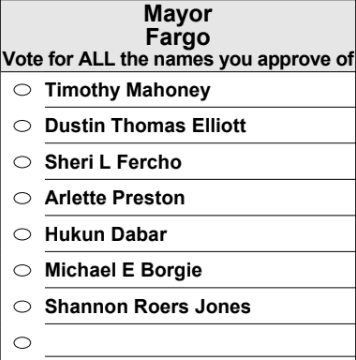
Approval voting ballots look like typical choose-one ballots, but the approval voting races will include different voting instructions. The instructions will read something like, “vote for all the names you approve of.”
Comparing use of RCV vs. approval voting in practice
RCV in practice
As of August 2022, ranked choice voting is in use in over 50 jurisdictions in the U.S., including two states (Maine and Alaska) and major cities such as New York and Salt Lake City. Over 10 million voters have access to ranked ballots, and it has been used in presidential primaries in four states.
FairVote collects data on all 500+ RCV elections held in this country since 2004. It is customary for most RCV jurisdictions to release a full cast vote record, allowing independent verification and analysis. In the interest of open data, FairVote has compiled those cast vote records for public viewing here.
Key findings from FairVote’s analysis of nearly two decades of RCV elections include:
- 73% of voters in RCV elections ranked the winner in their top 3 choices, representing strong mandates for the winners
- 71% of voters choose to rank multiple candidates in RCV elections
- Ballot error rate in RCV is comparable to that of choose-one elections
- Exit polling reveals that voters in RCV cities and states like using it, and prefer it to their prior voting method. See our Data on RCV webpage for more.
Approval voting is used in two cities, Fargo, ND (since 2020) and St. Louis, MO (since 2021). Due to a lack of data from these elections, it is not possible at this time to make direct comparisons to the RCV statistics above. However, election results from those two cities do reveal some concerning trends.
Approval voting in practice
Approval voting in St. Louis, MO
St. Louis used a modified version of approval voting in 2021, using approval voting in the first round of a two-round runoff election. Results were mixed. In the mayoral preliminary election, voters “approved” of an average of 1.6 candidates to determine the two winners who would advance — a high rate for a typical single-winner election but low for a two-winner election. This was true even though the leading newspaper endorsed two mayoral candidates, and voters knew they could more safely vote for two candidates because two would advance. Ballot usage rates were much lower for the ward alderman positions, with voters typically approving of an average of just 1.1 candidates in each ward.
Voters in the general election — in which turnout was 30% higher — were presented with only the two choices identified by approval voting from the primary electorate. In other words, voters were presented with fewer choices at the time when turnout was highest. David Kimball, a political science professor at the University of Missouri at St. Louis found that voters in majority-White wards were more likely to cast multiple votes than voters in majority-Black wards. As a result, White voters likely had a larger say in determining the two finalists than Black voters.
Three city council runoffs resulted in different winners than those who led the approval-voting preliminary elections. The approval voting leader in Ward 17, for example, earned approval votes from 69% of voters, while the second-place candidate won approval from only 46% percent. Nonetheless, the second-place candidate beat the first-place candidate in the head-to-head runoff. Approval voting on its own was clearly unable to determine the candidate who would win in a head-to-head matchup.
See this spreadsheet for an analysis of how few voters use multiple “approvals” in approval voting in Fargo, compared to the higher rate of expressive voting in RCV elections of a similar size.
Approval voting in Fargo, ND
Fargo used multi-winner approval voting in 2020 and 2022 for city council and mayoral races. The city council races were two-winner contests where the top two finishers each earned a seat. This version of approval voting is a “winner-take-all” voting method, which means a cohesive majority can control all seats, shutting out minority voices.
The mayoral election was a single-winner race. A poll found that:
- 60% of respondents voted for only one candidate for mayor, even in a field of seven choices
- 30% reported voting strategically
- 51% of voters correctly identified what approval voting is
In the mayoral election, Multiple candidates included “vote for one” in their messaging, based on their understanding of strategic voting in approval voting.
I would probably bet that every candidate says just vote once because that has more power as a vote.
-Fargo mayor Tim Mahoney in announcing his successful re-election campaign in February
The problem is the more candidates you vote for, the more it dilutes the impact of your vote.
– Rep. Shannon Roer Jones in January as she launched her mayoral campaign that resulted in a third place finish
Scholarly research on RCV and approval voting
Ranked choice voting is the subject of extensive academic and applied research given its history in the U.S. and around the world. It has been used for over 100 years around the world in countries such as Australia and Ireland. FairVote’s Data on RCV page includes a round-up of academic research on RCV, as well as FairVote’s own research, organized by topic. Highlights include research on the impact on women and candidates of color; research on ballot error; research on voter understanding; and research on increased campaign civility.
Approval voting does not have a similar body of research because of less robust data and a lack of approval voting elections to date. Some computational research has attempted to measure how approval voting would work in hypothetical elections with mixed results. Existing academic research highlights how susceptible approval voting is to strategic manipulation, but relies on computer simulations due to a lack of real-world election results. (See The Burr Dilemma in Approval Voting, Statistical Evaluation of Voting Rules, and Collective Decisions and Voting: The Potential for Public Choice.
Advantages of RCV compared to approval voting
Votes for a backup choice can harm your first choice in approval voting.
Approval voting can be challenging for voters with strong preferences. A vote for a second choice counts exactly as much as a vote for a first choice, creating incentives to “bullet vote,” or choose only one candidate, even when voters have second- or third-choice preferences. Because voters can’t back compromise candidates without weakening their first choice, the use of strategic voting increases — especially in contested elections. In these races, few voters will vote for more candidates than winners, reverting the system back to plurality-like dynamics.
St. Louis also used approval voting in the first round of seven city council elections in 2021. In those contests, voters “approved” an average of between 1.1 and 1.4 candidates. In Fargo, 60% of voters selected only one choice in a field of 7 candidates for mayor. This dismal rate may reflect voters’ unwillingness to support second-choice candidates when it can undermine their first-choice.
In RCV, voters’ ranking for a backup choice only counts if their first choice is defeated, eliminating the incentive to bury support for a second-choice candidate. Therefore, strategic voting is less likely under RCV. In fact, 71% of voters in RCV elections opt to rank multiple choices. See this spreadsheet for an analysis of how many voters choose to express multiple preferences in RCV vs approval voting in 2021.
Approval voting rewards strategic voters and campaigns.
Savvy voters with robust understanding of approval voting can ensure their vote is highly impactful, while other voters may miss this opportunity. Voters who know which candidate poses the greatest threat to their favorite candidate will understand that they can bury support for competitors to boost their favorite candidates’ chances. Voters’ inability to distinguish between strong and weak support increases incentives to vote strategically rather than sincerely, putting voters on uneven footing.
In fact, a poll of Fargo, ND voters who used approval voting in 2020 found that nearly a third of voters who voted for one candidate did so strategically.
Approval voting could also incentivize hostile and polarizing gameplay between campaigns. Campaigns could encourage bullet voting to increase their chances of winning. For example, if a left, right, and center candidate (relative to the jurisdiction) ran in an approval voting race, and all voters voted honestly, the center candidate would likely win, having gained approvals from both sides. Sensing this, the left and right candidates could demonize the center candidate, so their respective bases don’t give approvals to that candidate.
In Fargo, approval voting has already resulted in strategic-voting messaging from campaigns. Multiple mayoral candidates acknowledged the strategic incentives for voters to not engage in approval voting.
- “I would probably bet that every candidate says just vote once because that has more power as a vote.” – Fargo mayor Tim Mahoney in announcing his successful re-election campaign in February
- “The problem is the more candidates you vote for, the more it dilutes the impact of your vote.” – Rep. Shannon Roer Jones in January as she launched her mayoral campaign that resulted in a third place finish
RCV, on the other hand, does not redistribute a voter’s ballot until his/her initial preference(s) have been eliminated. This means a vote for one candidate does not equate to a vote against another. In fact, candidates will rely on the re-distribution of ballots (the back-up choices of other campaigns’ supporters) to win in later round(s). Thus, candidates are incentivized to find common ground with other candidates.
Approval Voting is Less Expressive and More Subjective than RCV
With approving voting, voters are unable to express stronger and weaker preferences, and must decide to what degree liking or agreeing with a candidate equates to an “approval.” Voters would have to fit a diverse group of candidates into two boxes: “yes” or “no.” RCV, on the other hand, allows voters to express preferences between all candidates on the ballot.
Because voters interpret “approval” in different ways, it gives them different amounts of power over election outcomes. One voter might only vote for candidates they actively like. Another might vote for all candidates whom they find palatable. These voters have a different impact on the result because they interpret “approval” differently. Rating a movie either “thumbs up” or “thumbs down” is highly subjective; so too is rating candidates this way. And both yield inconsistent returns.
RCV, on the other hand, allows for a more standardized way of voting and is less susceptible to strategic voting. Voters simply rank candidates in order of preference, knowing that a second-choice ranking will not harm their top choice, rather than worrying over exactly how much support to give to a second-favorite candidate — providing for a better and simpler voting experience.
Approval voting does not always elect candidates with broad support.
Even if voters are willing to “approve” of multiple candidates, candidates in a large field can win with low overall support from the electorate.
This is because approval voting has no majority criterion, and therefore might not elect a majority-preferred candidate. Because voters can’t distinguish between strong and weak support on their ballots, it’s possible that a candidate who is the top choice of well over half of voters could lose to a candidate with little-to-no first-choice support.
Approval voting could also result in victory for a candidate with no supporters who would select that candidate as their top choice over a candidate whom more than half of voters support as their first choice.
For example, Dartmouth College in New Hampshire is one of few places that has tried approval voting, but students ditched it after a string of student presidents were elected with support from less than 40% of voters. The University of Colorado saw the same phenomenon, where typically more than 90% of voters vote for only one candidate.
In RCV, by contrast, winning candidates must have a strong base of first-choice support and also broad appeal within the electorate. RCV is a majority system.
RCV improves representation for women and people of color.
No sustained evidence finds that approval voting increases representation among women and people of color in public office.
RCV, however, has a demonstrated track record of doing so. See research on RCV and representation.
RCV is on solid legal ground
Approval voting is so rare that it has never come before a judge, so its ability to stand up to legal challenges is untested. Voters in approval voting elections have varying levels of electoral power based on how they interpret and assign their “approvals,” which could lead to legal challenges.
RCV, in contrast, has been upheld against every federal constitutional challenge brought to date.