Ranked choice voting and voter patterns in at-large races in the District of Columbia
Explore the report on this page, or download as a PDF.
Executive summary
There is a current ballot initiative in Washington, DC that would add the District to the growing number of American localities that use ranked choice voting (RCV) for state or local elections. The District’s unique circumstances warrant a closer look at how RCV might impact DC voters.
This paper examines recent voting behavior in DC and analyzes election data from other RCV elections in order to estimate the likely impact of RCV on DC voter turnout and participation – with a specific focus on DC’s at-large city council elections, which allow voters to choose two candidates.
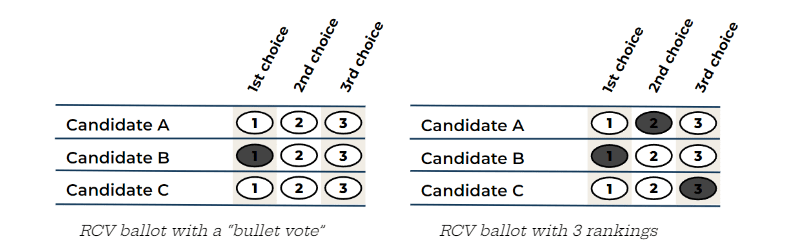
Some observers have noted the high number of DC voters who choose only one candidate in the vote-for-two at-large city council race (a practice known as “bullet voting”), and wondered whether those voters will be less likely to rank multiple candidates if the District moves to RCV.
Our key findings include:
- Bullet voting before RCV does not correlate with voters ranking only one candidate after the switch to RCV.
- Voting for only one candidate (“bullet voting”) instead of two in DC’s at-large city council elections is likely an informed and intentional choice.
- Bullet voting decreases dramatically when cities switch to RCV – in other words, the number of voters who rank only one candidate is far lower than the number of voters who chose only one candidate pre-RCV.
Our findings indicate that DC voters would likely understand RCV and participate in RCV elections at high rates across the District’s eight wards.
Bullet voting in vote-for-two races in DC is likely an informed and intentional choice
“Bullet voting” occurs when voters only vote for one candidate, even though they have the option to pick more than one – like in general elections for DC’s at-large city council seats, in which voters can vote for two candidates. In the at-large city council race, voters have two votes but there is only a single Democratic nominee on the ballot.
Voters in Ward 7 and Ward 8 have higher rates of bullet voting than other wards. Evidence going back several election cycles suggests that this behavior is likely informed, intentional, and based on partisanship.
First, Wards 7 and 8 demonstrate a stronger preference for Democratic nominees than other wards. For example, in 11 out of 12 single-winner citywide races over the last six years – including races for mayor, DC attorney general, and at-large city councilors – voters in Wards 7 and 8 preferred the Democratic nominee by a wider margin than the District as a whole.
In the at-large city council race specifically, voters in Wards 7 and 8 have regularly given more support to the single Democratic nominee, matching their behavior in single-winner elections. Even considering that fewer total votes are cast in these wards, the difference is significant. (See Figure 1.)
Second, Wards 7 and 8 have some of the highest rates of participation in other down-ballot races. As a recent example, in 2022, voters in Wards 7 and 8 were more likely than voters in other wards to participate in the U.S. representative and attorney general races during the general election. They were also among the most likely to vote in the at-large city council primary that year. (See Figure 2.)
These two findings paint a picture of voters who are making informed choices, and who want to support Democratic nominees without elevating other candidates, since casting two votes in a vote-for-two election threatens to harm a voter’s favorite candidate.
Figure 1: Vote share for Democratic at-large city council nominee by ward, 2016-2022
Figure 2: Participation rate in down-ballot races, 2022
Bullet voting in non-RCV elections does not correlate with ranking only one candidate in RCV elections
Many other locations in the United States have switched from vote-for-two elections to ranked choice voting, so DC will not be unique. We examined other cities that switched from vote-for-two elections to RCV in order to determine whether behavior in non-RCV elections is a good predictor of RCV behavior.
Twelve cities in Utah adopted RCV in 2021 after previously using citywide at-large voting. Among these cities, five released enough ballot data to compare the number of voters who ranked only one candidate in RCV races in 2021 with the number of voters who “bullet voted” in their previous vote-for-two elections.
Figure 3: Bullet votes in 5 Utah cities, pre-RCV and post-RCV
As the graph above shows, there is no correlation between bullet voting in vote-for-two elections (purple bars) and ranking only one candidate after switching to RCV (orange bars). In all five of these cities, bullet voting was lower after the adoption of RCV; in four of five, the rate fell dramatically. This is likely because RCV does not create the same incentives to vote strategically as vote-for-two voting.
Given this evidence, there is no reason to believe voters in Wards 7 and 8 are more likely to rank only one candidate if RCV is adopted.
RCV and voter turnout
Ranked choice voting can also boost voter turnout in municipal elections. For example, when New York City used RCV in its 2021 primaries, that election had its highest turnout in over 30 years. Recent research finds that voters in RCV jurisdictions are 17% more likely to turn out for municipal elections. Additionally, voters of color typically rank more candidates than White voters.
RCV can create a particularly strong turnout effect when combined with other complementary policies, as in Initiative 83, which would allow the District’s 75,000-plus independent voters to vote in the party primary of their choice. Currently, these voters – approximately 17% of the District’s voters – are ineligible to vote in any primary election.
Figure 4: DC voters ineligible to vote in primary elections
Conclusion
Our analysis finds no factual basis for claims that RCV would be problematic for voters in Washington, DC’s Wards 7 and 8. Ballot data suggests that voters in these wards appear to be making informed and intentional choices. Additionally, RCV has decreased the rate of bullet voting in other cities around the country – and there is no correlation between bullet voting rates before and after adoption of RCV.
We conclude that, if Initiative 83 is adopted, DC voters will likely understand ranked choice voting and participate in elections at high rates across the District’s eight wards. We would also expect an increased number of voters participating in elections, given that the initiative will open primaries to an additional 17 percent of voters.