Ranking limit recommendations for multi-winner ranked choice voting
Executive summary
FairVote recommends that in multi-winner ranked choice voting (RCV) elections, voters should be able to rank at least five candidates and up to nine, roughly equal to the number of seats being elected (N) and as ballot design and technology permit. This range allows voters to express a sufficient number of preferences and help elect a candidate of choice, keeps ballots short and easy to navigate, and gives jurisdictions flexibility to make decisions based on their own priorities and constraints.
This report explains the reasons behind our recommendation in more detail, as well as the general implications of ranking limits.
Our recommendations are supported by data from real multi-winner RCV elections. Voters generally rank more candidates as the number of winners and field size increase, but at a certain point, there is limited added value in allowing voters to rank more candidates than there are seats to be filled.
Figure 1. FairVote’s ranking limit recommendation
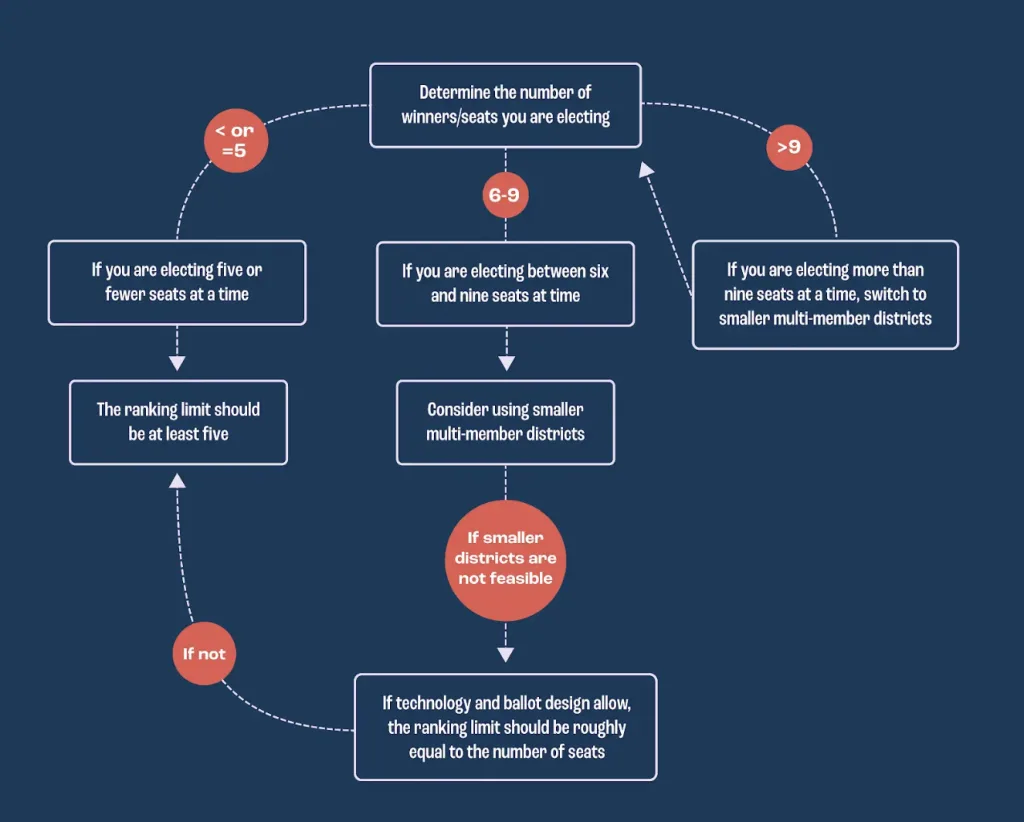
In jurisdictions where technology limits voters to fewer rankings than our recommended limit, our data suggests that most voters would still help elect a candidate of choice under proportional RCV. These recommendations reflect best-practices based on practical tradeoffs, while recognizing that most applications of proportional RCV give voters more choices and better representation.
Ranking limits require trade-offs for policymakers
According to the Center for Civic Design, when jurisdictions limit ballots to five rankings, two grid-style contests can fit side-by-side on a ballot. In a single-winner RCV race, voters who are able to rank five candidates will have room to rank a frontrunner, and have their vote count in the final round even if that frontrunner isn’t the voter’s first, or even fourth, choice. For this reason, FairVote recommends that jurisdictions allow at least five rankings in single-winner races. However, the rise in popularity of proportional RCV creates the need to update that recommendation for multi-winner races. (Throughout this report, we use “multi-winner” and “proportional” interchangeably, as proportional RCV is the gold standard for multi-winner RCV.)
Choosing a ranking limit means finding a balance between expression and simplicity. Voters should be allowed sufficient rankings to express a broad range of preferences and prevent their ballot becoming inactive due to the ranking limit. At the same time, imposing some limit on the number of rankings can keep ballots shorter and make voting simpler for voters and election administrators alike.
Research shows that strict limits on how many candidates voters can rank lead to higher rates of inactive ballots, while allowing more rankings substantially reduces them. For example, there are significantly more inactive ballots in single-winner contests limited to three rankings than in contests limited to five. Ideally, a voter’s ballot should only become inactive if the voter chooses not to rank additional candidates – and the only way to ensure that is to give the voter as many rankings as there are candidates.
However, there may be diminishing returns to increasing the number of rankings beyond a certain point, especially in multi-winner races. A ballot with dozens of candidates and unlimited rankings could appear long and cluttered, and even cause voters to make mistakes or leave parts of the ballot incomplete. Additionally, these races may require larger or additional ballot sheets, which can increase printing costs and voter roll-off.
To identify a range of ranking limits that could strike an appropriate balance between these tradeoffs, we turn to data from real-world proportional RCV contests.
Considerations for ranking limits in multi-winner RCV races
Multi-winner contests tend to invite more candidates than single-winner contests, so a ranking limit of five may not allow voters to express a wide enough range of preferences in a crowded field. On the other hand, because multi-winner contests allow more candidates to win, there is a higher likelihood of a voter’s most preferred candidate(s) being elected. For example, in single-winner RCV contests in the U.S., 78% of ballots rank a winning candidate in their top three choices. In most proportional RCV contests, that number is over 90%. This reduces the need for voters to fill out more rankings in order to elect a candidate of choice.
Figures 2 to 4 demonstrate that the more winners there are per race, the more candidates tend to run and the more rankings voters tend to use. Therefore, the ranking limit should be related to the number of seats being elected. This analysis is based on cast vote record data from contests in Cambridge (MA), Eastpointe (MI), Minneapolis (MN), and Portland (OR).
In forming a recommendation, it is important to balance the benefit of proportional RCV – allowing more voters to be represented in the outcome – with the practical need to keep ballots manageable in length and usability. One way jurisdictions can place an upper bound on the number of rankings on the ballot is by limiting the number of seats elected in a single contest, which in turn constrains the size of the candidate field. Electing at least five seats per contest is a recognized best practice for achieving proportionality. For large legislative bodies, this can be achieved by creating multi-member districts of up to five seats each, or by staggering elections so that no district elects more than five members at a time. We expand on this recommendation in our report, How to Get the Most Out of Multi-Winner RCV.
Adhering to the Center for Civic Design’s recommendation of a five-ranking minimum is the preferred baseline where possible, and seems intuitive for contests with up to five winners. Even when electing fewer than five seats per contest, there is no practical advantage to reducing the ranking limit further; ballots can already accommodate two grid-style contests side by side, so a lower limit would only constrain voter expression without significantly improving design or usability.
Take the 2024 City Council elections in Portland, OR, for example. Portland used proportional RCV to elect councilors in three-member districts. Voters could rank up to six candidates, and many voters (about 40-50% in every district) took advantage of that opportunity. This supports the recommendation to allow at least five rankings, even for contests with fewer than five winners. Figure 5 below shows the full distribution of how many candidates each voter ranked in a sample of recent proportional RCV races, including in Portland.
In some cases, however, holding contests with five or fewer winners may not be feasible. For example, some cities elect their 6+ member councils at-large, and may be committed to maintaining that structure for political, legal, or historical reasons. In other instances, drawing districts could unintentionally split key constituencies or communities of interest. Some jurisdictions may also prefer to maintain even or uniformly sized districts, and the total number of council seats may not lend itself to being grouped into contests of three to five seats.
As a result, there are – and will likely continue to be – jurisdictions that use RCV in contests with six or more winners. These elections will naturally attract larger candidate fields, for which a higher ranking limit might be appropriate.
Identifying an appropriate ranking limit, and testing it on real-world ballots
To determine which ranking limits are appropriate for larger contests, we can look to data from Cambridge, MA. Elections in Cambridge elect more candidates and allow more rankings than any other RCV races in the United States. Cambridge elects nine city councilors and six school board members at-large, and allows voters to rank up to fifteen candidates per race. Therefore, these races show us how voters rank when they are relatively uninhibited by ranking limits.
Refer again to Figure 5. One pattern that stands out is that in the Cambridge elections, the share of voters ranking a given number of candidates begins to decline around N – nine for city council and six for school committee. When we calculate the share of voters who ranked N or fewer candidates, the results – shown in Table 1 below – indicate that typically, over three-quarters of voters fall into this range.
If we treat Cambridge as a representative example of voter behavior – while acknowledging that it may not reflect other jurisdictions – it offers a useful model for thinking about ranking limits. In most races, most voters ranked N or fewer candidates, which could suggest a natural cutoff for a ranking limit. At the same time, is it acceptable for roughly 20-25% of voters to be unable to rank as many candidates as they would like?
It is worth noting that the real power of proportional RCV does not come from simply allowing voters to express all of their preferences, but from what those rankings enable them to do: weigh in between top contenders and help elect candidate(s) of choice. Therefore, to assess whether a ranking limit of N would be appropriate, the relevant question is not only whether most voters can rank as many candidates as they want to, but also (1) if the ranking limit were reduced to N, would fewer voters be able to weigh in between viable candidates? And (2) would fewer voters see a candidate of choice get elected? If not, would this still hold with an even lower ranking limit?
Looking at inactive ballots can help us answer the first question. A ballot becomes inactive when all of the candidates a voter ranked have been eliminated by the final round of counting. In this situation, the voter either chose not to express preferences among the remaining candidates, or was unable to do so within the constraints of the ranking limit. For the two most recent City Council and School Board races in Cambridge, we calculated the percentage of ballots that became inactive by the final round. We then used existing cast vote records to determine the inactive ballot rates if voters had been limited to N, five, and three rankings. The results are shown in Table 2 below.
As the results show, the share of inactive ballots hardly increases at all when the ranking limit is reduced to N – and in no case does it increase by more than one percentage point. This indicates that a limit of N would not meaningfully reduce voters’ ability to weigh in between viable candidates in the final round. In contrast, limiting voters to only five or three rankings produces noticeably more inactive ballots – between one and seven percentage points higher than in the actual elections – suggesting those limits would be too restrictive.
To answer the second question, we took the same cast vote records and asked: For each scenario (i.e. voters could only rank three, five, or N candidates), what share of voters ranked a winner somewhere on their ballot? Would the winners themselves have changed?
If a lower limit substantially reduces the share of voters who help elect a candidate of choice compared to the actual election, or if it changes the winners, the limit is likely too restrictive. Conversely, if the share remains similar and the winners stay the same, then allowing additional rankings beyond that point does not meaningfully increase how many voters help elect a candidate of choice.
As Table 3 shows, when the ranking limit is reduced to N, the share of voters who ranked at least one eventual winner remains essentially unchanged compared to the actual election – differences of zero to a few hundredths of a point. This means that letting voters rank up to N candidates provides nearly all the same representational benefit as allowing all 15 possible rankings.
With a limit of five or three rankings, the share of voters who rank a winner is still high, but noticeably smaller; and in one of the four elections (the 2023 School Committee race), a winner would have changed under both the five- and three-ranking scenarios. If technological or design constraints require a limit lower than N, these options still function reasonably well, but are more restrictive than ideal.
Taken together, these analyses point to the same conclusion: a ranking limit of N performs almost identically to a ranking limit of 15. In terms of keeping ballots active and ensuring that voters can help elect a candidate of choice, allowing more than N rankings provides little additional benefit.
That said, if a jurisdiction has minimal constraints around ballot design or technology – e.g. the vendor does not impose a hard limit – and the RCV elections happen in a year when fewer contests are on the ballot, it is possible and potentially beneficial to allow more than N rankings.
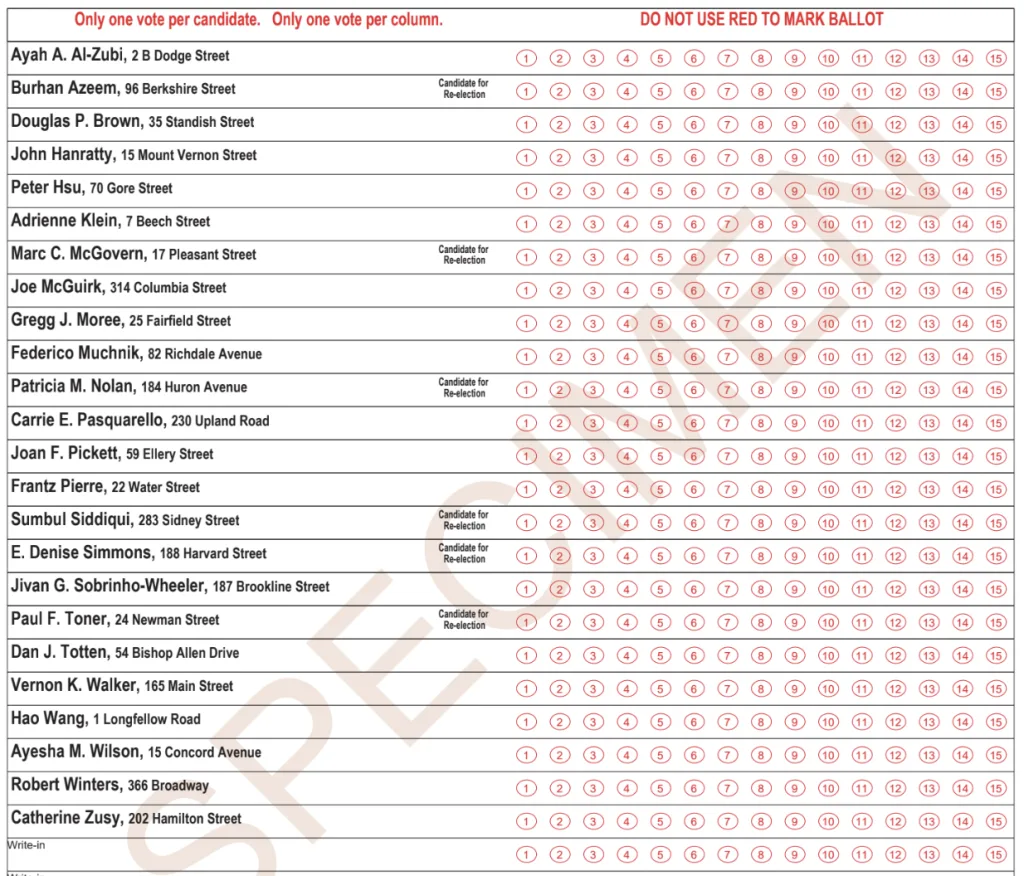
However, each additional ranking does make the grid slightly larger and more complex. There is some evidence that RCV elections with more candidates tend to see higher error rates – though the number of candidates is not necessarily a direct proxy for the number of rankings allowed. Put simply, there is a tradeoff to permitting more choices, and the exact ranking limit can be set based on priorities specific to each jurisdiction. However, once the number of rankings exceeds nine or 10, the ballot becomes undeniably crowded. See Figures 6 and 7 below, which are sections of sample ballots from Cambridge’s 2023 elections. This is consistent with the idea that ranking limits should scale with N, though N itself should be no greater than nine. With an N greater than nine, voters are likely presented with more choices than are practical for them to consider, and opportunities for more local, district-based representation may be missed.
Figure 6. Sample Ballot from Cambridge 2023 School Committee Election
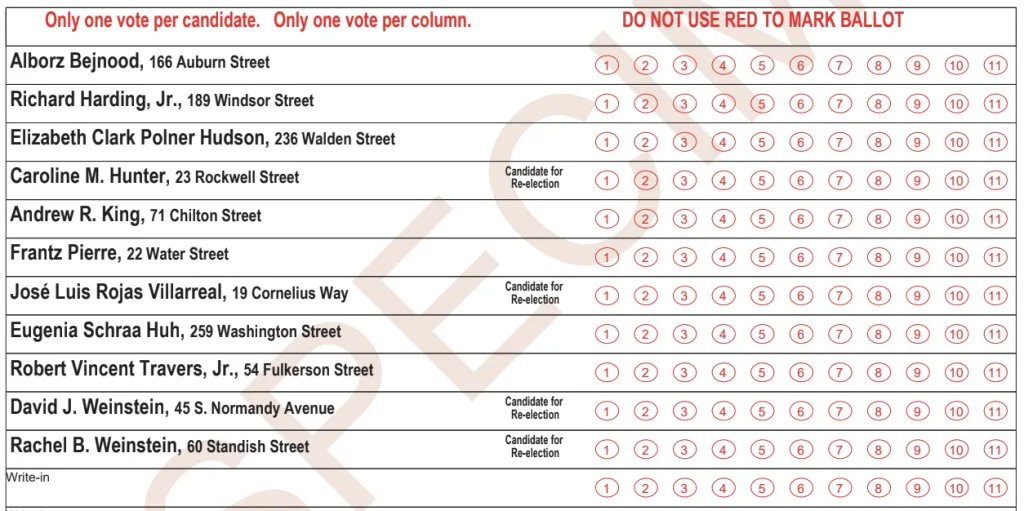
Figure 7. Sample Ballot from Cambridge 2023 City Council Election
Conclusion
Bringing all of these considerations together, proportional RCV jurisdictions should aim to provide voters with at least five rankings. In races electing more than five winners, there is value in allowing additional rankings, roughly in line with the number of winners (N).
However, once N approaches nine, both the ranking limit and the number of seats should be reconsidered, and creating smaller multi-member districts is advised. In short, jurisdictions should allow at least five rankings, and up to nine, roughly equal to N and as ballot design and technology allow.