Ranked Choice Voting Candidate Strategy Guide
Introduction
Ranked choice voting (RCV) is easy — but like any new system, it’s good to know the rules. Fortunately, candidates have been running RCV campaigns across the country for years. Here are some proven tactics and strategies employed by winners. Political parties and organizations can also use these tips when making endorsements.
If you’re looking for in-depth candidate training or additional campaign strategy support for an RCV election, please contact Democracy Rising.
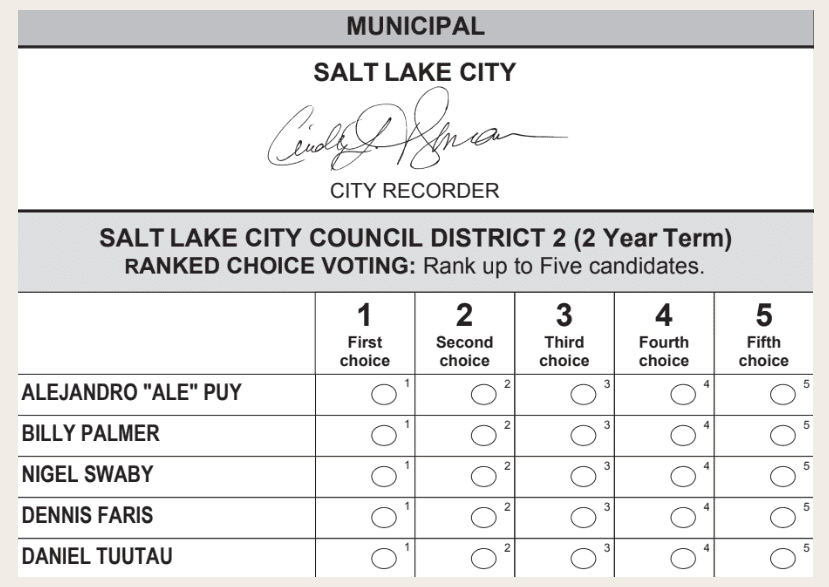
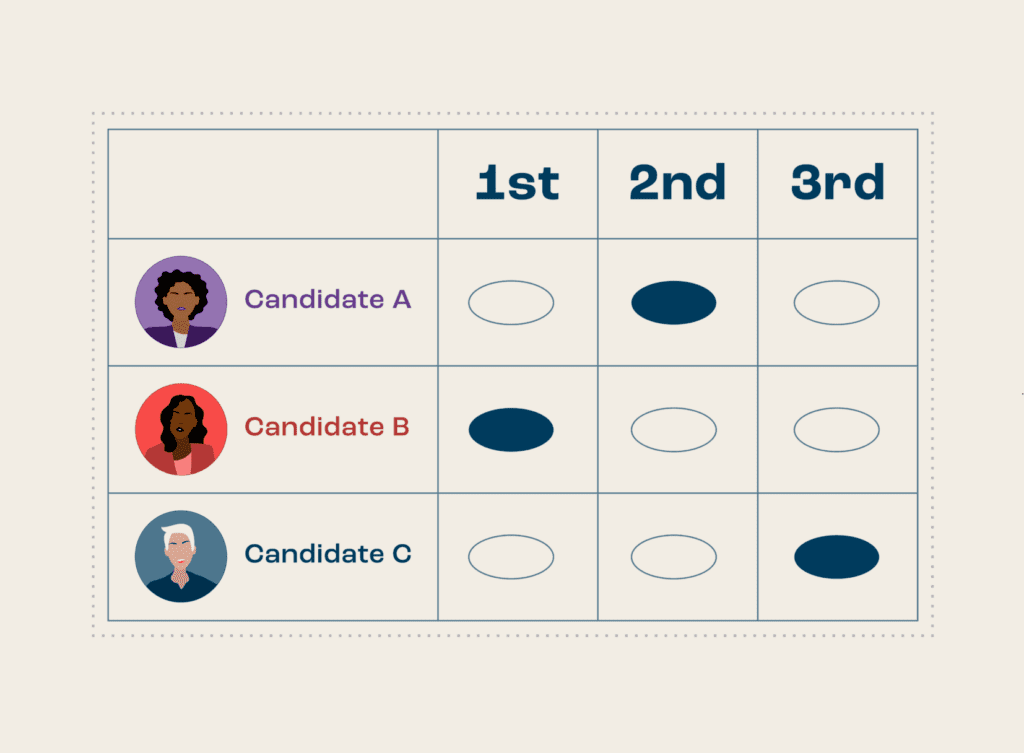
Ranked choice voting sample ballots
Ranked choice voting basics
- Ranking candidates: In an RCV election, voters can rank candidates in order of preference: 1st, 2nd, 3rd, and so on.
- Majority rules: If a candidate receives more than half of the 1st choices, that candidate wins. However, if there is no majority winner after counting 1st choices, the race is decided by an “instant runoff.” The candidate with the fewest votes is eliminated, and voters who ranked that candidate Number 1 will have their vote count for their next choice. This process continues until a candidate wins with more than half of the votes. Watch a video explainer here.
- No “spoilers”: When low-performing candidates are eliminated, voters who ranked them Number 1 will have their vote automatically count for their next choice. Voters and candidates don’t need to worry about playing “spoiler” or splitting the vote; votes will consolidate behind stronger candidates as candidates are eliminated.
- Ranking gives your vote more power: Voters are not required to rank candidates — but ranking more candidates ensures that your vote still matters in the final outcome even if your favorite candidate can’t win.
- Ranking backup choices never hurts a voter’s top choice. Your vote stays with your 1st choice as long as they remain in the race.
How to win a ranked choice voting election
RCV elections are easy. The most important thing is to talk to as many voters as possible — candidates already know how to do this.
What’s different in an RCV election? You need a majority of votes to win. And even if a voter prefers one of your opponents, that’s not the end of the conversation! You can still be their backup choice.
As a candidate, the two most important questions are:
- “How can I be the 1st choice of as many voters as possible?”
(In most RCV races, the candidate with the most 1st-choice support wins.) - “If I can’t be a voter’s 1st choice, how can I be their backup choice?”
If your campaign strategy answers those two simple questions, you’re off to a great start. Here are some other tips:
Reach out to a broad range of voters (and endorsing organizations) — including those who support other candidates. Win their vote by showing you care about their interests and their community. The best way to do this is through direct interaction. Door-knocking, community meetings, and other “retail politics” tactics are key to convincing voters that you will listen to them. Don’t be afraid to knock on the door of a voter with another candidate’s yard sign. In an RCV election, you need a majority to win, and that may include voters ranking you 2nd or 3rd — it pays to talk to everyone! The same goes for endorsing organizations and media outlets — if a powerful union or the local Chamber of Commerce is closely aligned to another candidate, ask for an endorsement as their 2nd choice.
I door knocked a number of people who had signs up for my opponent…. The conversation didn’t have to stop because they had already pledged to someone else.
— Rebecca Noecker, Saint Paul, MN city councilmember
Help educate voters about RCV, including making a specific ask and using visuals when asking voters to support you. Don’t just say “Vote for me.” Instead, make it clear to voters that you want to be their 1st choice. Use phrasing like “Rank me #1.” And if voters don’t rank you 1st, ask them to rank you 2nd or 3rd. The best way for voters to learn how to rank candidates is seeing a correctly completed sample RCV ballot (see example above); it’s helpful for your mailers or campaign material to include a sample ballot so voters are ready to rank.
[Rank me as your] first choice…. I understand [some voters will rank other candidates 1st], and I will take your 2nd-choice vote or your 3rd-choice vote.
— Daniel Lurie, mayor of San Francisco
Voters follow cues from their favorite candidates on how to complete their RCV ballot. Set an example by indicating that you’ll rank multiple candidates, and encourage voters to use their power and do the same. This is discussed in more detail in the “How Not to Win” section, but simply — the more voters rank multiple candidates, the more likely they are to use one of those rankings on you.
Positive, issue-oriented campaigning is a winning RCV strategy. To win 2nd- and 3rd-choice support, focus on how you bring something unique to one of your opponent’s key issues — rather than arguing how your opponent falls short.
A man opened the door… and I said to him, ‘I totally respect that you want to vote for the Democrat, absolutely. I honor that, but you get a second choice… in ranked choice voting. And I would be honored if I could be your second choice.
— Sen. Cathy Giessel (R), Alaska State Senate Majority Leader
“Cross-endorsements” can be a good tactic, but may not be necessary. Voters listen to candidates; if one of your opponents says they plan to rank you 2nd, many of their supporters will too. It may be in your best interest to hold joint events with another candidate or even “cross-endorse” each other by encouraging voters to rank you 1st and 2nd. This is one option, but there are simpler ways to show common ground — like communicating where you and your opponent agree on policy.
Here are some recent examples of candidates who successfully put these tactics into action:
In the 2024 Portland, OR City Council elections, Tiffany Koyama Lane and Angelita Morillo campaigned together and encouraged supporters to rank them first and second. Their supporters followed their recommendations, as Morillo and Koyama Lane were by far the most popular second choice for each other’s supporters. Both won seats in a multi-member district.
In 2024, San Francisco Mayor Daniel Lurie defeated incumbent London Breed and 13 others, without excessive negative attacks on his opponents. His efforts to encourage his opponents’ supporters to rank him 2nd proved valuable. Lurie only held a 2-point lead over Breed before backup choices were counted. In the RCV count, Lurie’s lead grew to more than 10 percentage points because many voters ranked him 2nd or 3rd.
How not to win a ranked choice voting election
Attacking your opponents is not an effective way to earn voters’ backup choices. As stated above, if a voter won’t rank you as their 1st choice, you still want to convince them to rank you as a backup choice. That means assuring voters who prefer another candidate that you are a viable alternative. (The laws of politics still apply — a conservative candidate is more likely to earn 2nd choices from voters ranking a conservative or moderate 1st than from extremely liberal voters.)
Still, you won’t win by being everybody’s 2nd choice. The candidate with the most 1st-choice support usually wins an RCV election. If no voters rank you 1st, you’ll be eliminated in the RCV count — even if every voter ranks you 2nd. Candidates need both deep and broad support to win an RCV election — as many 1st-choice rankings as possible, and then 2nd and 3rd choices after that.
Engage with the system. Research and recent examples show that attacking RCV, or telling voters to only rank you, is a bad strategy. Remember, voters listen to candidates. If you attack RCV — or indicate that you won’t rank backup choices — voters may not rank you 2nd, and you’ll hurt your own chances. You’ll also hurt your own supporters — you’re asking them to limit the power of their vote if you’re eliminated in the RCV count.
Here are some recent examples of candidates who hurt their own campaigns by attacking RCV instead of simply adapting to it:
- In the 2022 special election for Alaska’s congressional seat, former Gov. Sarah Palin actively discouraged voters from ranking candidates, encouraging them to vote only for her. Just 50% of the voters who ranked fellow Republican Nick Begich as their first choice ranked Palin as their second choice. But, Palin changed her strategy in the regular election that November, encouraging voters to rank all Republican candidates. In that race, 67% of Begich voters ranked Palin as their next choice.
- In the 2021 New York City Democratic mayoral primary, now-Mayor Eric Adams spent much of the final weekend of the race campaigning against RCV. His closest opponent, Kathryn Garcia, supported RCV and encouraged voters to rank her as a backup. Adams eked out a narrow win — but Garcia’s vote share increased 115% as backup choices were counted, while Adams’ vote share only grew by 40%.
- In the 2018 and 2022 general elections for Maine’s 2nd Congressional District, candidate Bruce Poliquin adopted two different, ineffective strategies. In 2018, he attacked RCV and encouraged his supporters to rank him first and not rank any other candidates. In 2022, Poliquin encouraged his supporters to rank him (and only him) multiple times on their ballot — a useless tactic that did not increase his chance of winning.
Poliquin lost both times. The results also clearly show that voters listened to his instructions:
| 2018 | 2022 | |
|---|---|---|
| Ranked Poliquin 1st, used no other rankings | 28% of voters | 16% of voters |
| Ranked Poliquin multiple times | 2% of voters | 13% of voters |
ADDITIONAL SUPPORT AND RESOURCES
Please reach out to FairVote with any questions on this guide, and to Democracy Rising for in-depth candidate trainings and additional support. Additional resources — including several examples of RCV campaign materials — are available below.
- Ranked choice voting details
- Video: Ranked choice voting facts
- Sample ranked choice voting ballot
- Maine uses ranked choice voting: candidate training presentation
- Video: Alaska Senate Majority Leader Cathy Giessel (R) explains how she campaigns to all voters
- JD Spain campaign materials (Arlington, VA):
- Cross-endorsement examples: