FairVote’s Position on Fusion Voting
Executive summary
- Fusion voting allows multiple parties to nominate the same candidate. There are two forms of fusion voting:
- Aggregated fusion lists each party that has endorsed a candidate on that candidate’s ballot line.
- Disaggregated fusion lists the same candidate multiple times – once on each party’s ballot line.
- Fusion voting is gaining renewed interest based on a desire to (1) strengthen the role of minor parties in politics, and (2) solve the problem of “vote-splitting” to prevent polarizing plurality candidates from being elected against the will of the majority.
- Under fusion voting, minor parties can trade their ability to run and elect their own dedicated candidates for policy concessions from major-party candidates.
- However, as a standalone policy, fusion voting cannot address vote-splitting caused by independent candidates, and only reduces vote-splitting when minor parties decline to run a candidate of their own. This means a candidate opposed by the majority of voters can still win.
- Ranked choice voting (RCV) directly addresses the “spoiler effect” and offers minor parties another way to exert influence on the platforms and policies of major-party candidates. RCV eliminates vote-splitting between candidates, including independents. It allows minor parties to nominate their own candidates, run meaningful campaigns, elevate the party’s core issues, build the party’s own distinct brand, and use this energy and attention to grow the party’s ranks – all without risking the election of a candidate against the will of the majority of voters. Minor parties can also exert influence over policymaking by entering into pre-election coalition agreements whereby the minor party endorses (or declines to endorse) a “second-choice” candidate.
- One option is to combine RCV and aggregated fusion voting. By doing so, minor parties can reap the benefits of both. Minor parties can freely choose whether to run their own candidate (without fear of playing spoiler) and/or co-endorse a major-party candidate (without fear of watering down their message).
- Ballot access and party recognition rules also play an important role in the formation and growth of minor parties.
- Unlike fusion voting alone, ranked choice voting provides a seamless transition to a more transformative multi-winner system – proportional RCV. Proportional RCV could be combined with aggregated fusion voting.
Background: Solving problems in our elections
American democracy today struggles to provide voters with meaningful choice and voice. In general elections, voters are often faced with just two choices: Republican or Democrat. While third-party or independent candidates sometimes appear on the ballot, voters are often discouraged from voting for those candidates. Additionally, those candidates are often discouraged from running due to fear of the “spoiler effect” – the possibility that their candidacy might siphon votes from a candidate with similar views and therefore help their political opponents.
Perhaps the most famous modern “spoiler” is Ralph Nader, a Green Party candidate who earned enough votes in the pivotal state of Florida during the 2000 presidential election that he arguably delivered the presidency to Republican George W. Bush.
In 2016, Green Party candidate Jill Stein won enough votes in Michigan, Pennsylvania, and Wisconsin that her vote share could have swung the presidency to Hillary Clinton over Donald Trump. In 2024, Democrats won U.S. Senate seats in Michigan, Nevada, and Pennsylvania by smaller margins than the vote shares received by third-party conservative candidates.
The spoiler effect arises because our elections select the candidate with the most votes, even if that candidate falls short of a majority. Races with two candidates work well, but as soon as a third candidate enters the race, all candidates are at risk of vote-splitting and playing spoiler.
The spoiler effect compels voters to vote strategically, and minimizes healthy competition from third-party and independent candidates.
What is fusion voting?
Fusion voting has recently gained interest among some thought leaders. With fusion voting, multiple parties can nominate the same candidate. For example, a Republican nominee could also be the Libertarian nominee. The idea is that minor parties might help prevent vote-splitting, spoilers, and potentially unrepresentative outcomes by endorsing a major-party candidate. Fusion voting also provides voters with additional useful information. A candidate that is endorsed by both the Democratic Party and the Green Party, for example, has likely embraced policy stances acceptable to both parties, rather than just one of the parties.
Fusion voting takes two forms: disaggregated fusion and aggregated fusion.
With disaggregated fusion, each party gets its own line on the ballot. Multiple parties may list the same nominee on their line, meaning candidates may appear multiple times on the ballot. Disaggregated fusion is currently used in Connecticut and New York State.
Disaggregated fusion gives minor party voters the ability to “vote the party line,” which is expected to provide power to the minor party by helping it extract policy concessions from major-party candidates. If the major-party candidate is acceptable, the minor party can endorse the major-party candidate rather than running its own candidate. If all (or enough) minor parties choose not to run their own candidates, this can reduce the risk of vote-splitting and an undesirable outcome.
Below is an example of a 2020 disaggregated fusion ballot from New York State. The Democratic and Working Families parties each have their own line, but both list Joe Biden as their nominee. Biden’s total vote share was determined by adding votes for the Democratic and Working Families parties together. The official results still report how many votes Biden received from each party. Similarly, Donald Trump is listed as the Republican and Conservative parties’ nominee.
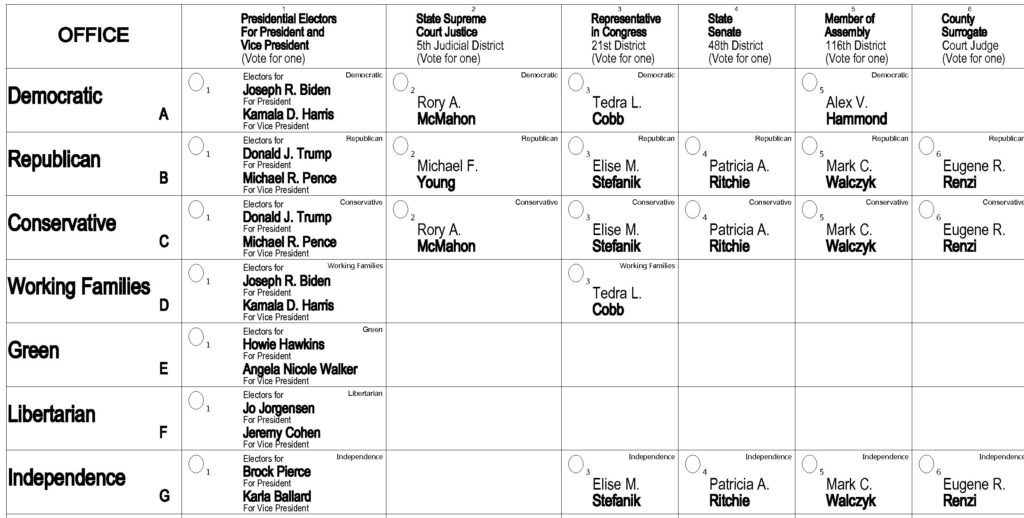
In this particular election, Biden earned 56.4% of the vote on the Democratic Party line and 4.5% on the Working Families Party line, totaling 60.9%. Trump earned 34.4% of the vote on the Republican Party line and 3.4% on the Conservative Party line, totaling 37.8%. Other minor parties – the Green, Libertarian, and Independence parties – decided to run their own candidates and earned a combined 1.3%.
As this example demonstrates, disaggregated fusion shows candidates where their support is coming from and how much each party has contributed to their vote total. Proponents of fusion voting argue that this incentivizes major-party candidates to listen to minor-party interests.
With aggregated fusion, each candidate gets one line on the ballot. The party (or parties) nominating the candidate appear underneath or next to the candidate’s name. Oregon and Vermont allow aggregated fusion. Below is a section of a 2022 general election ballot from Multnomah County, Oregon.

Take the U.S. Senate race, for example. Jo Rae Perkins, the first candidate on the ballot, is listed once, and her affiliation is listed as “Republican/Constitution.” This shows that Perkins is endorsed by both parties. The aggregated fusion ballot is shorter, cleaner, and easier to understand than the disaggregated ballot. However, aggregated fusion does not allow observers to know how many voters would have voted for Perkins on a “Republican Party” line versus a “Constitution Party” line.
A tradeoff of fusion voting: Minor parties might not run their own candidates
As a standalone policy, fusion voting cannot fully eliminate vote-splitting. For example, in the 1970 U.S. Senate race in New York, Conservative Party candidate James Buckley won with just 39% of the vote, because the other 61% was split between two candidates to the left of Buckley: Democrat Richard Ottinger and Republican Charles Goodell. Goodell was cross-nominated by the Liberal Party, but to no avail.
Vote-splitting can arise whenever any minor party chooses to run its own candidate. Consider the 2024 race for New York’s 17th Congressional District. In prior years, the Working Families Party had cross-endorsed Democrat Mondaire Jones. In 2024, they pulled their support from Jones and nominated a different candidate. However, by October, the party was effectively campaigning against its own nominee because their nominee’s presence on the ballot threatened to pull votes from the Democrat in a swing district.
The only way vote-splitting can be completely avoided under fusion voting is if every minor party chooses to endorse a major-party candidate rather than run a candidate of its own. Moreover, fusion voting does not prevent vote-splitting when an unaffiliated candidate runs (such as Ross Perot), when a group dissatisfied with the two major-party options (such as No Labels) seeks to run an independent candidate, or when a candidate runs in an effort to launch a new party (such as Cornel West’s efforts to use a presidential run to establish a “Justice for All” party).
Therefore, fusion voting can prevent vote-splitting, but at the cost of giving voters less choice in elections. For example, in an analysis of the 2022 House of Representatives elections, the think tank New America found that New York averaged only 2.11 candidates per district, ranking New York 42nd out of 50 states on this metric. New America suggested this is a positive finding, arguing that fusion voting does not overcrowd the ballot or confuse voters. However, because the same candidates may appear multiple times on disaggregated fusion ballots, it is not clear that this reduced set of candidate choices reduces voter confusion or ballot length.
To be sure, fusion voting creates opportunities for minor parties to exert influence in a race between major-party candidates. Yet, like plurality voting, fusion voting discourages minor parties from running their own candidates. Indeed, the very mechanism that fusion voting uses to marginally increase the influence of minor parties is the “credible threat” that a minor party will split the vote. Cross-nominating can help a minor party avoid an unwanted outcome, but it may also pose risks to the party’s long-term growth prospects. In short, fusion voting may put minor parties in a permanent bind: To have influence and avoid adverse policy outcomes, the party must forgo efforts to elect its own candidates to office. Or, to grow into a party that can elect its own candidates, the party must risk harming the very social and political goals it hopes to achieve.
Consider the 2024 Libertarian National Convention, where President Trump sought the endorsement of the Libertarian Party. Trump was booed and heckled, a reflection of the fact that “Many libertarians support the Libertarian Party precisely because they do not trust either [major-party candidate],” according to one reporter. “Trump’s icy reception should actually make it even more obvious that he has not earned the support of libertarians… people who prize individual liberty booed him louder and more consistently than any other voting bloc.” In his speech, Trump raised the spoiler problem: “What is the purpose of the Libertarian Party getting 3 percent? What is the reason to take a chance of having this horrible president [Biden] destroy our country?” However, it was clear that for this group of Libertarians, supporting Trump was not the solution. The benefits of fusion voting depend on minor parties’ willingness to fuse with major parties, but minor parties will often have good reasons not to.
That said, fusion voting allows minor parties to deliver numbers on a party line, creating leverage for minor parties to negotiate for policy concessions from major parties. Indeed, if a minor party can deliver an explicit, determinative share of votes to a major party, that major party has reason to take up some of the minor party’s agenda. According to the New York Times, “the Working Families Party aims to tug the Democratic Party to the left on economic policy, for instance, even as it usually backs Democratic candidates in general elections.” Anti-slavery third parties used disaggregated fusion in this manner to stimulate the antislavery movement in the mid 1800s. In short, disaggregated fusion may offer one policy option to help minor parties advance a legislative platform.
Nonetheless, this policy option carries substantial tradeoffs. In exchange for policy concessions, minor parties must give up the ability to present a genuine alternative to major parties and run candidates that campaign fully and forcefully about the issues that matter most to the party. They must be prepared to accept that withholding a cross-endorsement could mean a candidate opposed by the majority of voters (including the party’s own voters) is elected.
Ballot access laws have a large impact on minor-party building
Although electoral methods such as RCV and fusion voting are better for minor parties than the status quo, factors other than these voting methods may play an equally large role in helping minor parties organize, grow, and exercise influence.
Each state is different in how it determines what constitutes a “qualified” or “recognized” party. This affects whether minor parties are able to get on the ballot and receive votes. In fact, these state regulations (i.e., requirements for forming a qualified party, ballot access laws) appear far more likely than fusion voting to promote or prevent minor parties from gaining recognized status, winning votes, and winning seats. For example, a study on 2006 gubernatorial and senatorial elections shows that high signature requirements dampen the number of minor parties that run, and that fusion voting has no effect on minor-party vote shares. A 2005 study likewise shows that higher filing fees reduce the number of minor-party candidates more so than major-party candidates. Vermont grants party status based on a party’s organizing capabilities rather than performance in past elections, which may help explain why Vermont currently has the most minor party legislators of any state.
Fusion voting and ballot access reform can work together to help minor parties grow, but arguably, ballot access has the more important role. A minor party’s ability to fuse with a major party can encourage more voters to vote on their party line, which can help that minor party retain ballot access in the future. However, reasonable ballot access is necessary to get that minor party on the ballot in the first place, and without it, minor parties remain fragile. For example, New York’s Green, Libertarian, and Independence parties all lost statewide ballot access after winning too few votes in the 2020 election.
A party’s first step to any sort of influence is a spot on the ballot, making party recognition and ballot access rules one of the most fundamental aspects of voting reform for minor party advocates.
Fusion voting does not lead to centrist influence in practice
In general, the goal of election reform should not be to bolster one ideological faction or another (including centrism), nor should we expect any one reform to solve polarization. However, some advocates claim that fusion voting may indeed create more political centrism and address polarization, while also acknowledging that fusion voting doesn’t “pretend” minor parties “can win elections on (their) own.” For example, where a centrist party exists, Republicans and Democrats may compete for its nomination.
This has happened before. The Independence Party of New York attempted to fill such a moderate role for nearly three decades, and endorsed candidates like independent Ross Perot, Republican/independent former New York City Mayor Michael Bloomberg, and Democratic former Governor Andrew Cuomo. In the 2001 mayoral election, Bloomberg was the Republican and Independence Party nominee. The votes he received on the Independence line exceeded his margin of victory over his Democratic opponent, perhaps propelling him to victory. However, such examples are rare in modern politics, so this section will explore whether or not fusion voting bolsters centrism.
For fusion voting to promote centrism, a specific set of conditions must be in place. They are (1) a competitive general election and (2) a pre-existing, influential centrist party, or conditions where the emergence of an influential centrist party is plausible. The Liberal Party of New York, which used to occasionally deliver winning vote shares for Democratic and Republican candidates in the 1900s, emerged under circumstances that are starkly different from the extreme polarization of today: “the blurred partisan lines of the mid-twentieth century when there were liberal Republicans and conservative Democrats and the Liberal Party could easily build its progressive coalition.”.
Furthermore, for a moderate party to have influence over an extended period of time, it would have to command a large share of voters who would vote on the party’s line, no matter which major candidate the party endorses. This means some voters would have to cast their ballot for the major-party candidate they least prefer in any given election, which seems unlikely in today’s environment. For example, for a center-right moderate party to emerge and be effective, some disaffected Republicans would have to vote for the new moderate party’s endorsed candidate, even if the moderate party chooses to endorse a Democrat. Research suggests there is not a stable centrist voting bloc in the electorate, making this scenario – a durable centrist party that constitutes a faction consistently larger than the margin of victory in a given jurisdiction, whose voters will vote on the party’s line no matter who it cross-nominates – unlikely.
Parties to the left or right of the major parties do not necessarily face this same barrier. For example, because the Working Families Party almost always endorses Democrats, Working Families Party voters can be assured that their vote will never count toward their (presumed) least favorite major party: the Republicans. Of course, a moderate party supporter does not have to vote the party line if the party has endorsed that supporter’s less-preferred major party’s candidate. Yet if moderate party supporters are unwilling to do so consistently, it’s unlikely the moderate party would be able to consistently command the reliable share of votes necessary to deliver victories to either party.
In recent history, disaggregated fusion has appeared to have a non-centrist effect. According to the New York Times, “Fusion voting hasn’t always pushed the two major parties toward the center.” As mentioned, the Working Families Party tugs the Democrats to the left.
Additionally, some reporters note that “the [Independence Party] has struggled for relevance” in recent years, and has been criticized for its lack of a clear platform. The party lost ballot access in 2020, and in 2022, a new law restricted the use of “independent” or “independence” in party names to avoid confusion (i.e., preventing voters from signing up with a party if they meant to register as an unaffiliated voter).
Notably, the Independent Party of Oregon (IPO) existed prior to the state’s use of fusion voting, and has enjoyed ballot access since 2007. The IPO even helped the effort to pass fusion voting in 2009. However, like the Independence Party of New York, the IPO’s moderating influence has been limited. In a 2023 message sent to its members, the IPO said:
In 2022, the Independent Party of Oregon sided heavily with Democrats in state legislative races, based on concerns about rising authoritarian extremism in the Republican Party and because many of the Democratic candidates running represented themselves as aligning with the Independent Party’s 2022-2024 platform and agenda, including addressing issues like campaign finance reform and working in a more non-partisan manner to resolve issues like homelessness. However, at the 2023 session of the Oregon Legislature, there was little support for our party’s core issues among many of the Democrats we helped to elect, including election reforms to empower independent voters and campaign finance reform.
Connecticut recognizes the Connecticut Independent Party, which currently has statewide enrollment privileges. The Party historically cross-nominated Republican candidates, but decided to run its own gubernatorial candidate, Rob Hotaling, in 2022. Hotaling won 0.97% of the general election vote, 0.03% shy of what the party needed to retain ballot access in the next gubernatorial election. The party also lost ballot access for the next attorney general race. After the election, party chair Michael Telesca said, “If I had to do it over again, I would have done it exactly the same way in the sense that we are here for a reason and it’s not to rubber stamp anything.” Telesca’s words are emblematic of minor parties’ enduring bind under fusion voting: their existence and success relies on rubber stamping major-party candidates.
Fusion voting does not address independent candidates
Regardless of how well fusion voting addresses issues associated with minor parties, fusion voting cannot address vote-splitting by independent candidates and the subsequent “spoiler effect.” Independent candidates can be expected to crop up from time to time, and may even be meaningfully popular. In fact, the highest vote-getting presidential candidate outside the major parties in modern history was an independent: Ross Perot won 19% of the vote in 1992.
Ranked choice voting creates more opportunities for parties to define themselves
Ranked choice voting (RCV) is a reform whose supporters aim to address many of the same issues that matter to fusion advocates. RCV addresses the spoiler effect (including with respect to independent candidates), provides opportunities for coalition-building, and gives minor parties more influence.
RCV allows minor parties to nominate their own candidates without fear of splitting the vote. Because voters have the option to rank candidates on their ballot, voters can vote for minor-party or independent candidates while still ranking a backup choice. This removes the barrier that minor parties face to nominating their own candidates.
With RCV, major parties (and major-party candidates) have strong incentives to address minor-party policy priorities in order to earn backup rankings. In this way, RCV encourages inter-party coalitions (especially when elections are competitive), similar to fusion voting. However, because RCV encourages minor parties to run their own candidates, minor-party issues are presented to the electorate in a clear and compelling way by a full-throated representative of the party.
There is already some evidence suggesting minor parties fare better under RCV. According to a 2021 study, “Across a dataset for twelve competitive 2020 federal elections, the electoral arena was more open to new parties and candidates under RCV in Maine than under runoff or plurality elsewhere.”
Australia uses single-winner RCV for its House of Representatives, where a handful of minor-party candidates are regularly elected.1 (Of course, the Australian Senate, which uses proportional RCV, elects minor-party candidates at higher rates.) RCV has also encouraged electoral and legislative coalitions between major and minor parties based on their need to receive preference flows. This includes a long-running formal coalition on the conservative side of politics between the Liberal and National parties (often referred to as simply “the Coalition”), and a more recent informal electoral coalition between the progressive Labor and Green parties. This system allows smaller parties to wield influence while also developing their own party identity by running their own candidates.
Ranked choice voting naturally promotes majority winners
Unlike fusion voting, RCV guarantees candidates are elected with majority support from the voters. If no candidate earns a majority of first choices, trailing candidates are eliminated one at a time, with ballots for the eliminated candidate transferring to each voter’s next choice. In this way, the final winner is the candidate preferred by a majority of participants who have a preference between frontrunners.
FairVote believes elections should give voters meaningful choices, allow voters to vote without fear of vote-splitting, and elect the candidate who appeals to the most voters. RCV reliably achieves all of these important goals on its own.
Ranked choice voting reduces polarization
Unlike fusion voting, RCV would not require the existence of a centrist party to help reduce polarization – only the emergence of a centrist candidate. If a centrist party or candidate emerges in a given jurisdiction, moderate voters may be more willing to rank that candidate first, knowing they could choose whether to rank the Republican or Democrat second. The Republican and Democratic candidates could compete for the backup support of the centrist’s supporters, inducing a moderating effect.
Ranked choice voting and aggregated fusion voting work well together
RCV and fusion voting can be combined to maximize the benefits of both, give voters more information on the ballot, and let minor parties nominate their own candidate or cross-endorse a major-party candidate without fear of playing spoiler.2
The combination of RCV and aggregated fusion voting expands options for voters and parties alike. It also creates a simpler voter experience than, and is more readily implementable than, disaggregated fusion voting.3
Below is a sample RCV ballot that uses aggregated fusion voting.

In our example, the Libertarian Party and Green Party chose to nominate their own candidates, without being punished for doing so, while the Working Families Party chose to cross-nominate the Democratic candidate, and the Moderate Party chose to cross-nominate the Republican candidate. Both are valid approaches, and RCV with aggregated fusion voting allows minor parties that choice.
RCV achieves the goal of disaggregated fusion – that is, to allow minor parties to command their own explicit vote share. However, unlike disaggregated fusion alone, RCV ensures majoritarian outcomes and encourages minor parties to run their own candidates.
Of course, fair ballot access and party recognition laws are also necessary to achieve what these reforms aim to accomplish. Minor parties must be able to feasibly get ballot access in order to give voters more choices. The “RCV + aggregated fusion” model could be enhanced by tying ballot access and recognition to the party’s performance in any round of an RCV election – giving the party more opportunities to earn ballot access.
Looking ahead: Advancing proportional systems
Many activists see reforms like fusion voting and RCV as improvements to single-winner elections, while acknowledging that minor party candidates will rarely ever win seats in single-winner elections.
Multi-winner proportional systems are more transformative in this regard. By electing legislators in proportion to the share of votes they receive, political, racial, and other groups can gain more accurate representation. Such systems can also stop gerrymandering and inject more competition into elections. Therefore, analysis of single-winner reforms should consider whether said reforms are adaptable to multi-winner, proportional systems.
The only proportional election method that has ever been adopted and used in the U.S. is proportional ranked choice voting. Proportional RCV works similarly to single-winner RCV, except the “threshold to elect” is lower than 50% and is determined by the number of seats to be elected.
Proportional RCV has been used for decades in Cambridge, MA; Arden, DE; and Minneapolis, MN. In recent years, proportional RCV has been adopted and used in Portland, OR; Arlington, VA; and Albany, CA. In 2025, proportional RCV will be used for the first time in Portland, ME; Oak Park, IL; and Charlottesville, VA.
Proportional RCV could easily be combined with aggregated fusion voting, providing for a seamless transition from single-winner reform to multi-winner reform. Allowing multiple parties to endorse the same candidate on the same line does not interfere with ballot design or require any new tabulation processes, whether for single-winner or multi-winner RCV.
Moreover, the voter experience with the ballot would remain consistent for the voter across single-winner and multi-winner races: Voters simply rank the candidates in order of preference. Finally, the political dynamics and calculus of voters, parties, candidates, and coalitions would remain coherent across single-winner and multi-winner contexts: Minor parties could run their own candidates if and when that best suits their interests, or co-endorse a major party candidate when that best serves them.
On the other hand, fusion voting alone may not provide for such a simple transition to proportional elections. First, fusion voting and proportional representation may create competing political dynamics. Consider, for example, an open list proportional representation (list PR) system, where parties create a list of candidates, voters vote for a candidate on the party list, and seats are awarded based on the party’s share of votes. This is the opposite of how fusion voting works. As Professor Matthew Shugart has observed, “In [list PR], votes for different candidates pool to one party or alliance list. In American fusion voting, votes for different parties pool to a single candidate… the direction of vote flows is reversed.”
Second, to the extent adoption of disaggregated fusion might delay the timeline for implementing RCV, this may lengthen the path to the only form of proportional representation with a history of adoption and use in the United States.
Finally, while fusion voting alone (like RCV alone) could “help voters get used to voting for different parties,” according to New America, the question of how single-winner fusion voting transitions to a multi-winner proportional system remains open. Indeed, it seems that to get from A to B, minor parties would have to intentionally “spoil elections or run their own candidates to pose a credible threat to the two major parties.” This raises the question of whether minor parties – or minor-party voters – would be willing to go along with such an approach, and whether either major party would accede to these efforts rather than protecting their own interests by attempting to stomp out minor-party ballot access and/or ban fusion voting itself (as is the case in almost all states).
Conclusion
Ranked choice voting and fusion voting both aim to improve our elections by giving voice to more voters, addressing the spoiler effect, and creating opportunities for coalition-building. As a standalone reform, only RCV truly addresses the spoiler effect and elects majority winners, and only RCV allows parties to run their own candidates without fear of splitting the vote.
RCV plus aggregated fusion, however, can provide minor parties even more opportunities and options. FairVote also supports efforts to reform ballot access and party recognition laws to ensure that minor parties have a genuine opportunity to grow and compete in our politics.
If political considerations make the simultaneous pursuit of both RCV and aggregated fusion prohibitively difficult, FairVote recommends reformers first adopt RCV as a standalone reform. In jurisdictions considering either RCV or fusion voting, RCV is the better option for maximizing voter choice and party interests – and for creating political conditions that will allow reformers to have the benefit of both reforms in the future.
Footnotes
- Also known as “crossbenchers.”
- Because most states currently do not allow parties to cross-endorse, most RCV systems currently in use today also do not allow cross-endorsements.
- While disaggregated fusion voting can technically be combined with RCV, doing so raises novel implementation questions about ballot design, vote tallying logic, and voting system programming. Jurisdictions combining the reforms would require new developments from voting system vendors, software updates, and equipment recertification, all of which may lengthen the timeline for implementation and/or lead to increased costs. Because RCV can be easily and readily combined with aggregated fusion voting, we recommend that jurisdictions use this approach. For jurisdictions that already use disaggregated fusion voting — New York and Connecticut — we encourage reformers to contact FairVote to discuss how best to navigate the policy and implementation details associated with combining disaggregated fusion and RCV.