Best practices for using ranked choice voting to endorse candidates
Explore the guide on this page, or download as a PDF.
Executive summary
- Organizations that hold member votes to endorse political candidates can benefit from using ranked choice voting (RCV) to make their endorsements. RCV helps organizations pick candidates that most members can support, eliminates the need to vote strategically, and avoids vote-splitting that can wrongly lead to no endorsement.
- When using RCV to make endorsements, it’s best to not include a “No Endorsement” option on the ballot. Instead, continue the RCV count until one candidate remains, and then check whether that candidate has enough votes in the final round to meet your organization’s threshold for endorsement.
- Organizations can use RCV to endorse multiple candidates. We outline the best form of RCV to endorse only candidates that the body supports with broad consensus.
- Organizations should strongly consider using RCV to endorse multiple candidates when the election itself uses RCV. In an RCV election, organizations can maximize their impact by ranking their endorsed candidates (i.e. Sally Sparrow is our organization’s 1st choice, and Rudy Robin is our 2nd choice).
Introduction
Having seen the benefits of ranked choice voting for public elections, a growing number of private organizations have adopted RCV to decide which candidates to endorse, or have expressed interest in doing so. This interest is to be expected, as RCV improves endorsement contests much like it improves public elections. It helps identify consensus winners, removes the incentive to vote strategically, and can help the organization express support for more than one candidate. However, using RCV to make endorsements differs slightly from how RCV is used in public elections. What follows is a discussion of RCV endorsements, including why to make them and the best practices for doing so.
Benefits of RCV for endorsements
Endorsements differ from public elections in a significant way. With very few exceptions, elections always produce at least one winner, while endorsements routinely yield no winner if the organization lacks sufficient enthusiasm for any of the available candidates. To allow for the possibility of no endorsement, plurality endorsement ballots usually offer an explicit No Endorsement option alongside the available candidates. To win the endorsement, organizations may require a candidate to be selected by at least a majority – often a supermajority – of all members who participated in the endorsement vote.
By using a majority or supermajority threshold, endorsements avoid the familiar vote-splitting outcome common in plurality contests, in which the winning candidate lacks majority support. However, endorsements can suffer from a different form of vote-splitting, in which No Endorsement wins even when a consensus to endorse exists. Put differently, while plurality endorsements never allow the wrong candidate to win, they can wrongly allow No Endorsement to win.
To illustrate, consider a race between three candidates: Rudy Robin, Sally Sparrow, and Harry Horse. Your organization, “Bird PAC,” is using plurality voting to consider an endorsement in this race, and the PAC’s rules require a candidate to receive a two-thirds supermajority of support to win its endorsement. If no candidate reaches the threshold, no endorsement is made. When the votes are cast, Sparrow receives 60% of the vote and Robin the remaining 40%. No voters selected the No Endorsement option, but with all candidates below the two-thirds threshold, no endorsement is made.
After the endorsement vote, Robin voters express regret. Although Robin was their first choice, they would have preferred to endorse some bird over no bird at all, because they really don’t want Horse to win. Had Bird PAC used RCV for its endorsement vote, the organization would have captured the second-choice preferences of Robin voters and endorsed Sparrow instead, an outcome which would have better captured the will of the members.
Preparing the ballots
When preparing ballots for a ranked choice endorsement vote, it is tempting to include No Endorsement as a distinct candidate, but we recommend against doing so. It’s tricky to treat No Endorsement as a candidate on a ranked ballot, because unlike any other candidate, it’s an option that must remain until the final round of counting and never be eliminated. It’s also a “candidate” that should only ever be ranked last, as subsequent rankings serve no logical purpose. The reality is that No Endorsement is not really a candidate at all. It is an expression that all the remaining candidates are not worthy of endorsement, and presenting it as a candidate risks sowing confusion and misunderstanding.
Instead of a No Endorsement candidate, we recommend ballot language that clearly instructs voters to stop ranking once they consider none of the remaining candidates acceptable to endorse. Here are sample ballot instructions:
Please rank the candidates that you consider worthy of endorsement in order of preference. If all of the candidates you rank are eliminated, your ballot will count for No Endorsement instead.
Note that this approach interprets unused rankings differently from how they are treated in RCV elections. In an RCV election, unused rankings indicate a conditional abstention: The voter has chosen to “sit out” the decision entirely if and when all their ranked candidates are eliminated. By interpreting unused ranks as a preference for No Endorsement instead, we make such conditional abstentions impossible. In every round a ballot must count, either for a candidate or for No Endorsement – a voter can never abstain. In our view, the inability to conditionally abstain is a minor concern that does not outweigh the simplicity of this approach. As an endorsement should reflect broad and deep enthusiasm for a candidate, the material difference between a well-considered abstention and an affirmative vote for No Endorsement is insignificant. They both indicate a lack of enthusiasm for the remaining candidates.
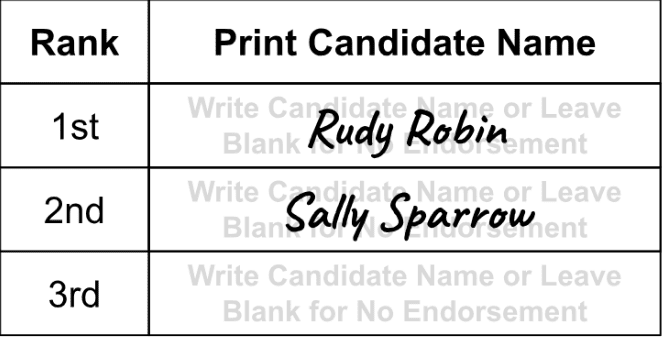
If the endorsement vote uses paper ballots, one can design and print the ballots with faded text reading “Write Candidate Name or Leave Blank for No Endorsement” in each of the available ranking slots, on top of which the voters can rank as many candidate names as they wish in darker ink. For example:
Tallying the Votes
Tallying the votes of an RCV endorsement contest works just like an ordinary RCV election, but with one modification: Continue the rounds of counting until one candidate remains.
While it is an established best practice for RCV elections to continue the rounds of counting until two candidates remain, an endorsement tally should continue for one additional round in which the runner-up candidate is eliminated and their vote redistributed. Once one candidate remains, compare the number of ballots for the remaining candidate to the number of total ballots to see if the candidate has met the threshold for endorsement, be it a majority or supermajority threshold.
There are many online voting platforms that can be used to make ranked endorsements. Not all of them support a “reduce to one” tally, but one of the most common platforms used for making ranked endorsements, OpaVote, has clear instructions for automating this secondary count.
If you use a platform other than OpaVote, there are straightforward workarounds to reduce to one. First off, it may be clear from the final round of a standard RCV tally that the winner has met the sufficient level of support among all voters to qualify for endorsement. In that case, no workaround is necessary. If it is not clear from the final round, one option is to download all the ballots and count the number of ballots on which the winner appears in any rank, perhaps with the aid of a spreadsheet. The percentage of ballots on which the winner appears is the same percentage they would be on had the field been reduced to one.
Endorsing multiple candidates
Many organizations regularly endorse multiple candidates in a race. This is the norm when endorsing for multi-seat offices, such as at-large city councilor, but is also common for single-seat offices elected with RCV. The process above can be easily extended to endorse multiple candidates at a time, all from the same set of ranked ballots.
For multi-winner endorsements, we recommend using sequential RCV. While it is a best practice to use proportional RCV for multi-winner elections to best represent the diversity of the voters, the aim of an endorsement is not to reflect the diversity and differences of opinion within the endorsing body. Rather, the goal of an endorsement process is to only select candidates that the body can support with broad consensus and ample enthusiasm, even if they all reflect the same beliefs and ideology, and even if that means endorsing fewer candidates than there are available seats.
To use sequential RCV for endorsements, start by using the process described above to determine the first candidate to endorse. If No Endorsement wins, zero candidates will be endorsed. If a candidate wins an endorsement, cross off that winner’s name from all the ballots and repeat the tally from the beginning, as if you are again endorsing a single candidate using those same ballots. This second tally chooses the second endorsed candidate.
Repeat this process until you have endorsed the number of candidates you want, or you reach a No Endorsement outcome. If using OpaVote, you can semi-automate this process by following their instructions for rerunning the election with candidate names withdrawn.
Using RCV for endorsements is particularly effective for elections that actually use RCV; it gives organization members experience ranking candidates as they’ll do on their election ballot, and also indicates the importance and value of ranking to voters following the organization’s guidance. When endorsing multiple candidates for an RCV election, we recommend that your organization publish the endorsed candidates in the order that they won endorsement under the sequential RCV method.
Conclusion
Ranked choice voting is an effective tool for organizations to use when endorsing political candidates. It picks winners that most members of the organization can get behind, and prevents No Endorsement from winning when most members want to endorse. Following the best practices above can help organizations get the most out of their endorsement process.