A primer on party preferential voting
How a party- and candidate-centered approach to proportional representation could work for U.S. elections
By FairVote and Protect Democracy
Executive summary
Proportional representation has the potential to make American democracy more functional and representative.
Proportional representation (PR) is a class of electoral system designed to allocate seats in a legislature in proportion to the preferences expressed by voters, so that the overall makeup of the elected body closely reflects the distribution of votes among the electorate. PR has the potential to make American democracy more functional and representative. There are several forms of PR, such as closed or open list PR and proportional ranked choice voting (RCV).
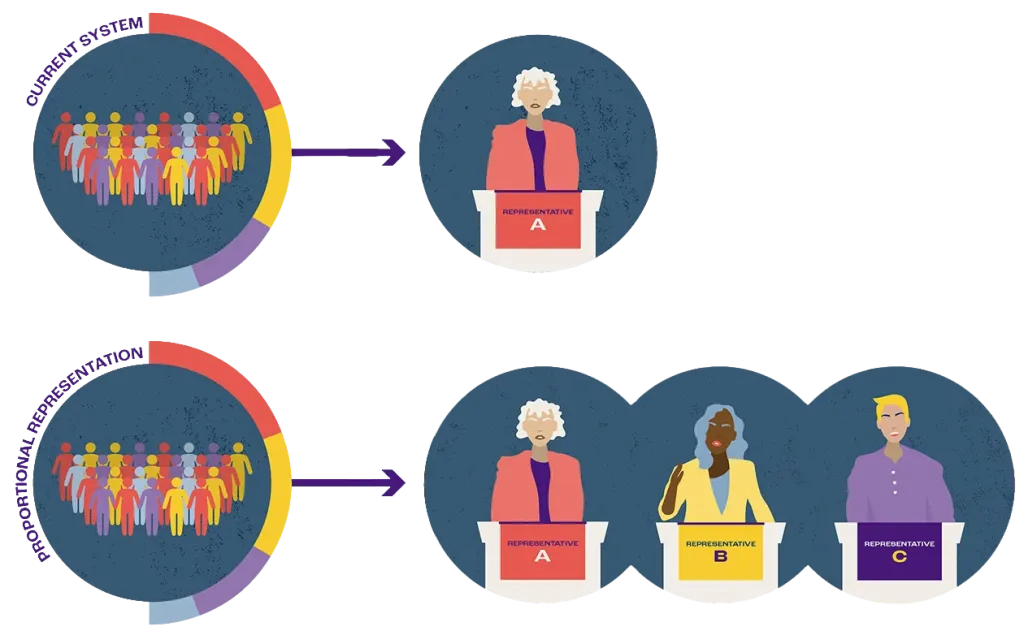
Party preferential voting systems allow voters the choice to rank preferences for either parties or candidates.
What we call “party preferential voting” (PPV) is a system developed in Australia, there called “above the line” voting. Under PPV, parties are listed in one section on the ballot and individual candidates are listed in another. Voters can choose to rank parties or candidates. Like closed list PR, it simplifies choice for voters by organizing their options through parties. Like proportional RCV, it maintains an option for candidate-centered voting, allowing voters to express preferences for candidates both within and across parties.
The combination of advantages party preferential voting offers makes it a solution U.S. policymakers should know about.
As the push for PR in the U.S. grows, a better understanding of party preferential voting can assist policymakers and reformers as part of a menu of PR options. Technical and administrative questions remain about its implementation. Yet Australia’s experience suggests that party preferential voting may provide a distinct combination of advantages of various PR models being considered in the U.S.
Background
Much of the current dysfunction in American politics can be traced back to the winner-take-all electoral system used for most elections, including for the U.S. Congress and all state legislatures. In a winner-take-all system, a single candidate or party wins each election to the exclusion of all others. For instance, at the district level, a candidate who wins 51% in a congressional district “takes all,” leaving the other 49% of voters without a representative of their choosing. Moreover, when aggregated across districts, parties typically secure seats out of proportion to votes won. In Massachusetts, all nine U.S. House seats are held by Democrats, despite Republicans constituting a third of the electorate; in Oklahoma, all five U.S. House seats are held by Republicans, despite Democrats constituting a third of the electorate. Non-proportional outcomes are commonplace under winner-take-all systems.
Winner-take-all elections are also associated with higher levels of polarization, greater dissatisfaction with democratic institutions, depressed voter turnout, less competitive elections, poorer governance outcomes, and underrepresentation of racial and partisan minorities, among other issues. Additionally, given the zero-sum nature of political conflict encouraged by winner-take-all elections — in which a win for one group means a loss for the other — political scientists have long understood that winner-take-all systems pose significant risks for polarized societies.
While a few major democracies continue to use a winner-take-all system for national elections, most today use some form of proportional representation. PR is a category of electoral systems designed to allocate seats in a legislature in proportion to the preferences expressed by voters, so that the overall makeup of the elected body closely reflects the distribution of votes among the electorate.
Whereas winner-take-all elections typically use single-member districts, PR requires the use of multi-member districts to achieve proportional results. When multiple representatives are elected from the same district, the share of votes needed to win seats drops, enabling representation (or seats won) to better reflect actual votes. Consider a three-member district that is 65% Republican and 35% Democratic. Under PR, two seats would likely go to Republicans while one would likely go to a Democrat. PR preserves majority rule while awarding fair representation to the minority.
Proportional systems also waste fewer votes than winner-take-all systems. Wasted votes are those that do not help elect a candidate or party. In winner-take-all systems, only the top vote-getter wins, meaning all other votes — even if they represent a large share of the electorate — have no impact on representation. In the 65/35 example, the 35% who voted Democratic would be left entirely unrepresented under a winner-take-all model. With PR, the floor for winning representation is lower, meaning more people can help elect a candidate of their choice and fewer votes are wasted.
At present, the only proportional system used in public elections in the U.S. is proportional ranked choice voting. With proportional RCV, voters rank the candidates in order of preference. Like other forms of PR, proportional RCV operates around a “threshold-to-elect” (i.e., the percentage of votes needed to win one seat) based on the number of representatives being elected. For example, in a five-member district, the threshold is 17%. Candidates are sequentially elected or eliminated until the desired number of winners have reached the threshold. If a voter’s favorite candidate cannot reach the threshold, or their favorite candidate has exceeded the threshold, they can help their next choice win a seat. Proportional RCV is currently used in Portland, Oregon; Cambridge, Massachusetts; Minneapolis, Minnesota; Albany, California; and other municipalities. The system is also used in Australia, Ireland, Scotland, and Malta (termed the “single transferable vote,” or STV).
There are, however, several forms of PR that have unique benefits and are worth exploring in the U.S. Internationally, party list systems, or list PR, are the most common. With list PR, parties produce a list of candidates, and seats are allocated to each party in proportion to the votes they receive. Party list systems come in two main forms. In a “closed” list system, voters choose a party, and the party determines which of its candidates are elected based on a preset order. In an “open” list system, voters select individual candidates from a party’s list; seats are still allocated to parties proportionally, but the candidates with the most votes within each party are the ones who win the seats.
Proportional RCV and list PR each have common benefits. Both facilitate a more competitive electoral environment than winner-take-all systems. In proportional systems, parties benefit from appealing to a broader share of the electorate, because even modest gains in votes can help a party win additional seats. Returning to the 65% Republican / 35% Democrat district example, a winner-take-all election would leave Democrats without a path to representation and Republicans with little incentive to broaden their appeal. Under proportional representation (in, say, a three-member district), both sides have something to play for: Democrats to secure a seat, and Republicans to secure a second.
Under both systems, parties also have incentives to form coalitions. Under proportional RCV, voters can rank candidates across party lines, which incentivizes parties to bargain for cross-endorsements. This has been true in Australia, where the ability to rank candidates (as well as parties, as explained later) has encouraged alliances among ideologically aligned parties. The system has supported a long-running formal governing coalition between the conservative Liberal and National parties, and a more recent informal electoral coalition between the progressive Labor and Green parties. Parties typically issue “how-to-vote” cards advising their supporters to rank their coalition partner second. In the U.S., this dynamic could manifest in the form of Democrats partnering with, say, the Working Families Party, or Republicans partnering with the Libertarian Party.
Under list PR, parties also coordinate their campaigns to maximize their electoral success. For example, in Germany, smaller parties have cooperated or merged to clear the 5% threshold required for representation in the Bundestag. In a U.S. context, the Green Party and the Working Families Party could, for example, form a joint list to pool progressive votes, and the Libertarian and Constitution parties could do the same on the right. Parties may also coordinate by targeting different geographic areas or segments of voters to avoid splitting the vote, or by pooling campaign resources. These alliances can lay the groundwork for formal governing coalitions after the election.
Each system also presents tradeoffs. For example, proportional RCV allows voters to express nuanced preferences between individual candidates, including across party lines. This can be especially valuable in contexts where voter preferences cut across traditional partisan divisions. For instance, a voter who prioritizes democratic norms may wish to support candidates from different parties who share those commitments. Voters can choose to rank candidates based on their own priorities.
Though proportional RCV strengthens candidates’ abilities to appeal to voters as individuals, it weakens their direct electoral ties to their party. Some may find this dynamic desirable. Candidates could be incentivized to make cross-partisan appeals, and some legislators may be elected by cross-partisan coalitions. However, compared to list systems, proportional RCV weakens the direct link between voters and parties. Voters’ choices are neither structured nor recorded strictly in terms of their partisan affiliation, and candidates’ electoral success is not directly tied to their party’s overall performance. This reduces parties’ role in organizing elections and makes the translation of votes into party seats less direct and predictable. Parties in particular may take issue with this, and some degree of ongoing party buy-in is necessary to make any reform viable and sustainable.
Under list PR, parties are more central to the process at every level. When a voter votes for a candidate in an open list system, for example, they are also casting a vote for that candidate’s party slate. This encourages voters to think in terms of explicit coalitions and how those coalitions will vote in office, and makes the task of supporting a particular coalition easier by tying votes to parties.
On the other hand, list PR limits the ability of voters to express multiple preferences within party slates or to express support for candidates from more than one party.1 Open list systems do allow voters to help elect individual candidates within a party, but voters still must accept that their vote could help elect other members from that candidate’s slate. This reinforces the role of parties in campaigning and governing, which is why list PR is often described as a “stronger party” system. While there is a large body of political science research that emphasizes the central importance of parties to democracy, this structure contrasts with the more candidate-centered political culture of the present U.S. system.
However, there exists a hybrid approach that combines elements of proportional RCV and list PR – referred to here as party preferential voting.
Party Preferential Voting
Party preferential voting is a system that exhibits characteristics of proportional RCV and list PR. For a given race, parties are listed in one section on the ballot and individual candidates are listed in another. Voters can choose to rank the parties or the individual candidates in order of preference. See two sample ballots below – where the voter chose to rank the parties, and another where the voter chose to rank the individual candidates.
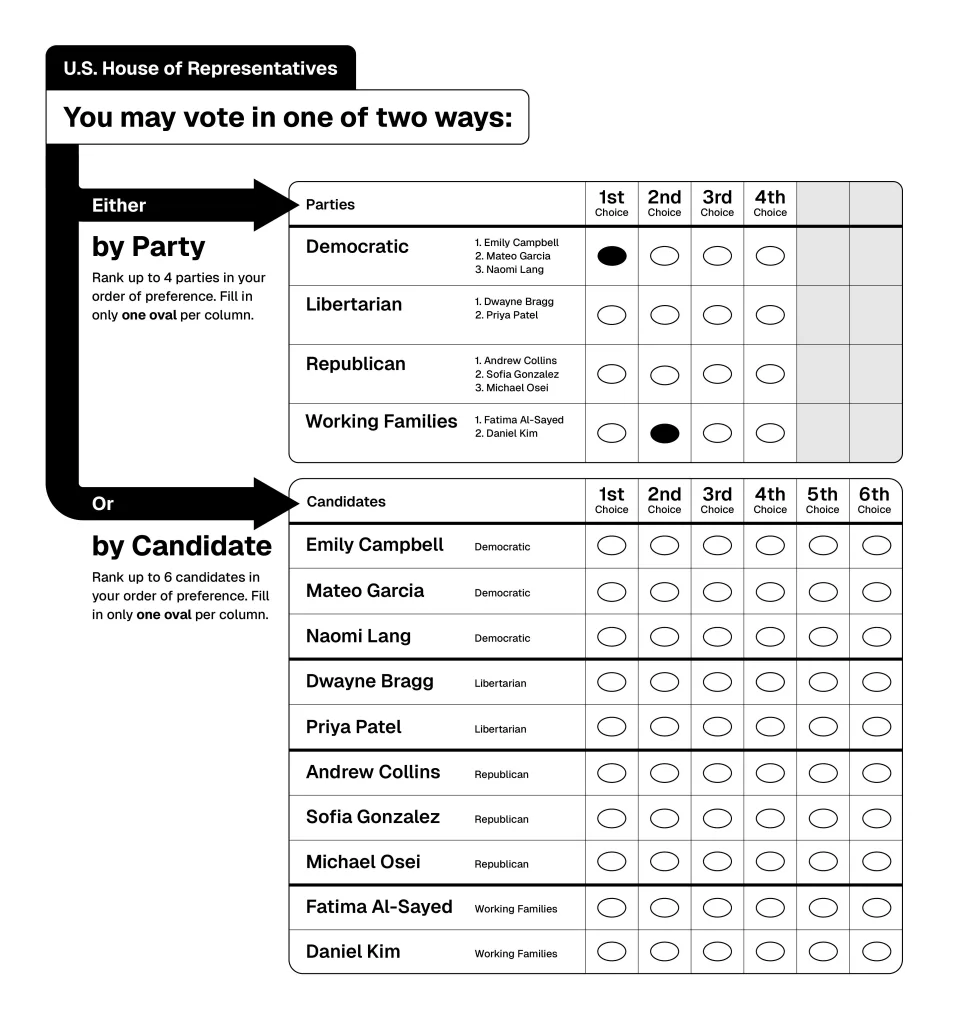
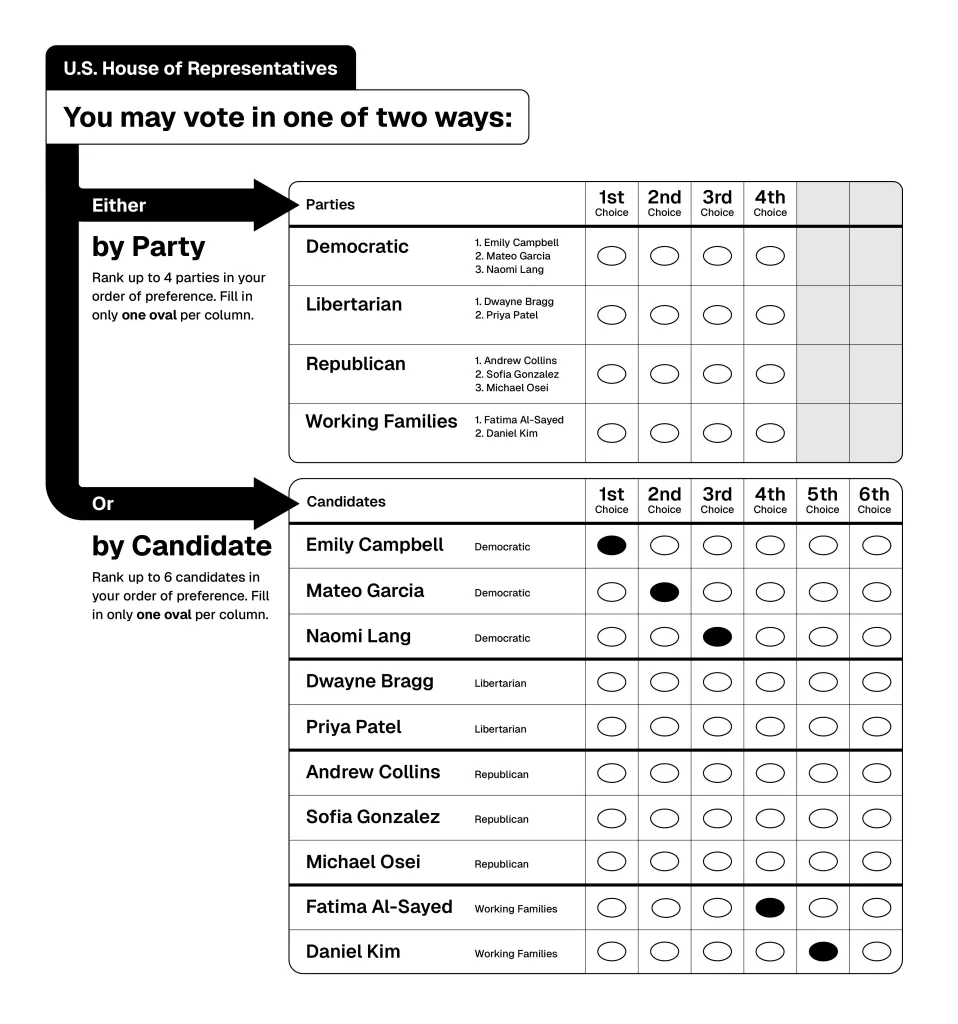
Each party has its own ranked list of candidates. If a voter chooses to rank a party (or parties), they are essentially casting their ballot in accordance with the party’s list. For example, say the Democratic Party’s list is:
- 1) Emily Campbell
- 2) Mateo Garcia
- 3) Naomi Lang
And the Working Families Party list is:
- 1) Fatima Al-Sayed
- 2) Daniel Kim
Say a voter ranks the Democratic Party first and the Working Families Party second. Their ballot would be treated as if they ranked the candidates in the following order:
- 1) Emily Campbell
- 2) Mateo Garcia
- 3) Naomi Lang
- 4) Fatima Al-Sayed
- 5) Daniel Kim
Whether voters ranked parties or candidates, each ballot represents a ranked ordering of candidates that is tabulated according to regular proportional RCV tabulation rules.
Party preferential voting resembles “straight-ticket” voting, which is an option in several U.S. states.2 In these states, voters who wish to vote straight ticket indicate their preferred party at the top of the ballot. Their vote counts toward that party’s nominee in each partisan race on the ballot.
Party preferential voting can be designed to apply at the office level or at the ballot level. To apply party preferential voting at the office level, voters would “pick a party” for each partisan race on their ballot (e.g. a ranking would only determine how the voter’s vote is cast for, say, their U.S. House district). To apply party preferential voting at the ballot level, voters could pick a party at the top of the ballot to apply across all partisan races on the ballot. This would be similar to straight-ticket voting in that a voter who ranks the Democratic Party first would have their vote count toward the Democrats first in all races on the ballot.
Australia introduced party preferential voting (which they call “above the line” voting3) in the 1980s, and has retained the system ever since.4 Ranking is compulsory in Australia, so before the option to rank parties was introduced, voters were required by law to rank a sometimes unmanageably high number of candidates. This resulted in a high number of invalid or random rankings. Allowing voters to rank parties helped simplify choices for voters.
Where proportional RCV is used in the U.S., and where it has been proposed, ranking is not compulsory. The implementation of proportional RCV could nonetheless face challenges similar to those that led to the Australian method. Consider the Fair Representation Act, a bill that would implement three-to-five member districts under proportional RCV for U.S. House elections. Pursuant to the Act, parties would be allowed to nominate up to as many candidates as there are seats. In a five-member district, voters could have up to ten major party candidates on the ballot, plus minor party and independent candidates. That said, parties may run a number of candidates closer to the number of seats they realistically expect to win. Still, voters may encounter high numbers of candidates at the ballot box.5 Party preferential voting could provide an alternative for voters who instead prefer to simply support their preferred party (or parties).
In Australia, over 90% of voters choose to rank the parties rather than individual candidates.6 This means most ballots count toward voters’ first choice party, unless all of that party’s candidates have been elected or eliminated. Because of this, party preferential voting operates much like a closed list PR system in practice. As used in Australia, the system retains the “strong party” feature of list PR because it reinforces party identity as the lens through which most voters cast their ballots.
Although Americans are not significantly more distrustful of political parties than people in other democracies, American political culture has been historically candidate-centered. By giving voters the ability to rank individual candidates, party preferential voting is consistent with this tradition. Suppose a voter supports one candidate from a given party but not the others; party preferential voting allows that voter to choose any backup choice instead of being locked into that party’s list.
Party preferential voting also helps reduce wasted votes. If a voter chooses to rank individual candidates, but their favorite candidate gets eliminated, they can help elect someone else. If a voter chooses to rank parties, but no candidate from their favorite party can win a seat, they can help a different party win a seat. By including a party ranking option, the system can reduce the number of votes that might be wasted by being cast for parties that fall below the threshold in a list PR system. Moreover, because voters may find it easier to rank parties than individual candidates, more ballots are likely to include viable backup options – potentially reducing wasted votes even more effectively than proportional RCV alone.
Party preferential voting may also help mitigate some of the structural barriers faced by minority communities in achieving representation. Like any form of PR, party preferential voting reduces the threshold-to-elect and risk of wasted votes — a dynamic that may particularly benefit voters seeking alternatives to major parties that have historically under-served them. Moreover, allowing voters to vote for candidates as individuals — as is the case in proportional RCV and open list PR but not closed list PR — can amplify this effect by giving voters a degree of control over which candidates within the parties are elected. For example, Lisa Singh became the first person of South Asian heritage elected to the Australian Parliament in 2010. In the 2016 election, Singh was demoted to the sixth place on her party’s list, a position that was described as “unwinnable.” Singh successfully appealed to voters to vote for her as an individual and retained her seat.
In short, if a key objective of proportional representation is to give voters more choices, having a party-line option can help organize and simplify those choices. At the same time, having the option to vote for individual candidates allows voters greater choice and flexibility. Party preferential voting offers one way to preserve both options.
Further questions and considerations
Party preferential voting raises additional policy and implementation questions. As with most election rules and procedures in the U.S., this would require state-level decision making. Key decisions include:
- Party list formation.7 Party lists could be determined in primary elections. However, under systems of proportional representation, separate primary elections are potentially duplicative; the two elections could in practice be combined. Proportional ranked choice voting and open list systems allow voters to select among several candidates affiliated with a political party – as in a primary – during the general election. Under party preferential voting, candidates could petition to access the general election ballot, with party labels determined by candidate affiliation or by the consent of the parties. Parties could also determine their nominees in privately held caucuses or conventions.
- Ballot access rules. States would need to determine how parties qualify to appear on the ballot – likely through a mix of vote thresholds, signature requirements, or filing fees. Independent candidates could still access the ballot in the candidates section, or could even form a slate that could be ranked in the party section.
- Ballot design. A new ballot layout would be required to accommodate rankings for both parties and individual candidates. This would need to be tested for usability, accessibility, and compatibility with U.S. voting equipment.
- Ballot interpretation rules. There would need to be a clear rule for how to count a ballot where the voter ranked both the parties and the candidates. In Australia, candidate-level rankings override party-level-rankings. A similar principle applies in U.S. jurisdictions that use straight-ticket voting.
- Application to nonpartisan offices. As described, party preferential voting requires nominations to be workable. However, places with nonpartisan elections that do not want to adopt partisan elections could allow candidates to form slates, and then adopt a variation of the system where voters may either rank candidates, or rank the slates as if they were parties.
Conclusion
Proportional representation in the U.S. is increasingly viable and urgently needed. Seven municipalities have adopted proportional RCV since 2020.8 An increasing number of pro-democracy organizations have made PR a strategic priority.
Party preferential voting draws on strengths from other systems used internationally. Like list PR, it simplifies choices for voters and reinforces the constructive role parties can play in organizing those choices. Like proportional RCV, it preserves a candidate-centered voting option and offers voters flexibility on the ballot.
As reformers explore PR in their states, they must assess which forms of PR may be a strong fit for their context. Our hope is that this resource can help reformers navigate an additional and potentially promising option.
Authors
Grant Tudor, Protect Democracy
Drew Penrose, Protect Democracy
Rachel Hutchinson, FairVote
Deb Otis, FairVote
Michael Parsons, FairVote
We thank Benjamin Reilly at the United States Studies Centre and Tabatha Abu El-Haj at Drexel University’s Thomas R. Kline School of Law for their valuable feedback on this report.
Footnotes
- One list PR system, often called “free list,” does allow voters to express preferences for candidates across multiple parties, as well as express a stronger preference for some candidates than others.
- The states that offer straight-ticket voting as an option are Alabama, Indiana, Kentucky, Michigan, Oklahoma, and South Carolina.
- On the Australian ballot, there is a line separating the list of parties and candidates. Voters choose to vote “above the line” or “below the line.” If a voter votes above the line, they rank the parties in order of preference. If a voter votes below the line, they rank the individual candidates in order of preference.
- Australia reformed its above the line (ATL) system in 2016 such that it now works as described above. The old variation of ATL is briefly discussed in footnote 7.
- That said, voters do not have to rank all or even many candidates in order to achieve substantially proportional results under proportional RCV. The MGGG Redistricting Lab’s Ranked Choice Voting and Minority Representation models PRCV in four U.S. jurisdictions, including scenarios where voters rank only a limited number of candidates, and still finds proportional representation for the minority racial group in every case.”
- 90% may be high compared to what we might expect domestically, given ranking is compulsory in most places in Australia. For example, in the 2020 general election, about two-thirds of voters chose to vote straight-ticket in Alabama and South Carolina. In the 2024 election, just under 38% of voters chose to vote straight-ticket in Oklahoma.
- One lesson from Australia is that this system is most transparent and fair when each party submits its own list of candidates. When ATL voting was first implemented in Australia, each party’s list contained a ranked ordering of every candidate from every party. Voters marked a single preference for a party (or group), and their ballot would be treated as if they had ranked all of the candidates in the same order as that party. This resulted in parties making back-door deals and attempting to game the system, which prompted a reform to the method in place today.
- The list includes Albany, CA; Arlington, VA; Charlottesville, VA; Oak Park, IL; Portland, OR; Portland, ME; Skokie, IL.