Ranked choice voting can empower Arab American voters
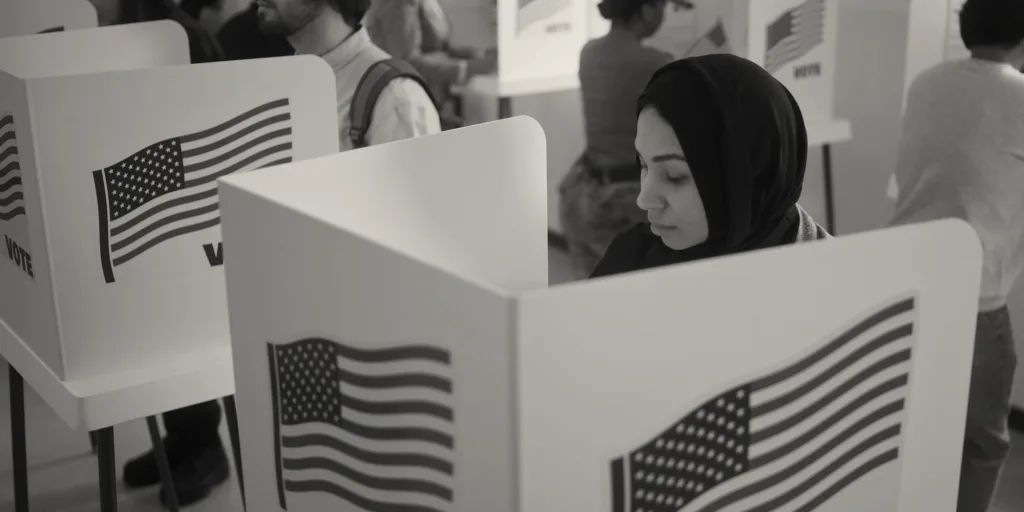
Arab Americans are underrepresented at every level of government. Elected officials find it easy to ignore our community when making policy.
National Arab American Heritage Month, which occurs every April, offers an opportunity to discuss how our community can build political power. Doing so will take a lot of on-the-ground work, and structural reforms also have a role to play – especially ranked choice voting (RCV).
Arab American voters are not a monolith – and binary, “choose-one” elections often fail to represent us. Our community includes liberals, conservatives, moderates, and people who don’t fall neatly on the ideological spectrum. In many elections, neither major candidate speaks to the issues our community cares about – yet we’re told that if we don’t pick one of them, we’ll be “throwing our vote away.”
With ranked choice voting, voters can rank their choices. If a voter’s favorite candidate can’t win, their vote goes to their next choice. This would give Arab Americans more choices at the ballot box; we could vote for candidates who speak to issues we care about – even if those candidates aren’t one of the frontrunners.
And if Arab American voters are split between different first choices, that wouldn’t dilute our community’s voice. Through the RCV count, Arab American voters could consolidate around a consensus candidate who will fight for us in office.
Additionally, because candidates in RCV elections need majority support to win, candidates can no longer afford to ignore Arab American voters. Elections around the country have shown that when a city or state adopts RCV, candidates reach out to voters they wouldn’t have talked to before.
RCV provided an incentive for me to campaign beyond my likely base. I canvassed neighborhoods in every section of the district and engaged with voters who I already knew preferred another candidate.
– San Francisco Board Supervisor Myrna Melgar
I door knocked a number of people who had signs up for my opponent…. The conversation didn’t have to stop because they had already pledged to someone else.
– Saint Paul City Councilmember Rebecca Noecker
For me personally, Mayor Zohran Mamdani’s win in New York City shows the power of ranked choice voting. Mamdani was an outsider candidate who started at 1% in the polls; RCV races allow these candidates to stay in the race and make their case to voters.
Though not an Arab American himself, Mamdani actively sought support from Arab American voters, and Arab Americans were a key part of his coalition. As a Muslim and pro-Palestinian candidate outside his party’s establishment, Mamdani may not have been taken seriously in a choose-one race. But with RCV in the primary, voters gave him a closer look – and he gained enough traction to eventually become a frontrunner and win.
Choose-one elections degrade our democracy, leading to a government that doesn’t reflect its people and leaders who don’t listen to us. Maintaining the status quo is not an option we can afford.
As Arab Americans work to build political power, it’s crucial to consider reforms like ranked choice voting that give us more choices and make candidates listen to every voter.
Haliema Twam is the Civic Engagement and Advocacy Manager at the Palestinian American Community Center. The views expressed in this article are her own, and do not necessarily reflect those of the Center or FairVote.
Sign up for the latest news from the election reform movement, or get involved in your community.