This memo explains why proportional ranked choice voting is the gold standard for multi-winner ranked choice voting, and compares it to sequential ranked choice voting and “bottoms-up” ranked choice voting. All three are multi-winner forms of ranked choice voting (RCV), and the voting experience is the same; voters simply rank the candidates in order of preference. However, the way winners are determined is different in each method.
Proportional RCV (also known as single transferable vote) identifies winners who are representative of the whole electorate. Candidates win when they receive a certain share of votes. As a result, political or demographic groups pick winners in proportion to their share of votes cast.
Sequential RCV is “hyper-majoritarian” – the majority faction can essentially elect (or nominate) every spot and shut out the voice of minority factions.
Bottoms-up RCV is “semi-proportional,” meaning minority groups are likely to earn some representation but may not achieve fully proportional representation. It is a middle ground between proportional RCV and sequential RCV.
Proportional RCV
Impact: In a two-winner proportional RCV contest, a candidate needs a little over 33.3% of votes to win, and at least 66.6% of voters elect a candidate of their choice.
With more winners, the threshold is lower. This lowers barriers for minority political or demographic groups to win representation (or advance from a primary to a general election). At the same time, a significant majority of voters will always elect a candidate of their choice, and if there is a majority bloc in the electorate, they will win most of the seats.
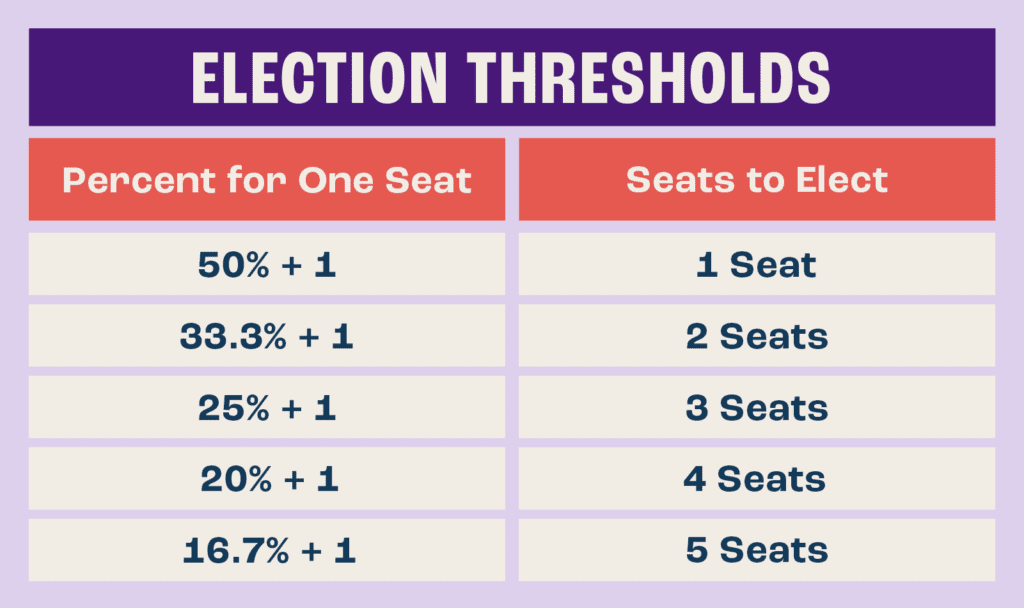
Where it’s used: Proportional RCV is used around the world, including in Ireland and Australia. In the United States, it’s used in Albany, CA; Arden, DE; Arlington, VA; Cambridge, MA; Minneapolis, MN; and Portland, OR.
Sequential RCV
Impact: Voters who already helped elect a candidate of their choice get a second “bite at the apple.”1 As a result, this system preserves majority rule, but also allows a majority faction to essentially determine who wins each seat.
Where it’s used: Sequential RCV is not currently used anywhere in the world. Utah’s legislature enacted a pilot program that allowed municipalities to use RCV for local elections, including sequential RCV for multi-winner contests, from 2019 to 2025. Sequential RCV was used in Australia in the early 20th century before being abandoned in favor of proportional RCV.
Bottoms-up RCV
Impact: With bottoms-up RCV, trailing candidates are eliminated until the number of remaining candidates is equal to the number of seats to fill. Voters whose first choice is a winning candidate do not ever have their vote count for another candidate, so each winner represents a unique group of voters.
Unlike proportional RCV, there is no fixed threshold to win. Some candidates may end up with more (or fewer) votes than a hypothetical threshold.
Where it’s used: Bottoms-up RCV is used by several state Democratic parties for presidential primaries. It is also scheduled for use in Washington, DC general elections beginning in 2026 and Seattle primaries beginning in 2027.
Side-by-side comparison
See the following mock proportional RCV vs. sequential RCV vs. bottoms-up elections. All three examples assume the same set of ranked ballots.
In these examples, the Orange Party constitutes 55% of the electorate, and the Purple Party constitutes 45%. With proportional RCV, a candidate from each party wins one spot. With sequential RCV, the Orange Party wins both spots, meaning the Purple Party has no representation, despite making up nearly half of the electorate. Bottoms-up is considered a middle ground between proportional RCV and the hyper-majoritarian sequential RCV. In this example, bottoms-up would elect Rust and Plum, just like proportional RCV.
Though not all elections are partisan, the same logic applies to issue or demographic groups; proportional RCV identifies winners relative to their share of support in the electorate, and sequential RCV allows the majority faction to choose all winners.
In general elections, proportional RCV leads to more accurate representation. In primary elections, proportional and bottoms-up RCV better represent the party by ensuring multiple factions within the party can advance a candidate of their choice, whereas sequential RCV may shut out a faction. For these reasons, proportional RCV is the gold standard of RCV for multi-winner elections.
Comparison table
| Proportional RCV | Sequential RCV | Bottoms-up RCV | |
|---|---|---|---|
| Philosophy | “Different factions should earn representation in proportion to their share of the electorate.” | “The biggest faction should have the power to win every seat.” | “Different factions should earn representation, in relative proportion to their share of the electorate.” |
| Equal for each voter? | Yes – one “single transferable” vote per voter | No. Voters who elect their first-choice candidate can also elect their second choice, while other voters’ voices are not heard. | Yes – each voter’s ballot counts once for their highest-ranked active candidate. |
| Where it’s used | International standard for multi-winner RCV | Not in use | Democratic presidential primaries, Washington, DC, Seattle |
- One could argue that proportional RCV also gives some voters a second “bite at the apple” via surplus votes. However, surplus votes only count as a fraction of a vote. Think of your vote like a dollar: If it only takes 90 cents to elect your first choice, you can spend the remaining 10 cents on your next choice. However, if you supported the candidate who won the first seat in a sequential RCV contest, you would get another full dollar, equal in power to those who have not yet helped elect a candidate of their choice. ↩︎