New York mayoral election shows need to expand ranked choice voting

New York City voters elected Democrat Zohran Mamdani as their next mayor after a contentious general election campaign. With some absentee ballots outstanding, Mamdani has earned 50.4% of the vote, followed by former Governor Andrew Cuomo with 42% and Republican Curtis Sliwa with 7%.
This campaign was notably different from New York City’s primary elections, which use ranked choice voting (RCV). Those races – particularly the marquee Democratic mayoral primary – were marked by positive campaigning and coalition-building. RCV also guarantees a majority winner in a crowded field – Mamdani earned 44% of voters’ first choices, and won 56% of votes in the RCV count.
Sign up for the latest news from the ranked choice voting movement, or get involved in your community.
The New York City general election, which used choose-one voting, saw an entirely different tone. Debates were highly negative, and dominated by discussion of which candidates were playing “spoiler” and who should drop out – rather than candidate platforms and the issues facing the city.
Outgoing Mayor Eric Adams ended his campaign because of this pressure, and Sliwa similarly faced calls to drop out. This attitude continued through the last days of the election, with Cuomo and supporters repeatedly saying that “a vote for Sliwa is a vote for Mamdani.”
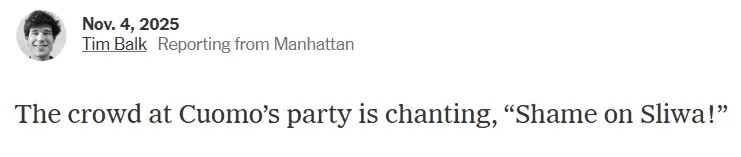
Screenshot from election night coverage by the New York Times
Ranked choice voting puts voters first, not electoral math. Voters would have more choice without fear of spoilers or vote-splitting, and the city would always elect a candidate supported by the majority.
In this case, RCV may have delivered the same outcome – a majority win for Mamdani. (Mamdani earned more votes than Sliwa and Cuomo combined.) However, RCV would have changed the tone of the campaign and empowered voters. Voters could honestly rank their favorite candidate first, without fear that doing so would help the candidate they like least. In other words, no fear that “a vote for Sliwa is a vote for Mamdani.”
Additionally, though Mamdani did win a majority, there was significant discussion about the possibility that he would not and that it would weaken his mandate to lead; if the city used RCV, elected officials would always have a majority mandate to lead.
New York City has used RCV for primary elections since 2021 – and voters have embraced the system. For instance, in this year’s primary, voter turnout crossed 1 million for the first time since 1989, 96% of voters said RCV was simple, 78% of voters in the Democratic mayoral race ranked two or more candidates, and 76% said they wanted to keep or expand RCV.
New York City should expand ranked choice voting to its general elections so all voters can have better choices and better elections. To support RCV in the Empire State, visit Common Cause NY and Rank the Vote NYC.