Democrats could be locked out of race for California governor

The race to succeed California Governor Gavin Newsom is heating up. Many Democrats are looking to replace the term-limited Newsom; recent polling suggests two Republicans and zero Democrats might advance from the “top-two” primary to the general election in this deep-blue state. If California used an Alaska-style system – with a top-four primary and ranked choice voting (RCV) in the general election – voters would have more choices and elections would deliver more representative outcomes.
Sign up for the latest news from the ranked choice voting movement, or get involved in your community.
In California’s top-two primary, all candidates run on the same primary ballot and all voters can participate, regardless of party affiliation. The two candidates with the most votes advance to the general election.
Top-two primaries have been an important reform allowing every voter to participate in both rounds of the election; in theory, this system gives voters a choice between the two most competitive candidates in November. However, when more than two candidates from the same party run in a primary, it’s possible that they split the vote and lock their party out of the general election – even if most voters favor that party.
That might happen in the race for California governor this year. Eight notable Democrats have already entered the contest – including members of Congress, big city mayors, and a former federal cabinet official. Without a clear frontrunner, there is a real possibility that the Democratic vote will be split across too many candidates, sending two Republicans to the general election in a state that usually votes about 60% Democratic.
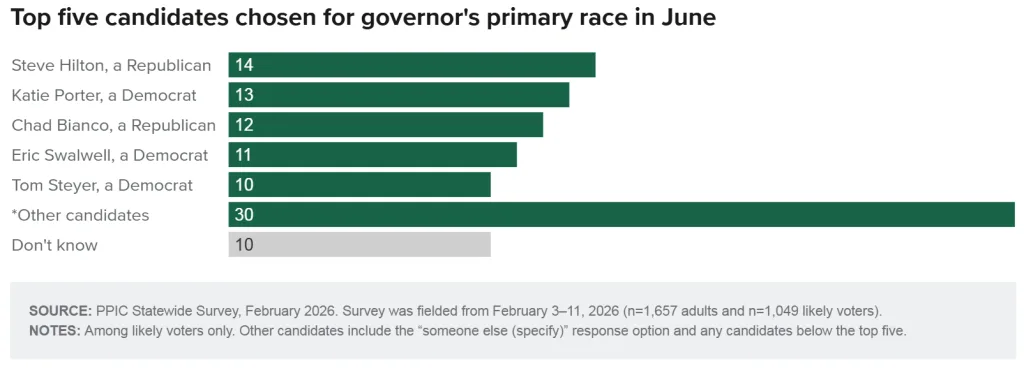
Democrats are starting to scramble; on March 3, the chair of the state Democratic Party wrote an open letter urging candidates without a “viable path” to the general election not to enter the race. The letter also asked candidates who do file to drop out by April 15 if they fail to show “meaningful progress toward winning” the primary. In a system vulnerable to vote-splitting, that kind of coordination becomes a rational, if uncomfortable, response.
California’s lockout problem isn’t new, and it doesn’t just affect Democrats. Both major parties have been locked out of major elections in California over the years. In 2022, for instance, Republicans were locked out of the race for the State Senate’s 4th District seat, even though almost 60% of the primary electorate voted for a Republican. And Democrats were locked out of the 2012 race for the 31st Congressional District, despite Democratic candidates receiving roughly 50% of votes in the primary.
Another state offers a different version of an all-candidate primary that prevents the lockout problem. In Alaska, the top four candidates advance from the primary, and the general election uses ranked choice voting to determine a majority winner. This system gives voters more choices in the general election and makes it far less likely that one party gets locked out of the general election.
In Alaska’s 2022 gubernatorial race, for example, the general election ballot featured two Republicans, one Democrat, and one independent. In California, a similar system would likely make space for Democrats and Republicans in the general election for governor, and could allow independents and third-party candidates to advance as well. RCV, like Alaska uses, allows voters to choose from several candidates, and still identify a winner with broad support.
Local voices are already calling for this change, including election reform leaders Tom Charron and John Palmer. And several California cities already use RCV, including San Francisco, Berkeley, and Oakland. The Los Angeles Charter Reform Commission recently recommended by a 10-1 vote that the City of Angels join them. With millions of Californians already familiar with RCV, expanding the system statewide would build on a practice voters already know and like.
A competitive race like California’s gubernatorial election should offer voters meaningful choices and a real say in the outcome. A top-four primary with ranked choice voting would let the competition run its course, and the candidate (and party) with the most support would win.
For more information, visit CalRCV and Californians for Electoral Reform.