Democratic Primary 2020 Poll, February 28
FairVote commissioned a SurveyUSA nationwide poll of 825 likely Democratic presidential primary voters which took place on February 25 and 26, starting immediately following the presidential debate in South Carolina. The goal of our poll was to elevate approaches to polling crowded fields that provide greater insight than the usual focus on “single choice” results. We also asked respondents for their views about using ranked choice voting in presidential primaries and, adding in non-Democrats, to rate each Democratic candidate’s chances to win in November.
This presentation of findings includes:
- FairVote’s summary report of featured insights and graphics
- Crosstab analysis from SurveyUSA and a link to the full questions
- A FairVote press release about the poll
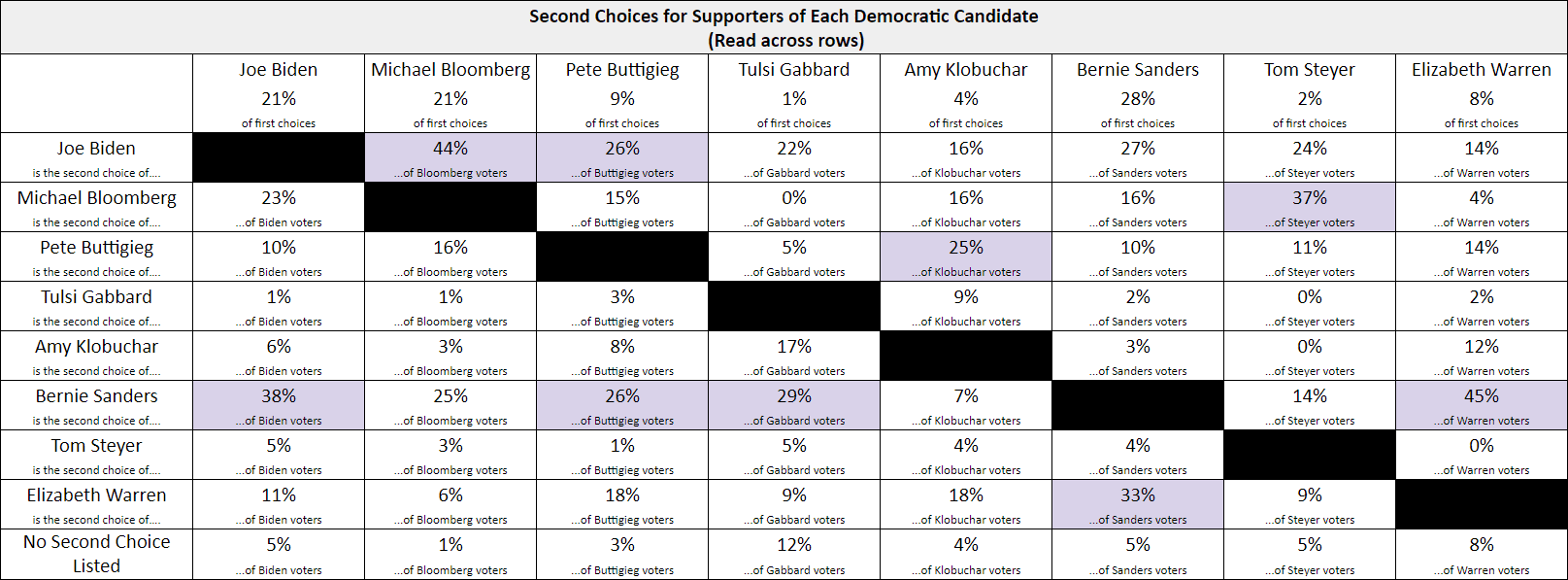
Second-choice table
A second-choice table shows who voters would prefer if their first choice drops out of the race, or is eliminated in a round-by-round RCV count.
Head-to-head comparisons
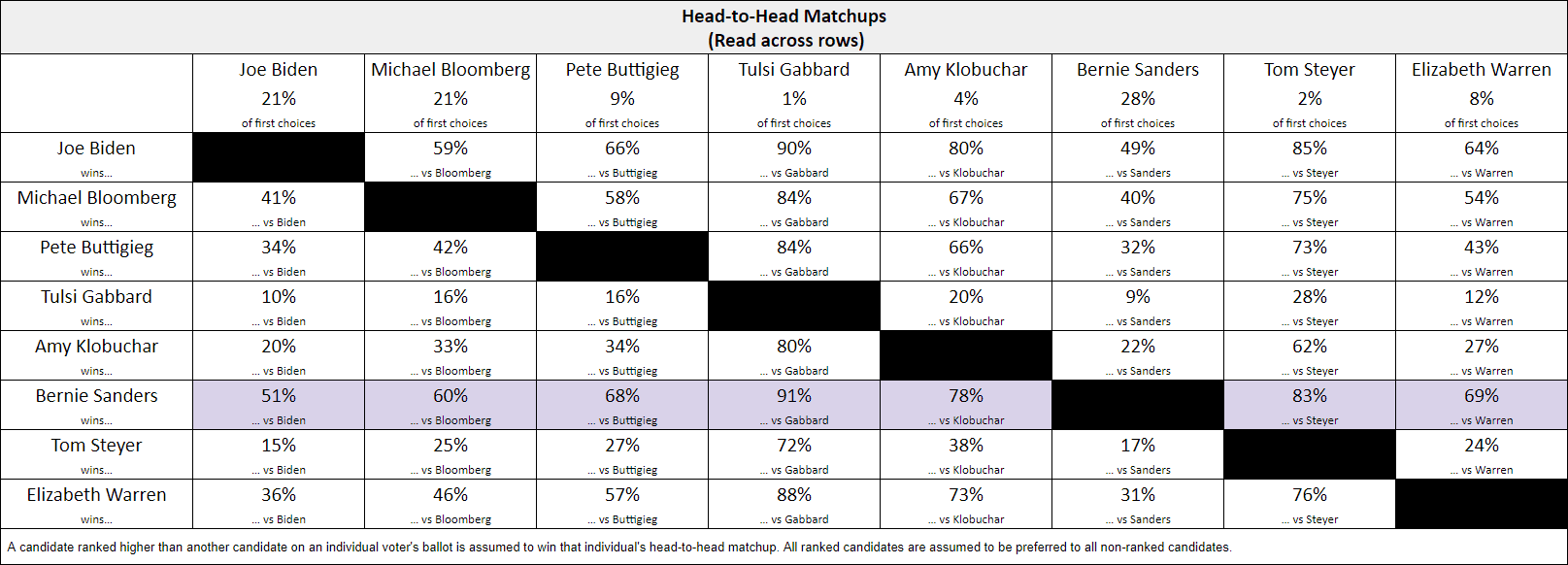
A head-to-head table simulates head-to-head match-ups based on respondents’ rankings. A candidate ranked higher than another candidate on a voter’s ballot is assumed to win that voter’s head-to-head match-up. All ranked candidates on a ballot are assumed to be preferred to all non-ranked candidates.
This chart is best read across rows. For example, the Joe Biden row can be read as: “Joe Biden wins 59% of head-to-head match-ups against Michael Bloomberg, 66% of head-to-head match-ups against Pete Buttigieg…” and so on. As shown, Bernie Sanders wins a majority of a head-to-head match-ups against each other candidate.
Cumulative rankings
Cumulative support across rankings is a way to measure how quickly a candidate consolidates support.
For example, only 28% of voters ranked Bernie Sanders as their first choice, but 49% ranked him in their top two, and 62% ranked him in their top three. Only Sanders and Biden were ranked in the top three rankings by a majority of voters.
Click the menu bar and arrows below to watch how candidates accumulate support from first choice rankings, two-two rankings, top-three rankings, and so on.
https://e.infogram.com/7b22cdfe-0e8f-4148-8354-9f019781a7d2?src=embedSurveyUSA Feb28 Cumulative Support550736no0border:none;allowfullscreen
Chances in the general election
In addition to the ranked choice voting questions, our poll asked respondents the likelihood that each Democratic candidate could Donald Trump in a hypothetical general election. Only likely Democratic primary voters were asked to rank the candidates, but all registered voters were asked to estimate candidates’ likelihood of defeating President Trump in the general election, allowing us to compare responses from Democrats and Republicans.
The exact wording of the question was:
“Some voters say any Democrat will defeat Donald Trump in November. Some voters say no Democrat will defeat Donald Trump in November. Others think certain Democrats will beat Trump and others will not.
For each Democrat running for President, please tell me how likely that Democrat is to defeat Trump. You may enter any number between 0 and 100, where zero means you think a particular Democrat has no chance whatsoever to defeat Trump, where 100 means this candidate is absolutely 100% certain to defeat Trump, and where 50 means you think the particular Democrats has a 50-50 chance of defeating Trump.”
Three charts below show results from different groups of respondents.
infogram_0_5569f03f-4e8d-40f6-9c97-13172a088d30SurveyUSA-Feb2020-vTrumpPartisanshiphttps://e.infogram.com/js/dist/embed.js?qzytext/javascript
infogram_0_5fa4667f-c677-4183-9e40-51ac1f147ea0SurveyUSA-Feb2020-vTrumpIdeologyhttps://e.infogram.com/js/dist/embed.js?1RRtext/javascript
infogram_0_5bb2f864-9e48-4e5b-9b62-6b254f58d91dSurveyUSA-Feb2020-vTrumpCandidatehttps://e.infogram.com/js/dist/embed.js?Doztext/javascript
Who can defeat Trump? By candidate choice
An overarching feature of the 2020 Democratic nominating contest is that many candidates have tried to make the case that they alone offer the best chance for the Democrats to take back the White House. Our poll tried to understand how voters feel about those claims by asking respondents to estimate the chances that each Democratic candidate would defeat Donald Trump in a hypothetical general election.
The chart below sorts voters by their first preference, then shows how supporters of each candidate feel about other candidates’ chances.
Most groups of supporters believe that their candidate has the best choice of defeating Donald Trump. A notable outlier is Tulsi Gabbard voters who believe that Gabbard only has a 29.6% chance to beat Trump and that Bernie Sanders would be more likely to win.

S
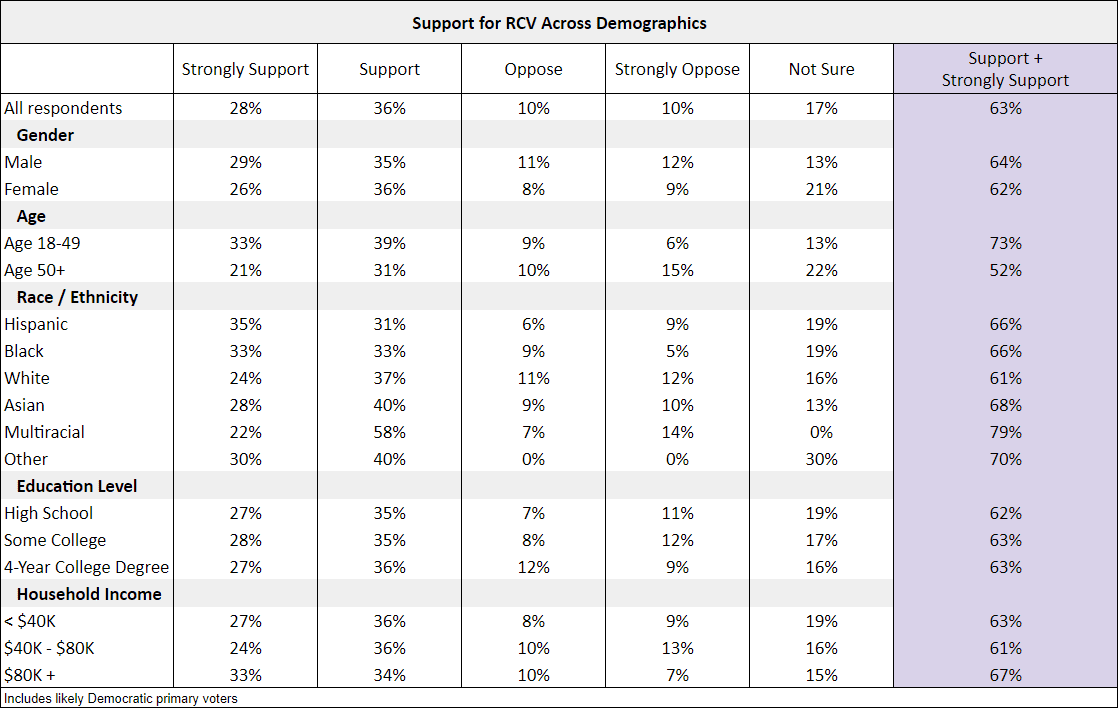
Support for RCV in primaries
63% of respondents reported favorable opinions towards using RCV for presidential primary elections, with consistently majority support across various demographics.
Number of rankings used
95% of poll respondents who participated in the ranking questions chose to rank at least two candidates, showing that voters are comfortable choosing backup candidates. More than half of respondents ranked seven choices, the maximum allowed by our survey.
infogram_0_cdd0cb69-5280-4485-999d-3f3a997e8b6aSurveyUSA - Feb2020 - Number of Rankingshttps://e.infogram.com/js/dist/embed.js?FXWtext/javascript
More presidential primary polling
This is part of a series on RCV in presidential primaries. For more presidential primary polling, see the following: